


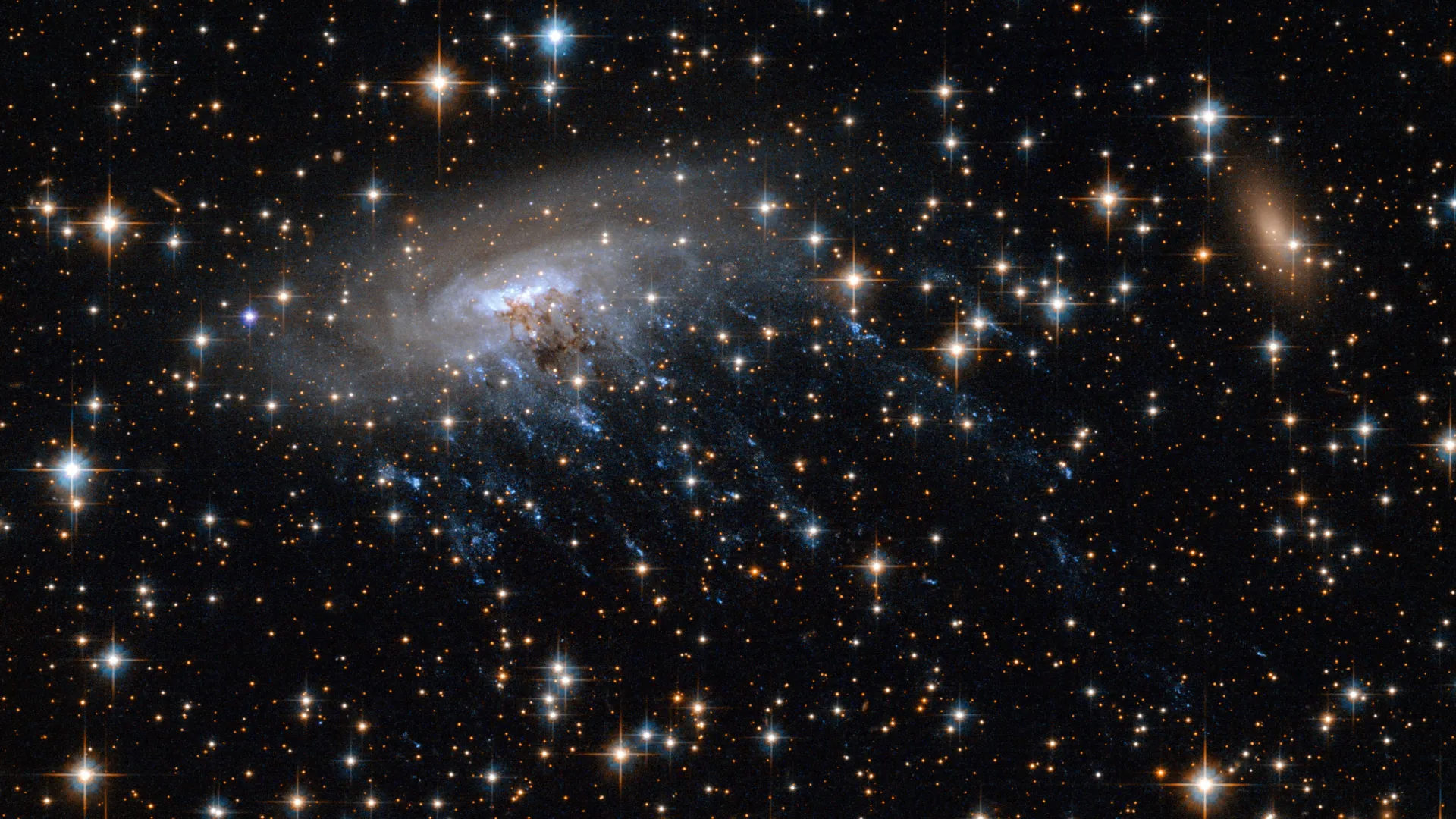
Researchers at the University of Waterloo have identified the most distant jellyfish galaxy ever observed. The discovery was made using deep space observations from the James Webb Space Telescope (JWST).
The jellyfish galaxy gets its name from the long streams of gas that extend behind it, resembling tentacles. These galaxies zip through crowded galaxy clusters filled with extremely hot gas. As they move, the surrounding gas pushes against them like a powerful headwind, sweeping their own gas backwards and creating a trailing bundle. Astronomers call this process ram pressure stripping.
This newly identified galaxy is located at z = 1.156. This means that the light took 8.5 billion years to reach us. In other words, we are seeing what the universe looked like when it was younger.
This observation provides a rare glimpse into how galaxies were reshaped in the distant past, and raises new questions about what conditions really were 8.5 billion years ago.
See the distant universe clearly
The research team discovered the galaxy while studying the COSMOS field (Deep Field for Exploration of the Evolution of the Universe), a region of the sky that has been extensively studied with multiple telescopes. Astronomers chose this region because it is far from the crowded plane of the Milky Way and receives less interference from nearby stars and dust. It is also positioned so that it can be observed with telescopes in both hemispheres, and there are no bright objects in the foreground that could obscure the view. This makes it an ideal window into the distant universe.
“We were combing through large amounts of data from this well-studied region of the sky in hopes of discovering previously unstudied jellyfish galaxies,” said Dr. Ian Roberts, a Bunting postdoctoral fellow at the Center for Astrophysics at the School of Science at Waterloo. “Early on in our exploration of the JWST data, we discovered a distant, undocumented jellyfish galaxy and were immediately intrigued.”
Bright blue star formation in stripped gas
The galaxy itself has a fairly typical disk shape. What stands out are the bright blue blobs dotted along its flow. These glowing knots are very young stars. Their age indicates that they likely formed outside the galaxy’s body, in displaced gas. This type of star formation is consistent with what astronomers would expect from a jellyfish galaxy that is stripped of ram pressure.
Rethinking galaxy clusters in the early universe
The study of this object has overturned previous assumptions about the early universe. Many scientists believed that galaxy clusters at the time were still assembling and that separation due to ram pressure was relatively rare. New findings suggest otherwise.
“The first is that the environment in the cluster was already harsh enough to strip away the galaxies, and the second is that the cluster could significantly change the properties of the galaxy sooner than expected,” Roberts said. “Another is that all of the challenges listed could have played a role in the formation of the large numbers of dead galaxies seen in galaxy clusters today. This data provides us with valuable insight into how galaxies changed in the early universe.”
If confirmed by further studies, these results could reshape our understanding of how the dense cosmic environment influenced the evolution of galaxies billions of years ago.
To investigate further, Roberts and his colleagues requested additional observing time from JWST to study this galaxy in more detail.
This study, “JWST reveals candidate jellyfish galaxy at z=1.156,” astrophysical journal.
