


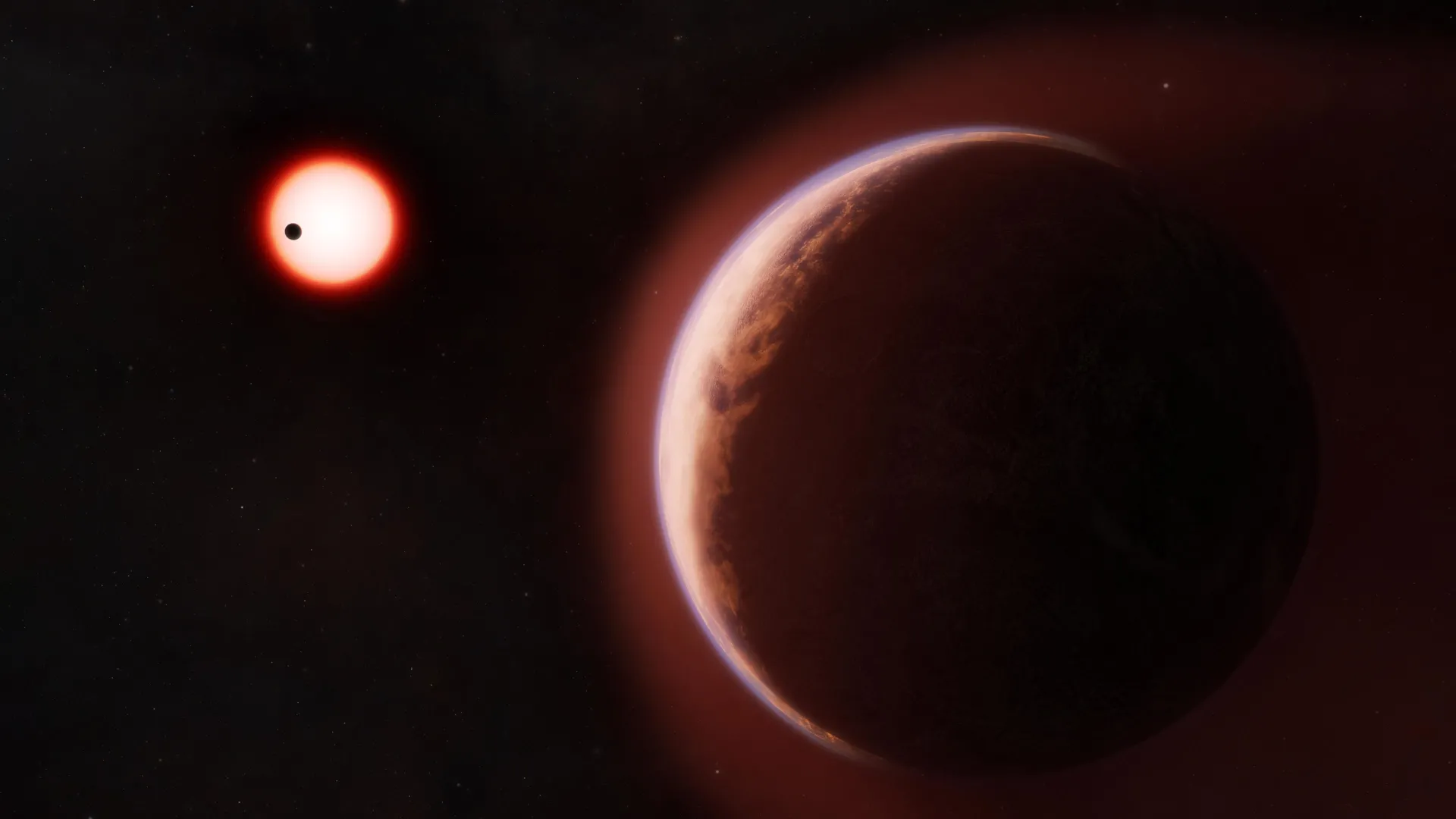
Astronomers have reached a major turning point in the search for extraterrestrial life by detecting an atmosphere around a rocky, Earth-like planet located in the habitable zone of another star.
The discovery provides the strongest evidence yet that planets with broadly Earth-like temperatures and rock compositions exist outside the solar system and may also harbor conditions that could support life.
“Atmospheres are essential for planets to support life as we know it,” said lead author Colin Cherubim, who recently completed his Ph.D. in Earth and Planetary Sciences from Harvard University.
“This is the first time that we have discovered the atmosphere of a rocky planet in the habitable zone of another star.”
Helium reveals exoplanet atmospheres
The study was published on July 16th. scienceobserved helium being emitted from LHS 1140 b, a rocky exoplanet located approximately 48 light-years from Earth. This signal confirms early theoretical predictions that the planet has an atmosphere.
LHS 1140 b orbits a red dwarf star within its habitable zone. This is a region around a star where temperature and other environmental conditions can leave liquid water on the planet’s surface.
Scientists have identified thousands of exoplanets, including some rocky worlds in the habitable zone. But determining whether these planets have atmospheres is one of the most difficult challenges in exoplanet research.
“Twenty years ago, we wondered if other terrestrial planets existed,” said Robin Wordsworth, Gordon McKay Professor of Environmental Science and Engineering and Professor of Earth and Planetary Sciences at Harvard University and one of Cherubim’s dissertation advisors. “Then we learned they were common and found several in the habitable zone. The next question was whether any of them were able to maintain an atmosphere. We now know that at least one exists.”
A rocky world that retains its atmosphere
Previous research has identified rocky planets orbiting within their stars’ habitable zones. But this study is the first to clearly show that one of those worlds has an atmosphere that may have persisted for billions of years.
Cherubim and his colleagues developed a theoretical model that predicts that LHS 1140 b’s upper atmosphere contains large amounts of helium, which will slowly escape into space.
The researchers tested that prediction using the Warm Infrared Echelle (WINERED) spectrometer at the Magellan Observatory in Chile. Their observations took advantage of a rare phenomenon in which LHS 1140 b and another planet cross in front of the star on the same night.
The second planet showed no signs of an atmosphere. However, LHS 1140 b gave off a clear signal of helium leaking from the planet, providing evidence that it still retains an atmosphere.
Predictions supported by telescope data
Cherubim co-advisor David Charbonneau, astronomer at Harvard’s Center for Astrophysics and chair of astronomy at Harvard University and the Smithsonian University initially had doubts about whether the project would succeed. This prediction comes from a mathematical model, and this type of signal has never before been observed from the rocky world.
The results changed his mind.
“Colin analyzed the planet as we know it and predicted that this planet has a helium atmosphere,” Charbonneau said. “He then timed the telescope and acquired the data, and the detection was statistically rock solid.”
The discovery suggests that astronomers may be able to study the atmospheres of rocky exoplanets from the ground by looking for gas escaping into space.
Promising targets in the search for life
Astronomers estimate that LHS 1140 b’s atmosphere has existed for more than 3 billion years. Because of its long lifespan, this planet is particularly promising as an additional observational target.
Cherubim hopes to determine the complete chemical composition of the atmosphere and ultimately determine whether the planet has a surface ocean or other features relevant to habitability. He and his colleagues also plan to use the model to explore additional rocky worlds with atmospheres.
“This is a validation of the model, and we hope it’s just the first of many observations to come,” he said.
