


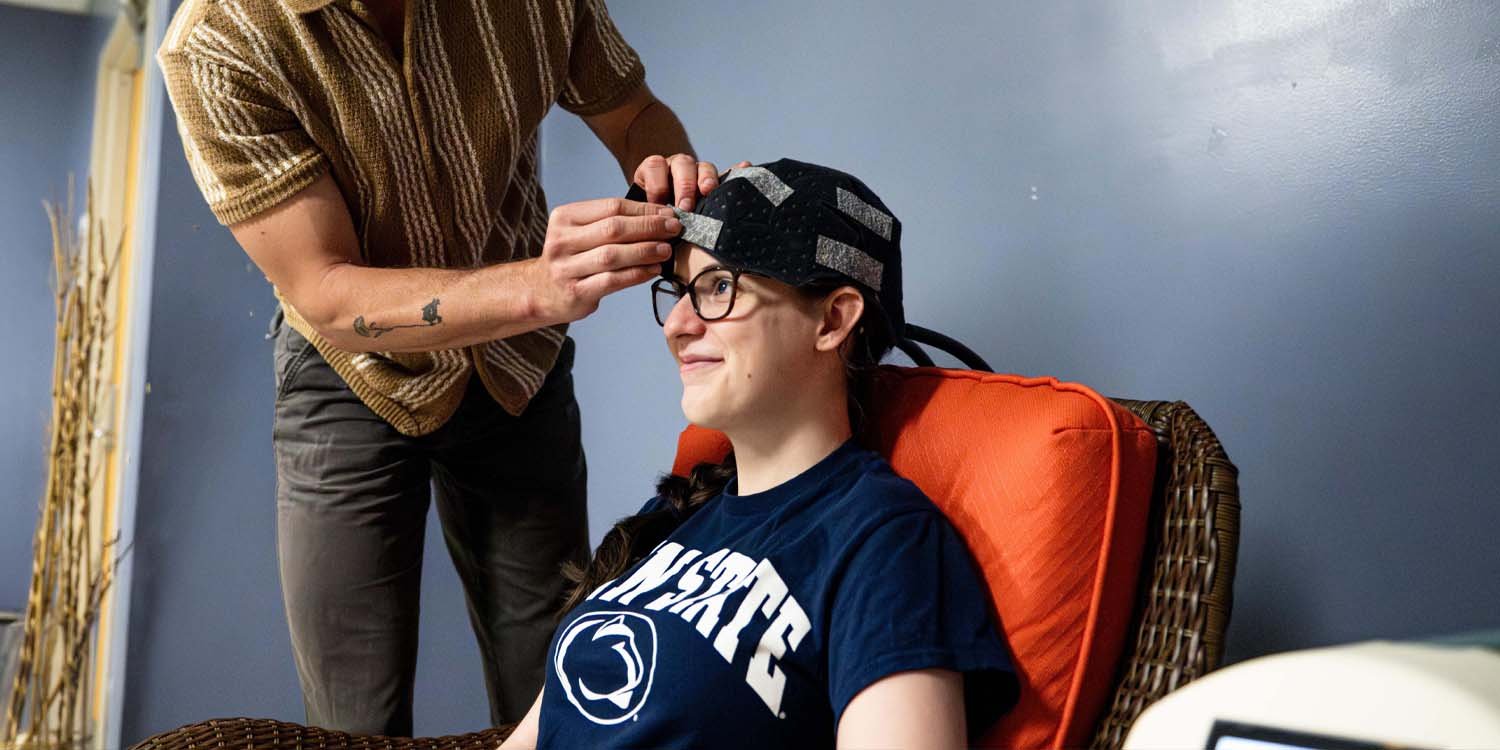
Wearing a cooling cap for just 30 minutes a day tends to improve young people’s mental health and promote relaxed brain activity. Recent experiments published in magazines Acta Psychologica We provide evidence that selective head cooling reduces depressive symptoms and increases brain waves associated with calmness. These findings suggest that this simple, non-invasive technique may offer new ways to manage everyday stress and mood challenges.
Selective head cooling involves applying a cold compress or a special device to the scalp for a period of time. Previous research by this scientific team has demonstrated that cooling the head and neck can help athletes recover faster from concussions. Zach Napola, lead author of the study and a graduate student at Penn State’s Sports Concussion Research Service Institute, explained the genesis of the experiment.
“It came out of something we noticed by chance,” Napora said. “Our lab primarily works on cooling athletes’ heads and necks after concussions. And while we were doing those studies, people were trying the cap and saying it felt good and helped them relax. So we put together a study to see if there was any truth behind these anecdotes.”
College students experience high levels of academic and social stress. This stress often causes subclinical levels of anxiety and depression. This means that although the symptoms are present, they may not meet the criteria for a formal medical diagnosis. Both anxiety and depression can negatively impact a person’s cognitive function, particularly working memory and attention. Subclinical stress is also associated with low-grade inflammation in the brain and impaired neuroplasticity, the brain’s ability to adapt and grow.
Studies in animals have shown that cooling the brain reduces neuroinflammation. Cooling the skin on your head may also send sensory signals to your brain that change neural networks involved in emotional regulation. Gentle cooling has also been shown in some studies to promote brain-derived neurotrophic factors. This protein supports the survival of existing neurons and promotes the growth of new connections.
To measure these potential changes in humans, scientists use electroencephalography, commonly known as EEG. EEG is a safe, painless test that measures electrical activity in the brain using small sensors placed on the scalp. The brain generates different types of radio waves depending on a person’s mental state.
Alpha waves are usually dominant when a person is awake but relaxed. Decreased levels of alpha activity are common in people with depression and anxiety disorders. Beta waves and high beta waves, on the other hand, are faster electrical signals associated with arousal. High levels of beta activity tend to correlate with stress, worry, and panic.
The study involved 24 college students between the ages of 18 and 26. The scientists randomly divided these participants into a head-cooling group and a control group, ensuring that each group had an equal number of men and women. At the beginning of the experiment, all subjects completed a series of neuropsychological questionnaires. These surveys include the Beck Depression Inventory to measure depression, the Hamilton Anxiety Rating Scale to assess anxiety, and the Pennsylvania Worry Questionnaire to assess general worry.
Participants also completed cognitive tests to measure memory, motor speed, and attention. These include digit span tests, which require participants to memorize and repeat a series of numbers, and trail-making tests, which require participants to connect dots as quickly as possible. After the survey and cognitive tests, each person underwent 3 minutes of EEG recording using a special 19-channel cap while they rested with their eyes closed.
The cooling group then sat in a dimly lit, quiet room for 30 minutes listening to the gentle sounds of the ocean. During this time, they wore active cooling caps that continuously circulated liquid coolant to maintain temperatures at 33 degrees Fahrenheit. The cap covered the entire scalp and part of the upper neck.
The control group sat in exactly the same environment and listened to the same ocean sounds for 30 minutes. They were not wearing cooling equipment. Immediately after this session, all participants underwent repeated psychological surveys, cognitive tests, and EEG recordings. To ensure that muscle twitching and eye blinking did not corrupt the brainwave data, the researchers used a special computer algorithm to remove these common electrical artifacts.
Participants then returned to the laboratory daily for 6 days and completed each 30-minute cooling or resting session. On day 8, the researchers conducted a final questionnaire, cognitive tests, and electroencephalogram recordings to measure the long-term effects of the intervention.
The data revealed significant differences in brain activity immediately after the first session. In the head cooling group, relative alpha wave power increased by approximately 4%. The control group experienced a small decrease in alpha activity of about 0.5 percent during the same period. This suggests that a single session of head cooling effectively promotes the transition to a more relaxed brain state.
Mr. Napora summarized the key physiological and psychological results of the week-long trial. “When we wore the Welkins Arctic Cooling Cap in short daily sessions for a week, those who wore it generally reported significantly greater reductions in depression scores than those who just sat around, and we saw a small bump in alpha waves immediately after cooling. Alpha waves usually appear when someone is relaxed,” Napolla told Cypost. Participants who received the daily head cooling treatment reported that their depression scores decreased by about 5 points, while the control group only experienced a decrease of 0.5 points.
However, both groups reported a reduction in their depressive symptoms by the end of the week. “What surprised me most was how much the control group also improved,” Napolla said. “Those people didn’t cool down at all. They just sat in a dimly lit room with the sound of the ocean for 30 minutes a day. Yet their depression scores decreased over the week.” Both groups also showed improved scores on cognitive tests, which the authors attribute to the natural learning effect of taking the same tests multiple times.
The researchers also looked at a subgroup of eight participants with a pre-existing diagnosis of generalized anxiety disorder. In these individuals, the control group showed a tendency for beta and high beta waves to increase over time. The head cooling intervention appeared to reverse this trend for anxious participants, leading to a decrease in the frequency of these fast waves. This observation suggests that localized cooling may help calm the overactive brain networks typically associated with clinical anxiety.
Readers should be careful not to exaggerate the implications of these findings. Mr. Napora emphasized his main concern is how the public will view the results. “What I really want to argue against are people who take this as ‘cooling down can treat depression,'” Napora says. “Our participants were healthy students who were not clinically depressed.”
He added that the trial is a starting point for future investigations. “The purpose of this study was actually to test whether everything is possible, so calling this an advantage is an overstatement and should never replace actual care,” Napola said. Several other limitations must be considered when interpreting these results. This study is based on a small and relatively homogeneous sample of healthy young adults.
This small size limits the ability to generalize the results to the broader population and older adults. Exploratory data on participants with pre-existing anxiety disorders also relied on very small numbers of individuals. These specific trends require further testing in larger groups.
Control groups did not wear room temperature or inert caps. Because participants knew whether they were being snubbed, their expectations may have influenced their survey responses. The lack of a fake device means researchers can’t completely rule out a placebo effect. Future experiments should include a fake cooling cap to separate the real physical effects of temperature from the psychological effects of simply wearing the device.
Researchers did not track external lifestyle factors such as sleep patterns, diet, or daily stress levels during the week-long trial. These everyday variables can easily affect your brainwave patterns and mood, adding noise to your data. Future studies should control for these external factors to confirm the specific benefits of the cooling cap. Scientists also need to develop a standardized way to measure whether participants actually feel comfortable wearing subzero caps for long periods of time.
The study, “Selective Head Cooling Intervention Improves Mental Health Markers: A Multimodal Feasibility Study,” was authored by Zach Napora, Maddie McLaughlin, Owen Griffith, Laura Cooney, Elle McNally, and Semyon M. Slobounov.
