


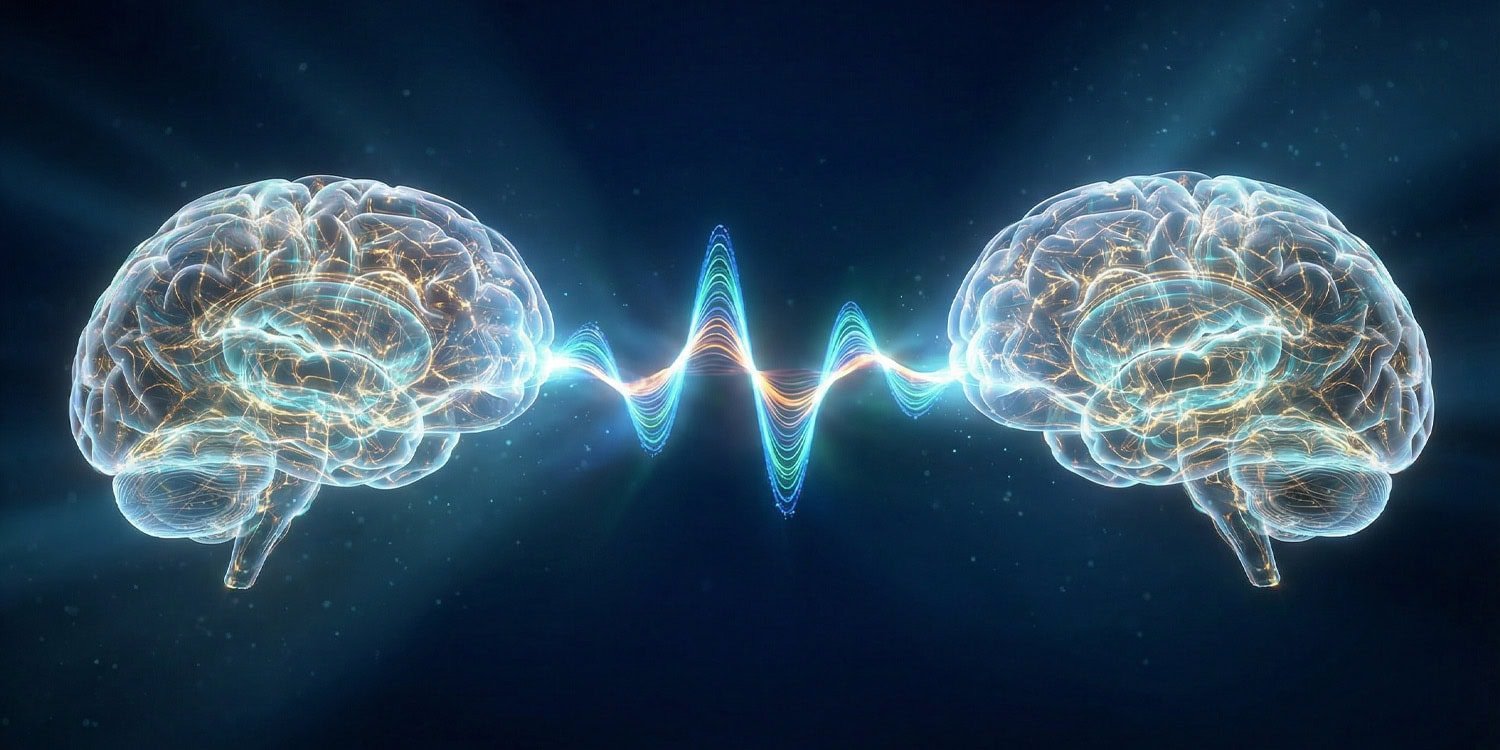
Recent research published in journals neuroimage When people collaborate on a video game, their brain activity matches up, but the results suggest that this synchronization doesn’t necessarily result in improved performance. The findings show that the way the human brain works together during teamwork is highly complex. This provides evidence that shared brain patterns may not directly cause successful collaboration.
When people interact, their brain waves often begin to match in real time. This phenomenon is known as interbrain synchronization. To study this, scientists use a technique called hyperscan. This allows the brain activity of multiple people to be recorded simultaneously. Previous research has shown evidence that this mental conditioning occurs during collaborative tasks such as playing games and solving puzzles.
During social interactions, two specific areas of the brain become highly active. The prefrontal cortex handles complex cognitive functions such as planning, decision-making, and understanding what other people are thinking. The right temporoparietal junction serves as a central hub for social skills, specifically helping individuals take the perspective of others.
A team of scientists from Singapore’s Nanyang Technological University, including SH Jessica Tan, SP Jesse Luke and Wei-Peng Teo, designed a project to investigate the causal relationship between brain coordination and teamwork. The authors wanted to know whether brain synchronization directly causes better cooperation or is just a byproduct of the interaction.
To test this, the research team used a technique called transcranial magnetic stimulation. This method uses short-term magnetic fields to temporarily accelerate or decelerate neural activity in targeted brain regions. By altering activity in the right temporoparietal junction, the researchers wanted to see whether changes in this social brain region affected how two people cooperated.
Researchers gathered 33 pairs of same-sex strangers for the experiment. Each pair participated in three separate sessions involving the classic puzzle video game, Tetris. During each session, participants played the game individually or collaboratively for 7 minutes.
In the individual version of the game, each person controlled their own falling blocks. In the collaborative version, the pair shared one game screen. One person was strictly responsible for moving the block from side to side, and the other person was responsible for rotating the block.
During the cooperative game, participants were prohibited from talking to each other. This rule forced them to rely on predicting their partner’s next move and taking turns. By limiting verbal communication, scientists were able to observe nonverbal teamwork in action.
To measure brain activity, scientists used a technique called functional near-infrared spectroscopy. This non-invasive method uses sensors placed on the head to shine near-infrared light through the skull. By measuring how that light is absorbed, the sensor can track changes in blood flow to different parts of the brain. The researchers placed these sensors in the participants’ prefrontal cortex and right temporoparietal junction.
In two of the three sessions, one randomly selected person in each pair received a brief period of safe magnetic brain stimulation before the game began. One session used an uninterrupted stimulation pattern known to temporarily reduce brain activity in the right temporoparietal junction. Another session used a pulse pattern designed to temporarily increase activity in the same region. The third session served as the baseline and no stimulation was applied.
Brain scans revealed that participants experienced much stronger brain synchronization when they played Tetris together compared to when they played alone or when they were resting. This synchronization was significantly stronger in the prefrontal cortex than in the right temporoparietal junction.
Modulating the right temporoparietal junction with magnetic stimulation did not change how participants played together. The stimulation also did not change the level of brain synchronization between the partners. The scientists noted that altering one person’s brain activity may not be enough to disrupt shared interactions, as other people’s brains may naturally adapt to maintain social connections.
The data also revealed some surprising patterns in gaming performance. The researchers measured success by looking at the number of rows in blocks completed and the number of combination movements. Combined moves occur when multiple rows are deleted at the same time.
The authors found a negative relationship between brain synchrony in the prefrontal cortex and the number of combinations completed by a pair. Essentially, the pairs that showed higher levels of mental coordination actually performed worse when setting up complex, high-scoring moves. This suggests that high neural integrity does not necessarily guarantee success in strategic tasks.
Participants also completed a questionnaire about their partner before and after the match. According to the responses, participants consistently rated their partners as more likable after working together. This positive social feeling occurred regardless of how poorly they performed or whether they received brain stimulation.
Several factors limit how these findings can be applied to real-world interactions. In this study, participants were required to play Tetris over three different sessions, which likely allowed them to learn the game and adapt to their partner’s style over time. This learning effect can influence how the brain synchronizes during subsequent sessions.
The equipment used in the study also relied on a limited number of sensors and only tracked specific parts of the brain. Future studies may benefit from using more advanced scanning techniques that look at the entire brain at once. This helps us understand exactly how different neural networks respond to social interactions and magnetic stimulation.
It’s also possible that the observed brain synchronization was partially caused by both participants seeing the exact same falling blocks on the screen. When two people see the same visual input, their brains can process the information in similar ways, mimicking deeper social connections.
To separate genuine social synchrony from shared visual processing, the scientists suggest adding control conditions in future studies. For example, participants can watch a recording of a game without actually playing together. This will help verify whether brain coordination is truly based on teamwork.
The negative relationship between brain synchrony and gaming performance highlights the need to reevaluate how we understand mental coordination. Increased brain synchrony is often thought to improve teamwork and information sharing. This new evidence suggests that the function of synchronization between the brains is very subtle.
Higher levels of synchronization tend to emerge during teamwork, but this may reflect the cognitive effort required to understand a partner’s strategy rather than successful execution. More research is needed to determine exactly why brain waves align and how this biological process affects relationships.
The study, “Interbrain synchrony during collaborative gaming: A study using theta-burst stimulation in the right temporoparietal junction,” was authored by SH Jessica Tan, SP Jesse Luke, and Weipen Teo.
