


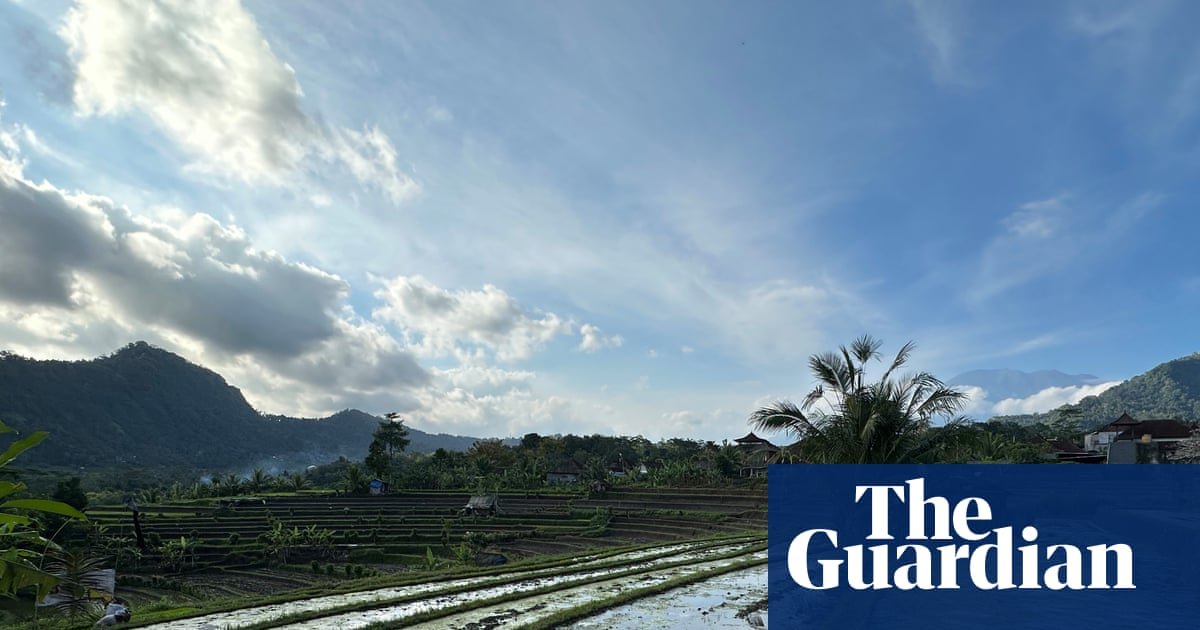
I Puthu Partayasa presses his fingers into the soil as he squats on the edge of a rice terrace. It will come up dry. There is water in his field. His neighbors are not. “We have a big problem during the dry season,” he says. “Fifteen years ago, we had water every day. But now we have less water.”
The 52-year-old man, who goes by the name Parta, is lucky that his property is high enough above the irrigation system that he still gets his share. He worries that he knows where the rest are going. “Companies are taking our water and bringing it to tourist destinations,” he says. He gestured to the lower terrace, now a patchwork of greens and browns that was once solid green. “The forest is getting smaller. The springs are drying up.”
Mr Parta, who earns around 1.5 million Indonesian rupiah (£62) a month, has cultivated the land all his life. “I used to drink water from the river. Now I buy plastic bottles.”
Parta: “We used to drink water from the river. Now we buy plastic bottles.” Photo: Christian Karim Kloborg
He belongs to the Subak, a water-sharing cooperative that has managed Bali’s irrigation since the 9th century, and is also a temple council, an agricultural guild, and a philosophy. Members gather in the temple courtyard and decide when the water will flow and who will receive it and in what order.
Offerings are made to Dewi Danu, the goddess of water, and water is seen not as a resource but as a gift to be shared. UNESCO recognized the system as a World Heritage Site in 2012. For more than 1,000 years, this system has connected springs, fields, and families, but the chain is breaking.
According to the Bali Land Agency, the island has lost more than 6,500 hectares (16,061 acres) of rice fields in the past five years, a decline of more than 9%. A 2018 Transnational Institute report estimated that Bali has already lost nearly a quarter of its agricultural land as tourism has grown 330% over the past 25 years.
Paddy fields are being concreted to improve tourism and its infrastructure. Photo: Christian Karim Kloborg
Paddy fields are not only a source of income, but also water infrastructure. Rice fields slow runoff, store water, and recharge the aquifers below. Once sealed under concrete, its functionality is permanently lost.
Many of Parta’s neighbors have already sold their land, and his children have no interest in farming.
The same story unfolds 20 miles south, but faster.
The Canggu shortcut is a road between rice fields that is barely wide enough for one car to pass, but it is congested. Hundreds of scooters travel in both directions. Bali’s tourism workforce includes digital nomads with laptops, influencers in yoga pants, and fitness enthusiasts who frequent gyms with padel courts, infinity pools, and ice baths. The rice fields that were here not too long ago are now concrete, filled with tattoo studios, co-working spaces, and restaurants.
Bali will record more than 16 million tourists in 2024, four times its permanent population. Tourism is a big part of Bali’s economy, and the sheer number of visitors has not only changed the skyline, but also the relationship between the island and the water. Tourism consumes over 65% of Bali’s fresh water.
A farmer who has a villa in a rice field. Photo: Christian Karim Kloborg
In southern Bali, where development is concentrated, groundwater extraction has pushed aquifers beyond sustainable levels in many areas, a study by IDEP’s Bali Water Conservation Program and local hydrologists has found. Coastal wells are turning brackish as seawater moves inland and fills the cavities. IDEP Foundation, A Bali-based NGO focused on community resilience and sustainable development declared Bali to be in water crisis in 2018. Since then, seawater intrusion has been detected in at least six of the island’s nine districts.
Kadek Siska and his mother from Uluwatu. Photo: Christian Karim Kloborg
Kadek Siska, 35, and his mother live in Uluwatu, one of Bali’s most photographed clifftop locations. Many mornings start with the same question. “Do you have any water today?”
“Before, people here would give land for free to other Balinese people, but they wouldn’t take it because everyone knew there was no water,” she says.
Currently, Uluwatu is one of the most expensive real estate properties in Bali. Their homes are connected to the government’s public water network PDAM. In good weather, water flows through the pipe for an hour. “My mother leaves the faucet turned off so we can hear,” Siska says. “And we will wait and fill with all we have.”
Uluwatu water wheel. Photo: Christian Karim Kloborg
If a water station is empty, call the number painted on the back of the hundreds of water trucks that pass through Uluwatu each day. The delivery fee for 5,000 liters is approximately Rp 350,000. Drinking water must be purchased separately from the jug, and water can eat up a tenth of a household’s income.
IDEP estimates that resort tourists use 2,000 to 4,000 liters per day for pools, gardens, laundry, hotel operations, etc., while the average Balinese resident lives on 30 to 50 liters.
At the luxury resort, a few minutes’ drive from Siska’s home, the first water delivery took place before most guests had even woken up. According to a security guard who requested anonymity, eight to 10 trucks a day continue to arrive. Each can carry around 5,000 liters. This means that up to 50,000 liters can be delivered to one facility each day. This is enough to power Siska’s household for almost a year. “Of course there is jealousy,” Siska says. “But what else can we do?”
But where does this water come from? Follow the truck and you will arrive at the Jimbaran area. In the backyard of the family property, behind the gate, there is a well, the shaft of which is sunk deep into the ground. Pumps pump water through pipes and into dozens of tanker trucks waiting in narrow alleys.
The owner has obtained permission from the Jakarta government. Businesses buy water wholesale, load it onto trucks and resell it to hotels and vacation homes. No one is responsible for what happens to the aquifer below.
Water is big business in Bali. Photo: Christian Karim Kloborg
The surgery has been going on for 15 years. Luxury hotels will call you every morning to confirm your order. Water resellers overseeing deliveries say customers who pay higher rates will be given priority. However, IDEP staff say their research shows that there are about 10,000 water utilities in Bali, and about half of them are operating illegally or without proper permits.
Although drilling wells for personal use is permitted, it is less clear whether selling that water commercially falls under the same permit.
The Bali provincial government said permits are required for commercial groundwater extraction. The report said wells designated for domestic or private use “are not permitted for trading or reuse in the commercial/industrial sector.”
The state did not say how many licensed groundwater or tanker water projects are currently operating in Bali, adding that inspection and enforcement for the past five years had been under the authority of the central government.
Niluu Jerantik, a shoe designer, social media influencer, and Indonesian Regional Representative Council (DPD) senator for Bali, wants a moratorium on new hotel construction and enforcement of groundwater extraction rules.
Many farmers are selling. Photo: Christian Karim Kloborg
“When you build a hotel, you have to provide water to thousands of people,” she says. “Bali tourism’s income comes from people’s sweat. They don’t need additional stress.”
In Canggu, agricultural land decreased by 60% and undeveloped land increased by 69%. “Where is the rice field?” she asks.
What dismantled protections, Gerantik said, was replacing community consultation with a national online permitting system that allowed investors to apply remotely. “Before, you had to ask your neighbors before you could break ground. Now, developers can build right next to your house without having to ask.”
Water Monk Rudy Park: “I don’t want to sell it because I want to leave it for the next generation.” Photo: Christian Karim Kloborg
On a hill above Mount Munduku in the north, Rudy Pak, 49, wakes up before dawn to save flowers, rice and a small cup of coffee for the gods. He is a water priest in charge of waterfalls and a custodian of the Balinese Hindu philosophy known as Tri Hita Karana, which is the relationship between man, God, and nature.
The developer offered to buy the land up a steep hill from the waterfall to the family home for Rp 1 billion per 100 square meters. Rudy’s land is considered particularly valuable because of its expansive, unobstructed views. His daughter Talitha translates: “We will not sell it because we want to leave it for the next generation. We are already the fourth generation living here. We will leave this for the next generation.” Rudy looks over the hill. “This is my land,” he says. “It’s still green here.”
