

Close Menu

    Subscribe to Updates

    Get the latest creative news from FooBar about art, design and business.

    What's Hot

    Why does the human body have so many design flaws?

    July 11, 2026

    NASA satellite observes Earth’s newest island rising out of the ocean

    July 11, 2026

    Scientists have discovered a beneficial nutrient that parasites cannot live without

    July 11, 2026
    Facebook X (Twitter) Instagram
    Facebook X (Twitter) Instagram
    Health Magazine
    • Home
    • Environmental Health
    • Health Technology
    • Medical Research
    • Mental Health
    • Nutrition Science
    • Pharma
    • Public Health
    • Discover
      • Daily Health Tips
      • Financial Health & Stability
      • Holistic Health & Wellness
      • Mental Health
      • Nutrition & Dietary Trends
      • Professional & Personal Growth
    • Our Mission
    Health Magazine
    Home » News » NASA satellite observes Earth’s newest island rising out of the ocean
    Nutrition Science

    NASA satellite observes Earth’s newest island rising out of the ocean

    healthadminBy healthadminJuly 11, 2026No Comments4 Mins Read
    NASA satellite observes Earth’s newest island rising out of the ocean
    Share
    Facebook Twitter Reddit Telegram Pinterest Email


    Oceanographers often point out that scientists have mapped the surfaces of the Moon and Mars in more detail than much of Earth’s deep ocean. This contrast is particularly striking in the Bismarck Sea, north of Papua New Guinea, despite its incredible geological complexity. The region includes faults, volcanic structures, fissures, scarps, and active subduction and spreading zones, many of which are located at depths that make detailed sonar mapping extremely difficult.

    This lack of knowledge became especially clear when satellites detected signs of an unexpected undersea volcanic eruption in the central Bismarck Sea on May 8, 2026. Researchers believe the activity is occurring along Titan Ridge, about 16 kilometers (10 miles) southeast of the site of another underwater eruption in 1972. Still, scientists still cannot say with certainty which volcanic features are erupting, how deep the active vents were to begin with, or when they last erupted.

    “The good news is that there is tremendous opportunity to explore and learn using both government and commercial satellite platforms already in orbit,” said Jim Garvin, chief scientist at NASA Goddard Space Flight Center.

    Satellite reveals eruption from space

    Seismographs recorded the first small earthquake swarm on May 8th. Satellite observations soon confirmed that an undersea eruption was in progress.

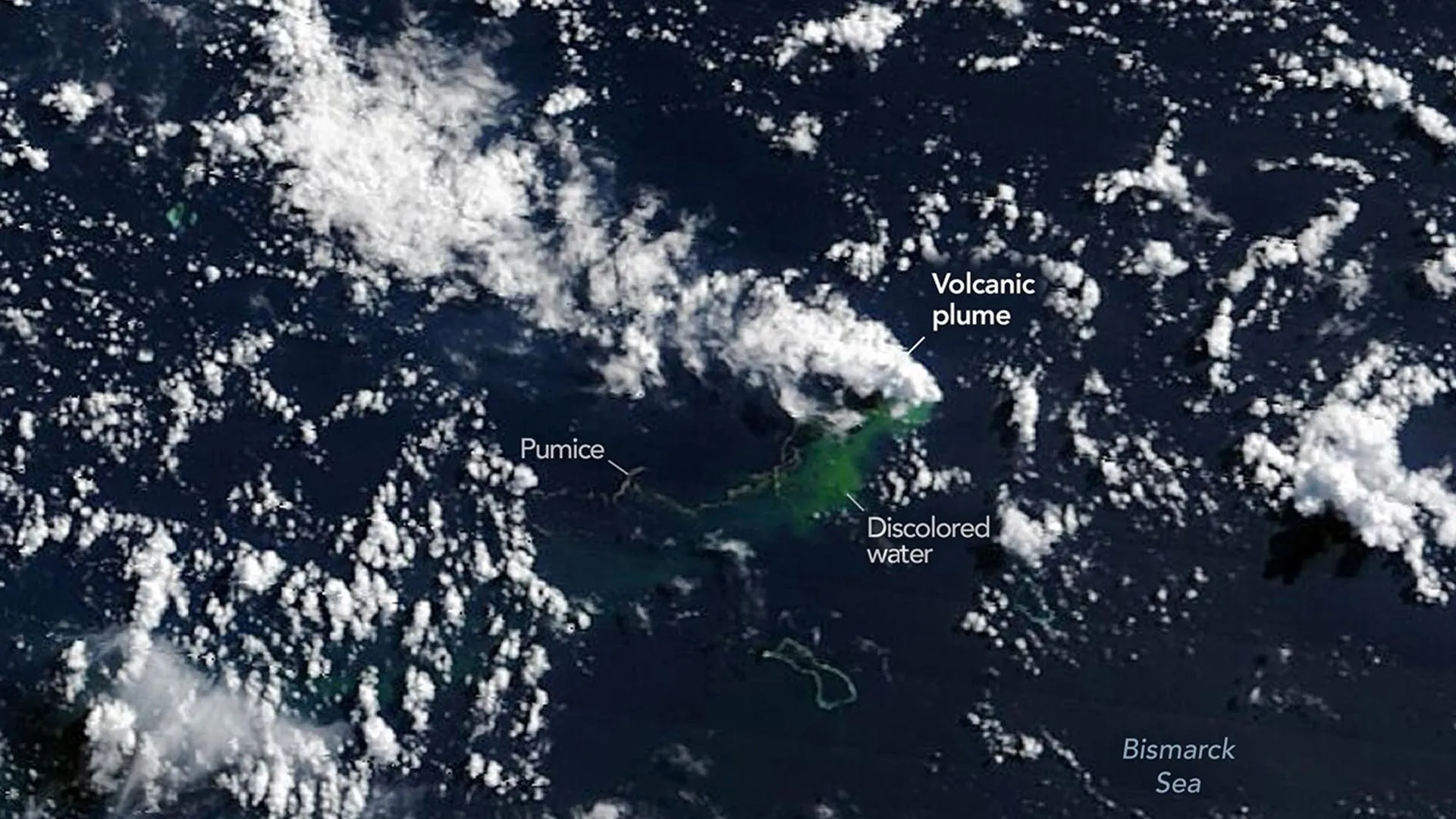
    Starting May 9, NASA’s Aqua and Terra satellites captured images of white, vapor-rich plumes rising into the atmosphere. At the same time, an ocean color sensor aboard NASA’s PACE (Plankton, Aerosols, Clouds, and Marine Ecosystems) satellite detected widespread discolored and turbulent waters around the eruption site.

    Other satellites soon spotted the plume reaching several kilometers into the sky. High-resolution images collected by the European Space Agency’s Sentinel 2 satellite and NASA/USGS Landsat 9 on May 10 and 11 provided a detailed picture of near-surface activity. The pseudocolor image (bands 7-6-5) highlighted the infrared signature of the eruption. Then, on May 12, the VIIRS (Visible Infrared Imaging Radiometer Suite) instrument aboard the Suomi nuclear power plant identified a thermal anomaly covering approximately 7 square kilometers.

    “There must be a lot of hot material near the surface to cause so many thermal anomalies,” said Simon Kahn, a volcanologist at Michigan Technological University. “This suggests a fairly shallow crater, much shallower than existing bathymetric measurements suggest, which indicate depths of hundreds of meters or more.”

    Is it possible that new islands are forming?

    Satellite images also revealed intense activity on the ocean surface. Large columns of discolored water, numerous steam and ash vents, and extensive pumice rafts (floating volcanic rock) have all been observed. Medium- and high-resolution sensors operated by government agencies and commercial satellite companies have tracked these floating pumice fields, which extend into long bands carried by surface currents.

    “We’re now waiting to see if new islands are about to form, and it’s rare that we can watch that happen with satellites,” Garvin said.

    If land appears above water, scientists will closely monitor how it develops. Volcanoes can build tuff cones with long-lived craters, or new land can quickly collapse and erode. If seawater reaches the shallow magma chambers that develop within growing submarine volcanoes, eruptions can also become significantly more explosive.

    Why did this eruption remain relatively calm?

    So far, this eruption has been much less explosive than recent undersea eruptions, such as the 2022 Hunga Tonga-Hunga Ha’apai eruption and the 2021 Huktoku-Okanobain eruption.

    Kahn said the eruption is associated with a volcanic ridge near the intersection of a transform fault and a back-arc spreading center, so dramatic expansion is unlikely.

    “Spreading centers are not associated with as much explosive activity, but the most explosive eruptions usually occur along subduction zones and involve large stratovolcanoes.”

    Scientists also don’t know how long the eruption will last. A nearby submarine eruption in 1972 lasted only four days, while another eruption about 100 kilometers away in the St. Andrew Sound began in 1957 and lasted almost four years.

    A rare opportunity to learn about a new island

    Garvin and researchers from several institutions continue to closely monitor the eruption. He plans to use radar data from the NASA-ISRO NISAR satellite and the Canadian Space Agency’s RADARSAT constellation mission to map newly rising land above the ocean and measure how its shape changes over time.

    If the eruption were to form a permanent island, Garvin believes it could become an extraordinary natural laboratory. Researchers he calls “island aviators” could study how plants and animals colonize new land, how rainfall and chemical weathering change the landscape, and how erosion changes islands over time, just as scientists did after the Hunga-Tonga-Hunga-Ha’apai eruptions.

    “This new eruption could be an even better opportunity for Island Astronaut exploration as we prepare to return to the Moon with the men and women on Artemis IV,” he said.


    Source link

    Visited 3 times, 3 visit(s) today
    Share. Facebook Twitter Pinterest LinkedIn Telegram Reddit Email
    Previous ArticleScientists have discovered a beneficial nutrient that parasites cannot live without
    Next Article Why does the human body have so many design flaws?
    healthadmin

    Related Posts

    Why does the human body have so many design flaws?

    July 11, 2026

    Scientists have discovered a beneficial nutrient that parasites cannot live without

    July 11, 2026

    Researchers warn that heavy marijuana smoking may increase cancer risk

    July 10, 2026

    This common insecticide may be quietly killing off future bumblebees

    July 10, 2026

    The biggest problem with solid-state batteries may finally be solved

    July 10, 2026

    Europe’s most active volcano may have a secret origin

    July 10, 2026
    Add A Comment
    Leave A Reply Cancel Reply

    Categories

    • Daily Health Tips
    • Discover
    • Environmental Health
    • Exercise & Fitness
    • Featured
    • Featured Videos
    • Financial Health & Stability
    • Fitness
    • Fitness Updates
    • Health
    • Health Technology
    • Healthy Aging
    • Healthy Living
    • Holistic Healing
    • Holistic Health & Wellness
    • Medical Research
    • Medical Research & Insights
    • Mental Health
    • Mental Wellness
    • Natural Remedies
    • New Workouts
    • Nutrition
    • Nutrition & Dietary Trends
    • Nutrition & Superfoods
    • Nutrition Science
    • Pharma
    • Preventive Healthcare
    • Professional & Personal Growth
    • Public Health
    • Public Health & Awareness
    • Selected
    • Sleep & Recovery
    • Top Programs
    • Weight Management
    • Workouts
    Popular Posts
    • 1773313737_bacteria_-_Sebastian_Kaulitzki_46826fb7971649bfaca04a9b4cef3309-620x480.jpgHow Sino Biological ProPure™ redefines ultra-low… March 12, 2026
    • pexels-david-bartus-442116The food industry needs to act now to cut greenhouse… January 2, 2022
    • 1773729862_TagImage-3347-458389964760995353448-620x480.jpgDespite safety concerns, parents underestimate the… March 17, 2026
    • 1773209206_futuristic_techno_design_on_background_of_supercomputer_data_center_-_Image_-_Timofeev_Vladimir_M1_4.jpegMulti-agent AI systems outperform single models… March 11, 2026
    • 1774403998_image_28620e4b6b0047f7ab9154b41d739db1-620x480.jpgGait pattern helps distinguish between Lewy body… March 24, 2026
    • Leukemia-620x480.jpgBiomimetic platform powers CAR T therapy for… March 9, 2026

    Demo
    Stay In Touch
    • Facebook
    • Twitter
    • Pinterest
    • Instagram
    • YouTube
    • Vimeo
    Don't Miss

    Why does the human body have so many design flaws?

    By healthadminJuly 11, 2026

    The human body is often described as a marvel of “perfect design”: elegant, efficient, and…

    NASA satellite observes Earth’s newest island rising out of the ocean

    July 11, 2026

    Scientists have discovered a beneficial nutrient that parasites cannot live without

    July 11, 2026

    The secret to human cognition may lie in the complex computational abilities of individual brain cells

    July 11, 2026

    Subscribe to Updates

    Get the latest creative news from SmartMag about art & design.

    HealthxMagazine
    HealthxMagazine

    At HealthX Magazine, we are dedicated to empowering entrepreneurs, doctors, chiropractors, healthcare professionals, personal trainers, executives, thought leaders, and anyone striving for optimal health.

    Our Picks

    The secret to human cognition may lie in the complex computational abilities of individual brain cells

    July 11, 2026

    Researchers warn that heavy marijuana smoking may increase cancer risk

    July 10, 2026

    New research questions the idea that memories of childhood abuse are unreliable

    July 10, 2026
    New Comments
      Facebook X (Twitter) Instagram Pinterest
      • Home
      • Privacy Policy
      • Our Mission
      © 2026 ThemeSphere. Designed by ThemeSphere.

      Type above and press Enter to search. Press Esc to cancel.