


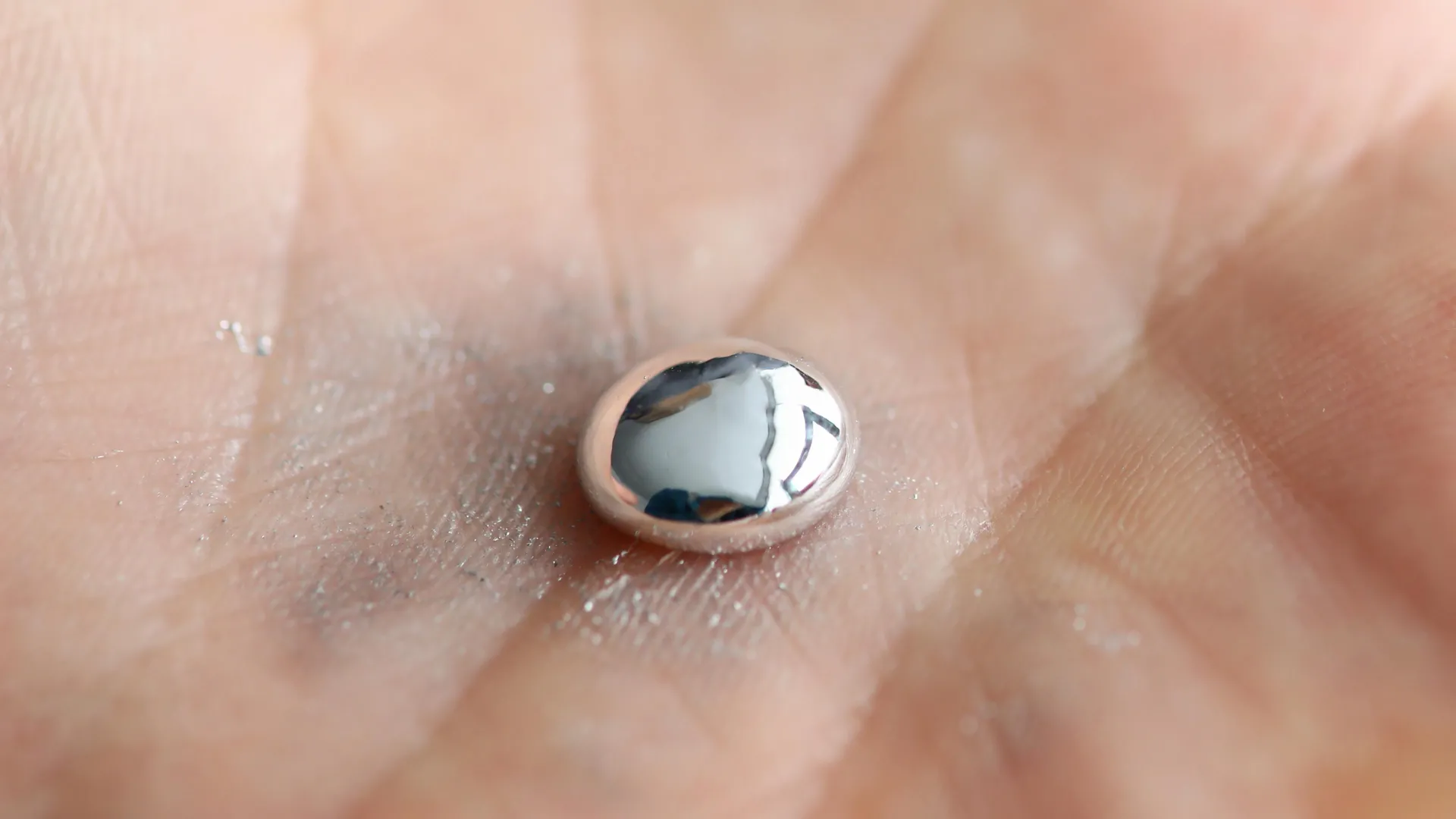
Almost 150 years after gallium was first discovered and added to the periodic table, scientists at the University of Auckland have revealed previously unknown details about the metal’s atomic structure and behavior.
Gallium was discovered in 1875 by French chemist Paul-Emile Lecoq de Boisbaudrin. It is best known for its unusually low melting point, so much so that a spoonful of gallium will dissolve in hot tea. This metal also plays an important role in semiconductors and many modern electronic technologies.
A newly reported discovery focuses on how gallium behaves at the atomic level, revealing properties that challenge decades of scientific understanding.
Strange metals with even weirder atomic behavior
Gallium is already superior to most metals in several ways. The atoms naturally pair up and form “dimers.” This means that they exist as a bonding pair. It is also one of the few substances that has a lower density as a solid than as a liquid, similar to ice floating in water.
Another unusual feature is that gallium forms “covalent bonds” where atoms share electrons. This type of bond is much more common in nonmetals than in metals.
Scientists have long believed that when gallium melts, those covalent bonds disappear. However, new research has found that although the bonds disappear at the melting point, they unexpectedly return when the liquid is heated to higher temperatures.
The discovery overturns a long-held hypothesis and suggests a new explanation for gallium’s extremely low melting point. The researchers propose that when bonds break, entropy, a measure of disorder, increases, freeing atoms and facilitating melting.
“Thirty years of literature on the structure of liquid gallium has had fundamental assumptions that are clearly not true,” says Professor Nicola Gaston from the University of Auckland’s Waipapa Taumata Rau and MacDiarmid Institute for Advanced Materials and Nanotechnology.
Looking back on decades of research
The research was carried out by Dr Steph Lambie, currently a postdoctoral fellow at the Max Planck Institute for Solid State Research in Germany, Professor Nicola Gaston, and Dr Christa Steenburgen from Victoria University of Wellington and the MacDiarmid Institute.
This breakthrough occurred while Lambie was completing his PhD at the University of Auckland and the MacDiarmid Institute. Lambie has assembled a more complete picture of gallium’s behavior by carefully reviewing decades of published research and comparing measurements collected at different temperatures.
The survey results are materials horizon In a paper titled “Resolving a decades-old debate: The surprising role of high-temperature covalent valences in the structure of liquid gallium.”
Why it’s important to understand gallium
A better understanding of how gallium changes with temperature could benefit nanotechnology, where researchers manipulate materials at extremely small scales to create new materials with special properties.
Gallium is valuable because it can dissolve other metals and is also useful for creating liquid metal catalysts and “self-organizing structures” in which disordered materials spontaneously organize into ordered forms.
In a previous project, Gaston, Lambie, and Steenburgen used liquid gallium to crystallize zinc into complex “snowflake” structures.
From predicted factors to the latest technology
Gallium was predicted even before it was discovered. In 1871, Russian chemist Dmitri Mendeleev created the first periodic table by arranging elements according to increasing atomic number and intentionally leaving blank elements that he believed had not yet been discovered. Gallium then filled one of these predicted gaps.
This metal is extracted from minerals and rocks such as bauxite and does not occur naturally in its pure form. Today, gallium is widely used in semiconductors, communications equipment, LEDs, laser diodes, solar panels, high performance computing, aerospace and defense industries, and as a safer alternative to mercury in thermometers.
Researchers are also investigating whether gallium can help identify signs of ancient life on Mars. Scientists from the university’s School of Environment and Te Ao Marama Research Center are investigating whether metals can preserve traces of past microbial life as chemical ‘fingerprints’.
The name gallium is derived from Gaul, the ancient Latin name for France, in honor of the nationality of its discoverer.
