


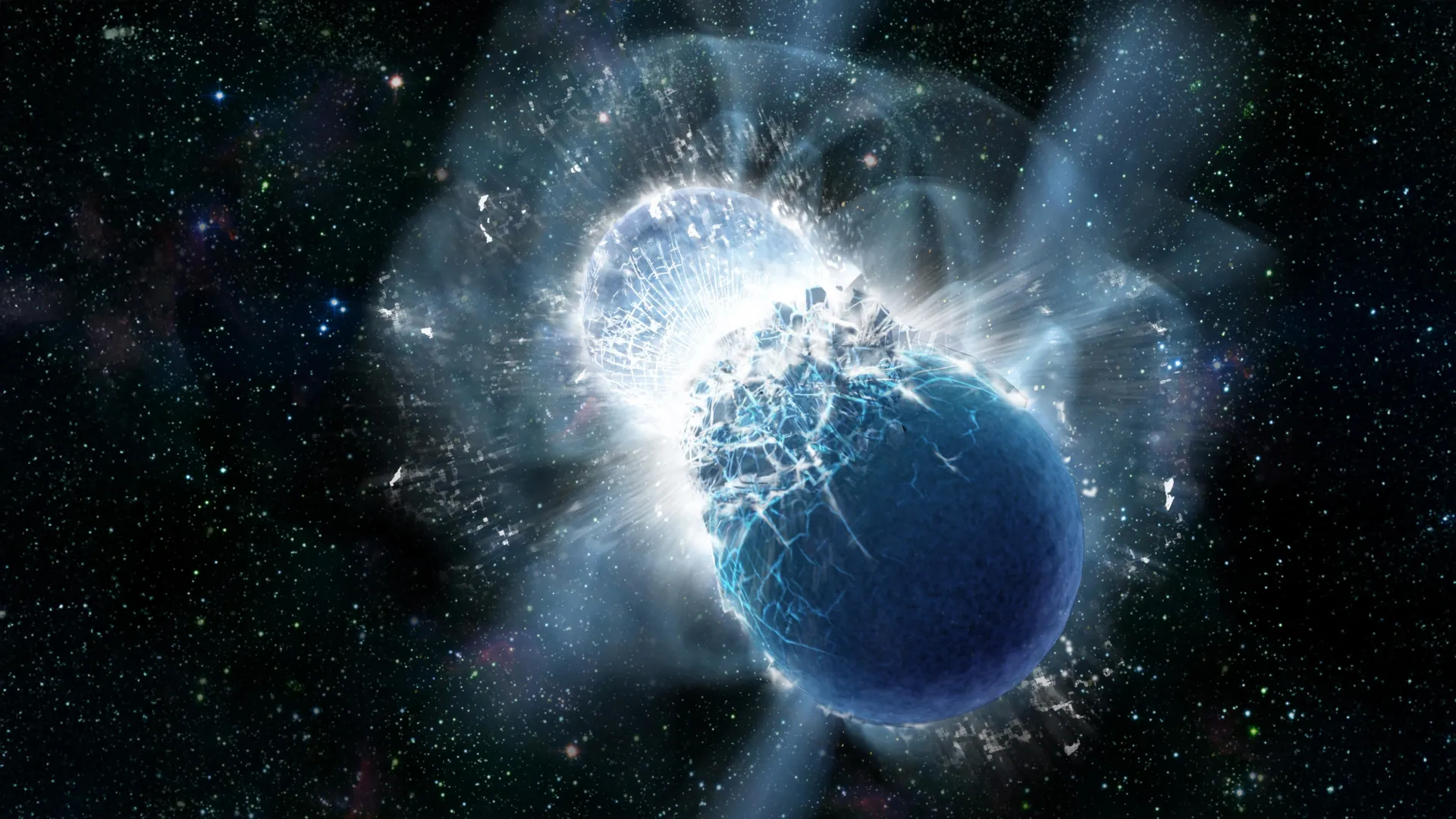
Researchers have developed a new artificial intelligence-powered simulation that could significantly improve our understanding of how the universe produces many of its heaviest elements. This machine learning model, created by an international team at GSI/FAIR, will enable scientists to simulate the complex nuclear reactions that occur during neutron star mergers and other violent stellar events much more efficiently than before. Their findings were published in the magazine Physical Review D.
AI improves simulation of heavy element formation
Many of the chemical elements found throughout the universe are created during extreme cosmic events such as supernova explosions and neutron star mergers. These giant explosions generate the energy needed to create heavy atomic nuclei through a process known as rapid neutron capture. r-process.
meanwhile, r-Process, the nucleus rapidly absorbs free neutrons. Some of those neutrons then change into protons, making the atomic nucleus larger and eventually forming many of the heavy elements found in nature.
Simulating these reactions is one of the biggest challenges in nuclear astrophysics, as their calculations require significant computational power.
“Researchers around the world are trying to understand these complex reactions through theoretical simulations. However, modeling all the parameters requires incredible computational power, so models often need to be simplified,” said Dr. Oliver Just, lead author of the study and researcher in GSI/FAIR’s Nuclear Astrophysics and Structures department. “Our new model RHINE, using artificial intelligence, provides an efficient alternative.”
Deep learning speeds up complex nuclear calculations
A new system called RHINE (r-Implementing Process Heating in Fluid Dynamics Simulations Using Neural Networks) relies on machine learning (ML), specifically deep learning neural networks, to estimate the amount of energy released during nuclear reactions. r-Processed while running a fluid dynamics simulation.
This release of energy is sometimes called heating, and plays a key role in determining how matter is ejected during a star’s explosion. It can affect both the velocity of the ejected material and the light subsequently produced. When neutron stars merge, their brilliant glow is observed as a kilonova.
Rather than performing all nuclear calculations during each simulation, the AI is initially trained using an extensive library of reference calculations, including complete nuclear reaction networks. Once trained, heating rates can be accurately estimated with a small amount of calculation.
“First, the ML model is trained using a large number of reference calculations generated on the complete set of nuclear reactions. The model is then employed to perform hydrodynamic simulations to approximate the heating rate during the reaction. rIt takes minimal effort,” explained Dr. Zewei Xiong, a scientist in GSI/FAIR’s “Nuclear Astrophysics and Structures” department and the lead developer of the machine learning model.
“A detailed comparison validated the ML scheme against reference data. The high degree of agreement suggests that the use of ML models can save a huge amount of computational time. We also inferred the following from our results. r– Process heating is an important effect and should be better considered in future modeling. ”
Linking future experiments with space observations
The researchers say RHINE could enable more detailed simulations in the future while significantly reducing the required computing resources. These improved models may eventually help astronomers link observations of exploding stars and neutron star mergers with experiments at the upcoming FAIR research facility.
RHINE’s source code is publicly available, allowing other researchers to build on its work. This project was co-funded by the European Research Council (ERC), along with other organizations.
