


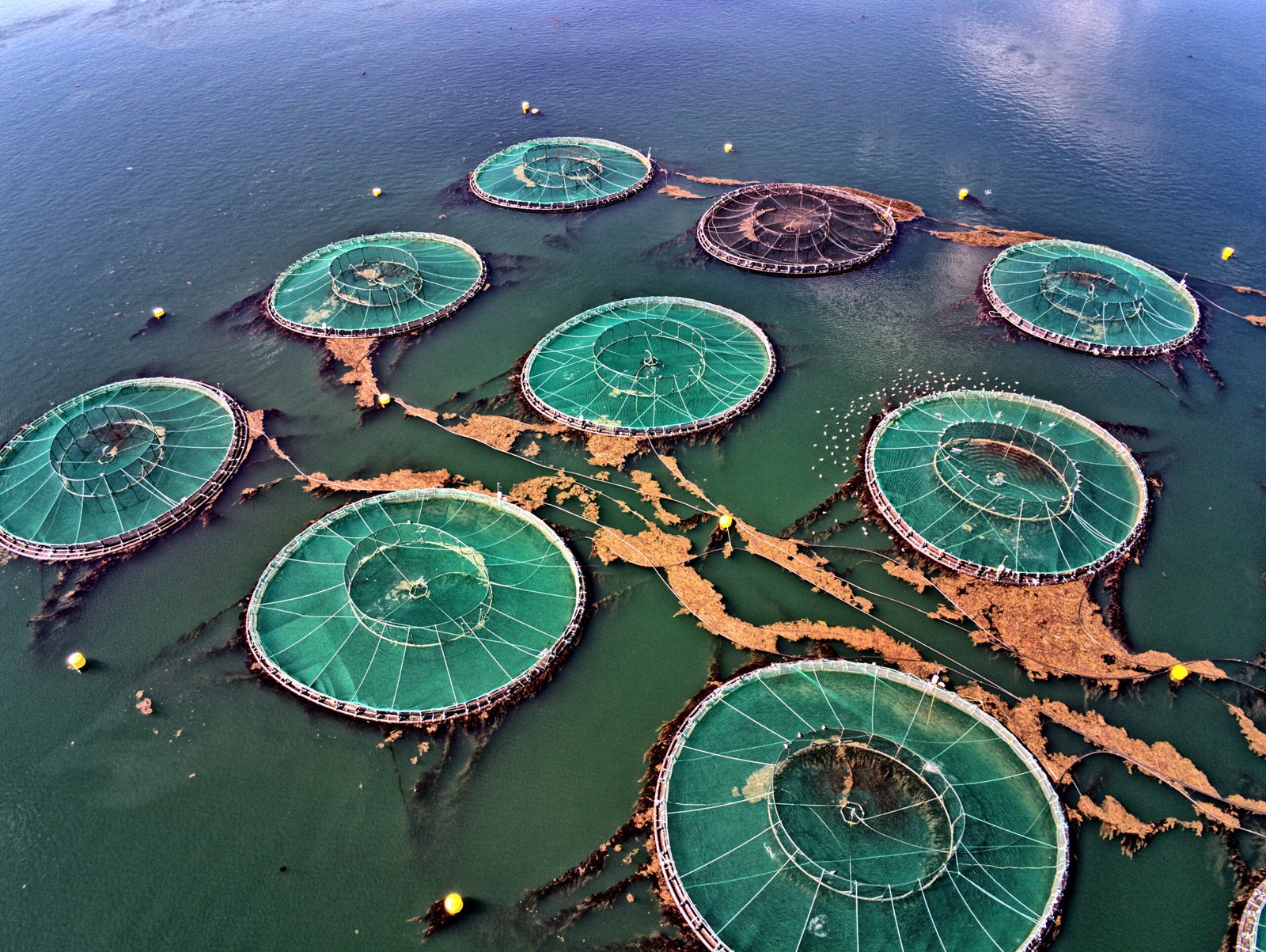
The world’s largest seafood and aquaculture companies are failing to tackle waste and underachieve fish welfare, a new benchmark assessment has found.
The first-ever seafood index, released in May by the global investor network FAIRR Initiative, assessed the social, health and environmental impact of 20 companies, including salmon farmers Mowi and Vaccafrost.
The study found that companies headquartered in Europe, Asia-Pacific, North America and Latin America performed well on social indicators such as worker representation and worker rights, but relatively poorly on pollution, traceability, antibiotic use and animal welfare.
The Seafood Index is derived from FAIRR’s Protein Producer Index, which combines seafood and land-based animal protein producers in its assessment, with Mowi, the world’s largest salmon farmer, previously ranked as the “Most Sustainable Protein.”
In the new ratings, salmon giant Mowi once again took the top spot, while food companies Cisco and Kyokuyo were given the lowest scores, scoring 14 and 13 out of 100.
However, with Mowi’s overall score of just 57 out of 100, Laure Boissat, manager of FAIRR’s research and engagement team who worked on the Coller Seafood Index, noted there is significant room for progress.
“Although (Mowi) is in first place, the overall score is slightly above average, so we think there is room for improvement,” she said.
Overall, companies scored poorly on traceability and their ability to show evidence of implementing their policies, with an average score of just 27 out of 100, meaning consumers “may be exposed to mislabeled seafood.”
“The seafood industry is so under-scrutinized that it escapes a lot of state oversight,” said Jennifer Jacquet, a professor of environmental science and policy at the University of Miami.
“Tools like (the FAIRR Seafood Index) are desperately needed to compare company practices and encourage investors to invest in companies with better practices.”
The index used publicly available company information such as annual reports and press releases to score companies on a variety of criteria, including the presence of net-zero commitments. The researchers then totaled the points for each topic to create an overall score for the company. This score also reflects the “maturity of the company’s strategic response to risks and opportunities.”
“We recognize that the seafood and aquaculture industry in particular is very keen to promote themselves as environmentally friendly and sustainable solutions to food security,” Boisatt said.
“The reality is more complex. Increasing salmon production does not necessarily guarantee food security.”
A Sysco spokesperson told DeSmog that the company is “committed to sustainable practices and responsible management” of the natural world. “Cisco is 99 percent committed to meeting its aquaculture goals. 93 percent of the wild-caught seafood used in Broadline services in the U.S. and Canada is meeting its wild-catch goals,” they said.
The companies assessed scored particularly poorly on pollution, including organic waste from fish farms and plastics from pens and fishing gear, with an average score of just 19 out of 100, the lowest score of any category measured.
In general, aquaculture companies scored slightly better on pollution, with a score of 23 out of 100, compared to a score of 18 for captive fishing companies. At fish farms, sources of water pollution include organic waste, antibiotic use, and uneaten fish feed, which can amount to up to 50 percent of feed provided in some farms.
Although often invisible to the naked eye, organic waste around salmon farms is becoming increasingly recognized. In 2025, the Sunstone Institute, a data science organization, found that pollution in Norway’s salmon and trout farms was comparable to raw sewage in a country the size of Australia.
The index found that seafood companies scored an average of 39 out of 100 on social risks, including company policies against modern slavery and child labor, worker representation and employee benefits. Mowi, the world’s largest salmon producer, received a score of 69 out of 100. This is the highest score among the companies evaluated.
However, the index excludes the negative impact that seafood and aquaculture companies have on existing local industries.
In the Scottish Highlands, local crab and lobster fishermen are linking declining catches to the use of pesticides by salmon farms that are deadly to the shellfish, while in West Africa, exports of fishmeal and oil, the basic ingredients of feed for farmed seafood, are leading to increased unemployment among female fish workers.
In the Seafood Index, companies only score 27 out of 100 for sustainable use of marine ingredients (also known as fishmeal and fish oil). Last year, FAIRR found that five of the top seven salmon companies increased their absolute use of fish in feed by 39 percent between 2020 and 2024.
Boisatt describes salmon companies’ increased use of wild-caught fish as a “dead end” for the industry’s growth.
To reduce the demand for fish oil, some companies are starting to invest in new feedstocks such as algae and canola oil. Among the companies evaluated in the Seafood Index, Mowi received the highest score for the use of alternative ingredients, which accounted for approximately 4% of feed ingredients.
Boasa added the caveat that “Mowi’s targets remain quite low and the actual proportion containing new ingredients has not increased between 2023 and 2024.” Mowi did not respond to Desmog’s request for comment.
In an effort to reduce reliance on marine ingredients, companies are increasingly replacing fishmeal in feed with soy protein and other crops. However, this has brought new environmental challenges.
According to a 2024 study published in scientific progressFrom 1997 to 2017, the amount of food eaten per kilogram of farmed salmon doubled. The industry’s salmon production also tripled during this period, so by 2017 it was using six times more crops each year, requiring more than 3.2 square meters per kilogram. Based on the average weight of salmon at harvest (4.5 kilograms), DeSmog estimates this equates to 14 square meters of land per farmed salmon.
Some of the soy fed to salmon has also been linked to deforestation in Brazil. In 2020, three of the world’s four largest salmon feed producers – Cargill, Biomar and Skretting – sourced soybeans associated with recently deforested land in Brazil, according to data compiled by environmental group Trace.
“It is clear that parts of the global soybean supply chain remain at high risk of land conversion (and we are) actively working with suppliers to strengthen traceability and improve monitoring and verification processes,” Skretting told DesMog.
“Skretting is committed to moving beyond deforestation-free supply chains and addressing land conversion more holistically.” “We are committed to sourcing deforestation-free soy and palm raw materials globally by 31 December 2030. (…) By the end of 2030, no more of our raw materials will come from areas that have been deforested since 2020,” they said.
Cargill and Biomar did not respond to Desmog’s requests for comment.
The benchmark found that companies scored poorly overall on their environmental and social policy implementation.
“There’s a disconnect between what’s on paper and what’s happening on the ground,” said FAIRR’s Boisatt. “It’s much easier to create policies that look good on paper than to implement them.”
FAIRR’s ratings rely on publicly available information from companies, and it found that the top 20 seafood companies had low levels of transparency and traceability, exposing consumers to “labels of origin, species, and even seafood that may have been illegally caught.”
“Investors and scientists need companies to provide comprehensive, standardized, publicly accessible, and independently verified environmental data. Currently, no seafood company meets these standards,” said Matthew Hayek, an associate professor at New York University’s School of the Environment.
“It is ultimately up to seafood companies to provide information about their supply chain activities to further increase consumer and investor confidence.”
