


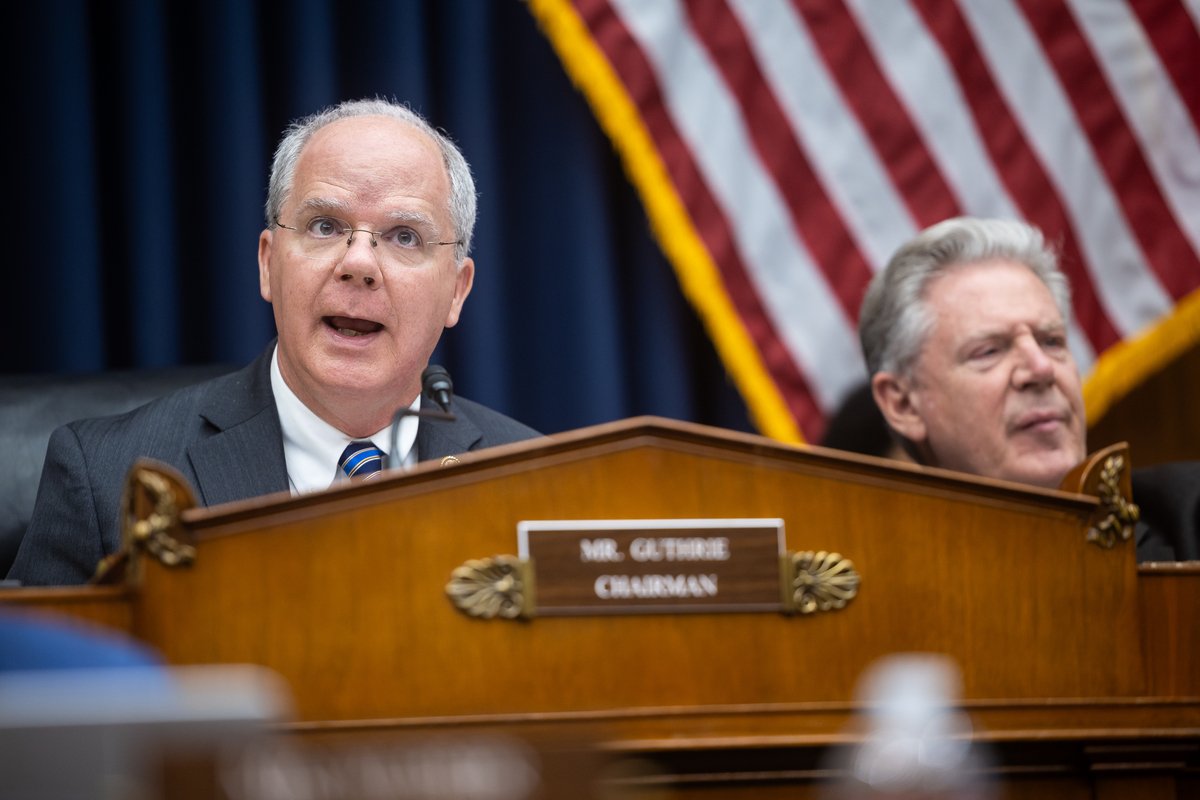
The House Energy and Commerce Committee is expected to vote this week on a bipartisan bill to protect utility customers from costs associated with data centers and advance legislation aimed at strengthening the nation’s power transmission system to meet surging demand.
The Ratepayer Protection Act, which seeks to codify the ratepayer protection pledges President Donald Trump made with big tech companies, is scheduled for a vote by the full committee on Wednesday after passing in a subcommittee last week.
Energy and Commerce Chairman Brett Guthrie (R-Ky.) said last week: “We have to win the race for (artificial intelligence) supremacy the right way.” “When data center developers come to town, they should be diligent about growing with the community, not asking for handouts at the expense of taxpayers.”
The bill passed by a unanimous vote in a subcommittee, reflecting broad bipartisan support, despite disagreements on Capitol Hill over how lawmakers should address data center energy issues.
Ranking Member Frank Pallone (D.N.J.) of Energy and Commerce threw a curveball in last week’s debate, supporting a national moratorium on new data centers, becoming the highest-ranking Democrat with energy and environment control to support the idea.
“Americans across the country have expressed concern and opposition to the rampant construction of AI data centers, and Congress should take this political upsurge seriously and impose a moratorium on data centers,” Pallone said.
Still, Pallone and other Democrats said the Ratepayer Protection Act is a good first step for Congress to address data center demand concerns across the country.
“I support this bill because it’s the right thing to do,” said Rep. Doris Matsui (D-Calif.). “American Families Shouldn’t Pay Their Utility Bills to Big Tech Companies.”
The bill would require states to consider implementing federal standards that would require large-scale electric customers to pay the full cost of new generation and transmission upgrades needed to provide electricity. It is co-sponsored by Representative Gabe Evans (R-Colo.) and Energy Subcommittee Ranking Member Kathy Castor (D-Fla.).
The Energy and Commerce Committee is scheduled to vote on several bills this week focused on strengthening the power grid to meet demand from data centers and other users.
One of these, HR 6633, the High Capacity Transmission Grid Act by Rep. Julie Fedorchak (RN.D.), would direct the Federal Energy Regulatory Commission to establish optimal transmission line standards for new interstate transmission lines and rehabilitation.
not on the agenda
Missing from the agenda is Castor’s Generator Interconnection Procedures Expedited Act, HR 2986, which would have FERC implement rulemaking to accelerate the interconnection of power generation and storage systems to the grid.
The bill passed by voice vote in a subcommittee, but Republicans say it doesn’t go far enough to prioritize power generation from sources like nuclear and natural gas, leaving the bill’s future in the Republican-controlled House uncertain.
Also absent is Rep. Randy Weber’s (R-Texas) Pipeline Safety Authorization Act, HR 9338, which would re-strengthen the Pipeline and Hazardous Materials Safety Management Program.
Lawmakers said last week they remained hopeful they could reach a compromise. Democrats opposed language that would have expanded the Justice Department’s authority to prosecute people for interfering with pipeline operations.
The Energy and Commerce Committee has struggled in recent years to reach agreement on the PHMSA bill. The House Transportation and Infrastructure Committee has already passed HR 5301 and the Senate has passed S. 2975.
Schedule: The Markup will be held via webcast on Wednesday, July 1 at 11 a.m. at 2123 Rayburn.
Josh Siegel contributed to this report.
