



A simple fasting blood test that measures two important incretin hormones could help match the most likely effective weight-loss drugs to severely obese patients, but researchers say the results are preliminary and need to be confirmed in larger clinical trials.
Fasting blood concentrations of glucagon-like peptide-1 (GLP-1) and glucose-dependent insulinotropic polypeptide (GIP) may help predict treatment response to semaglutide and tirzepatide in severely obese patients, according to a new hypothesis-generating pilot study published in the same journal. diagnosis.
Why patients respond differently to different obesity drugs
Obesity, characterized by excess fat accumulation in the body, is a global epidemic, affecting more than 650 million adults worldwide. This condition is associated with a significantly increased risk of cardiovascular disease, type 2 diabetes, certain cancers, and all-cause mortality.
Among pharmaceutical interventions, glucagon-like peptide-1 receptor agonists (GLP-1RA), including semaglutide, and dual glucose-dependent insulinotropic polypeptide (GIP)/GLP-1 receptor coagonists, including tirzepatide, have shown great promise in addressing this pandemic. However, one of the major drawbacks of these treatments is the individual variation in treatment response, highlighting the need to identify the biological mechanisms driving this variation.
GLP-1 and GIP are two major incretin hormones secreted by intestinal cells after food ingestion. GLP-1 suppresses appetite and promotes satiety through central nervous system pathways, whereas GIP regulates adipose tissue metabolism and energy expenditure. These incretin hormones act synergistically to regulate glucose metabolism and appetite, thereby playing a major role in the management of obesity and type 2 diabetes.
Given the frequent dysregulation of the incretin system in obesity, researchers from the University of Catania and MEDISAN in Italy designed this study to investigate whether fasting blood GLP-1 and GIP concentrations could help identify individuals more likely to respond to semaglutide and tirzepatide.
Pilot study compared fasting hormone profiles and drugs
The study enrolled 90 adults with a BMI > 40 kg/m² (class III obesity). Fasting blood samples were collected from participants to measure GLP-1 and GIP levels.
Each hormone was independently divided into low, middle, and high tertiles (a statistical division of the dataset into three equal parts) based on its distribution within the study population. The combination of GLP-1 and GIP tertiles resulted in nine different profiles, each containing 10 participants. Within each profile, participants were randomly assigned to receive either semaglutide or tirzepatide, with five participants receiving each drug per profile.
Participants’ pharmacological responses were assessed after 6 months. Weight loss <5%, 5–15%, and >15% were considered poor, intermediate, and optimal responses, respectively.
Low GLP-1 and GIP levels shape treatment outcome
Analysis of pharmacological response showed that participants in the three profiles characterized by lower GIP tertiles achieved an optimal response to tirzepatide, regardless of GLP-1 levels. These findings suggest that low fasting GIP levels increase responsiveness to exogenous GIP receptor agonists, such as tirzepatide.
Regarding semaglutide, the analysis showed that only participants in two profiles, characterized by the low GLP-1 tertile and the intermediate-to-high GIP tertile, achieved optimal response. These findings may suggest that the lower availability of endogenous GLP-1 leaves more GLP-1 receptors available for activation by exogenous semaglutide. On the other hand, moderate to high levels of endogenous GIP may indicate an intact or compensatory incretin secretory capacity that does not interfere with the efficacy of GLP-1 receptor agonists.
Participants with profiles characterized by high GLP-1 and high GIP tertiles had lower responses to both drugs. The authors suggest that this may reflect dysregulation of the incretin system that was not overcome by administration of pharmacological doses within 6 months. However, they point out that fasting hormone measurements alone cannot distinguish between incretin secretion deficiency and receptor resistance, making this interpretation speculative.
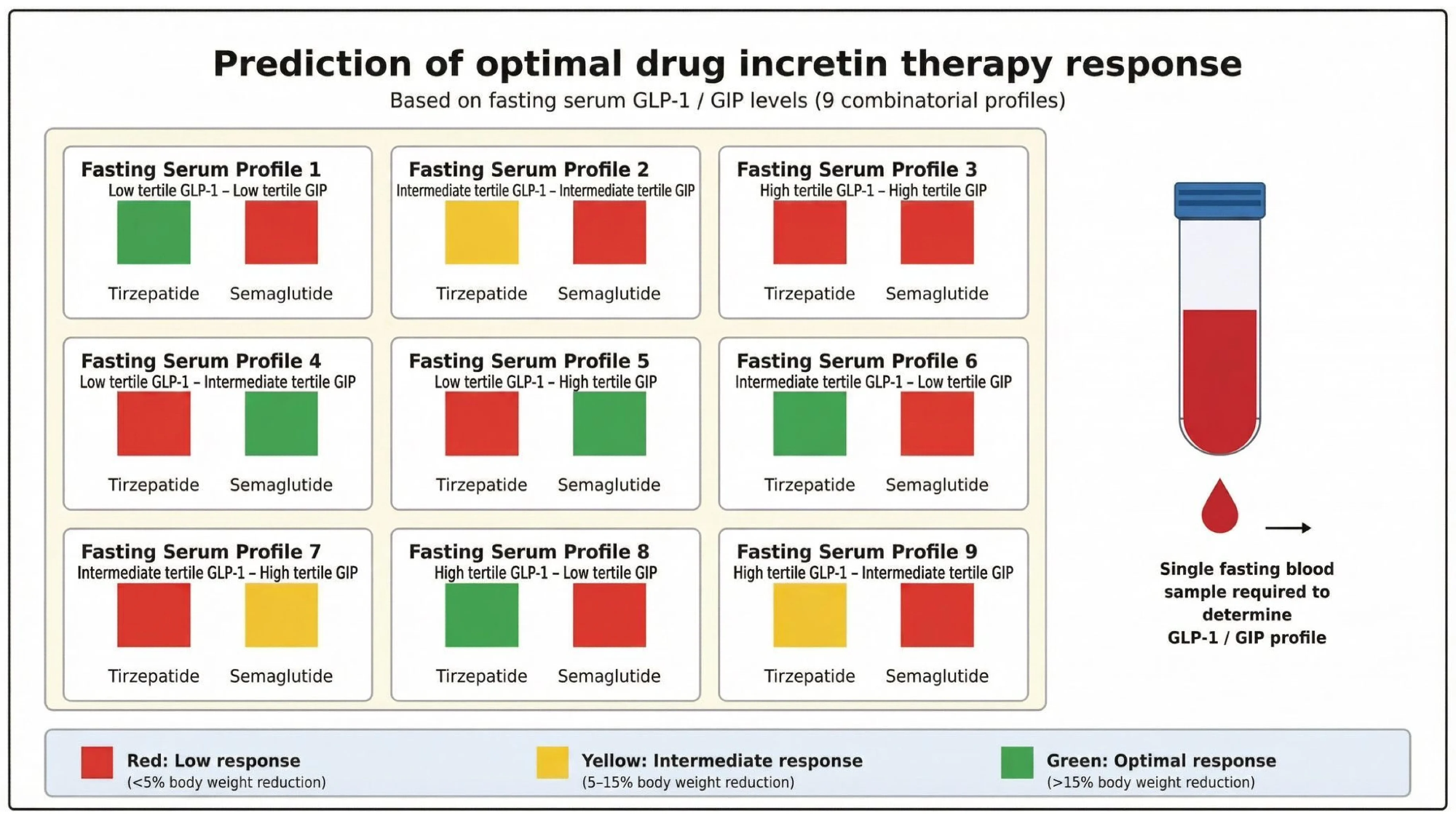
Diagram showing nine fasting GLP-1/GIP hormone profiles evaluated in a pilot study and their associated responses to semaglutide and tirzepatide. Green indicates optimal response (>15% weight loss), yellow indicates intermediate response (5-15%), and red indicates poor response (<5%). The proposed framework is for hypothesis generation and has not yet been validated for clinical use.
Regarding clinical outcomes, the analysis showed that participants who achieved optimal response to semaglutide or tirzepatide experienced significant reductions in waist circumference and improvements in insulin sensitivity, changes consistent with the pattern of weight loss observed across the response group, and demonstrated clinically meaningful improvements in central adiposity and metabolic health.
Blood biomarkers could personalize obesity drug selection
This study showed that fasting blood GLP-1 and GIP levels associated with treatment response to semaglutide and tirzepatide in severely obese patients; It helps identify individuals who are more likely to respond to treatment. Specifically, this study found that low GIP levels were associated with optimal tirzepatide response, and low GLP-1 levels and intermediate to high GIP levels were associated with optimal semaglutide response.
Because single time point measurements of GLP-1 and GIP levels cannot indicate receptor resistance, the researchers recommend treating these observations as hypothesis-generating and highlight the need for mechanistic validation of the associations observed through dynamic measurements of incretin levels and receptor activity.
The observed variation in treatment response may be explained by incretin receptor occupancy. Tirzepatide is a dual GIP/GLP-1 receptor coagonist, activating both receptor systems simultaneously. At low abundance (low fasting levels), GIP may not be able to fully occupy its receptors, leaving receptors available for exogenous tirzepatide. Upon binding to and activating the receptor, tirzepatide may then exert greater therapeutic effects by modulating adipose tissue metabolism, energy expenditure, and potentially central appetite regulation.
semaglutide, which exclusively binds and activates the GLP-1 receptor; may have the greatest therapeutic effect when GLP-1 receptors are relatively vacant due to low endogenous GLP-1 levels. In such conditions, semaglutide may more effectively restore GLP-1 receptor signaling and exert anorexigenic, insulinotropic, and metabolic effects.
Altogether, these findings provide preliminary clinical evidence for incretin-based personalized drug therapy that has the potential to improve treatment outcomes in obesity management. However, this was a small, single-center, open-label pilot study with only five participants per treatment arm for each hormone profile. Additionally, fasting hormone measurements cannot distinguish between incretin secretion defects and receptor resistance. Therefore, the authors emphasize that the results are preliminary and should not guide clinical practice until confirmed in a large, well-powered randomized trial.
Download your PDF copy now.
Reference magazines:
- Vinella, S. (2026). Do fasting GLP-1 and GIP levels predict early pharmacological response to semaglutide and tirzepatide? Diagnosis. https://doi.org/10.3390/diagnostics16131979. https://www.mdpi.com/2075-4418/16/13/1979#
