


Black neighborhoods in Hartford, which have historically faced discriminatory redlining policies, are most likely to be contaminated with high levels of lead in the soil, according to a new study from the University of Vermont.
These neighborhoods (Clay Arsenal, Downtown Hartford, and Sheldon-Charter Oak) were rated as “least desirable” by the Federal Housing Authority in the 1930s, receiving the lowest “D” grade and marked in red on the city’s historic redlining map. Banks often denied mortgages to people living in red-light areas or charged higher interest rates, even if the borrower was able to repay the loan.
“The most important parameter in determining whether a block is at risk for high lead levels is its historical redlining rate,” said Nico Perdrial, one of the study’s authors and a professor of geosciences at the University of Vermont.
These areas now have large Latino populations and, in the case of downtown Hartford, a sizable white community. They are also 20% more likely to have high levels of lead in their soil. Within these areas, the soil around apartment buildings is 40% more likely to be contaminated.
According to the U.S. Centers for Disease Control and Prevention, ingesting or inhaling lead, even at low levels, can damage the brain and delay development in children.
“The areas (neighborhoods) that were considered ‘undesirable’ at the time were also the most contaminated areas,” Pedrial said, “and this contamination is still present in the soil.”
How lead permeates into soil
Lead in the soil is thought to come from lead-based paint and gasoline. Both sources of lead have been banned for decades, but paint chips can flake off old homes and buildings, and airborne particles from lead-based gasoline can remain in the atmosphere for decades and eventually settle on the ground.
That means there are still many ways people can come into contact with lead in the soil and bring it inside.
“They could be digging directly into the soil,” said Justin Richardson, an assistant professor of environmental science at the University of Virginia, who also worked on the study. “If you have dirt on your shoes and you bring it into your home, you could inhale it into your home or blow it into your food.”
Why children of color are most at risk
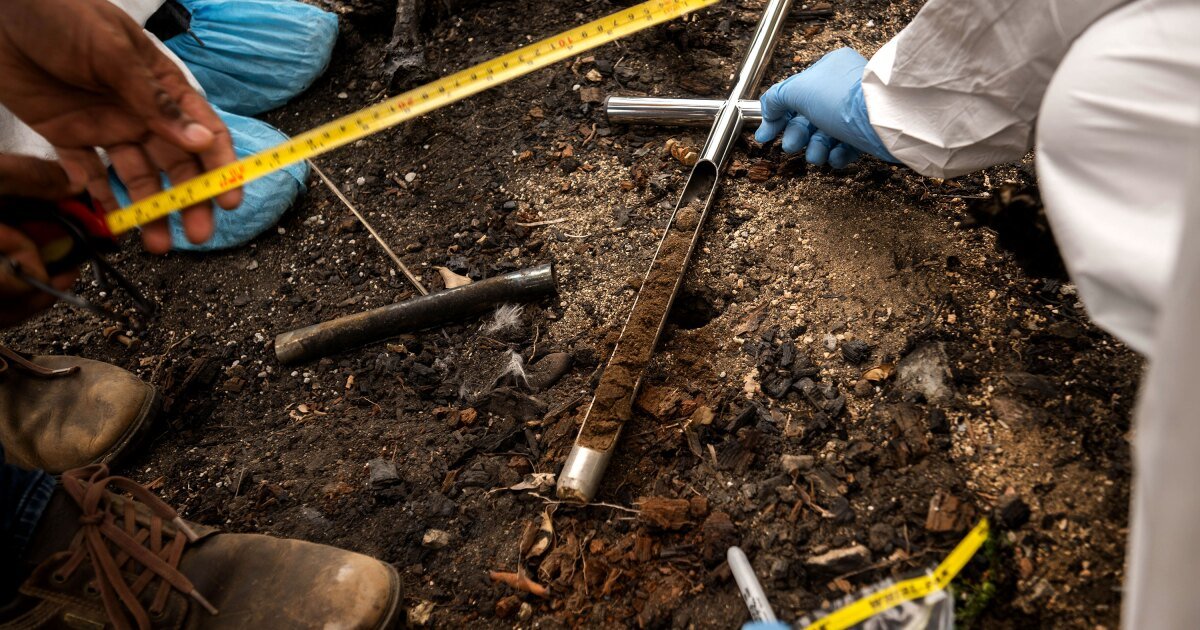
Researchers collected 150 soil samples from Hartford parks, schools and open spaces and tested them for lead.
About one-third of the samples had lead levels above 200 ppm, the standard used by the Environmental Protection Agency to determine whether soil in residential areas is contaminated.
The study, which examined soil samples in Hartford, Connecticut, and Springfield, Massachusetts, found that lead contamination closely tracks neighborhood demographics, with income, housing type, age, and race as key predictors.
In Hartford, children of color who live in apartment complexes are most likely to be exposed to lead in the soil.
The findings are consistent with a report by the Connecticut Department of Public Health that found lead poisoning disproportionately affects children of color in the state.
According to the department’s 2024 report, “Non-Hispanic black children and Hispanic children are at higher risk of lead poisoning than non-Hispanic children, with rates of 2.9%, 4.0%, and 1.3%, respectively.”
What to do if you live near contaminated soil
If you’re not sure if the soil near your home is contaminated with lead, the first step is to get a soil test. When soil samples are sent to the University of Connecticut, standard analyzes including lead screening will be provided.
For people living in or near contaminated areas, it is important not to dig or grow food in the soil. To avoid breathing in or accidentally ingesting lead-contaminated dust, always wash your hands after touching dirt and remove your shoes before going indoors. These memories are especially important for children.
“Since we were all kids, we’ve all been playing outside and digging in the dirt,” Pedrial said. “We usually put things in our mouths as young children.”
Pedrial said it is possible to remove contaminated soil and replace it with clean soil, known as a “dig-and-dump” method, but that option is expensive and unsustainable.
“If we were doing the same thing for everything, eventually we would run out of soil,” Pedrial said, noting that eliminating the original source of lead is more important.
“If you have a house that was painted with lead and you remove the soil around the house, if you don’t remove the paint, you’re not removing the source of the lead. So you’ll end up recontaminating the soil,” he said.
Connecticut officials note that lead paint must be removed by a qualified professional to avoid further spread of lead contamination.
Other cleanup methods include adding a new layer of soil, such as grass, or adding lime to the soil to slow lead absorption.
Áine Pennello reports for members of the American Legion about the environment and climate change in Connecticut.
