


 Photo courtesy of San Francisco Estuary Institute
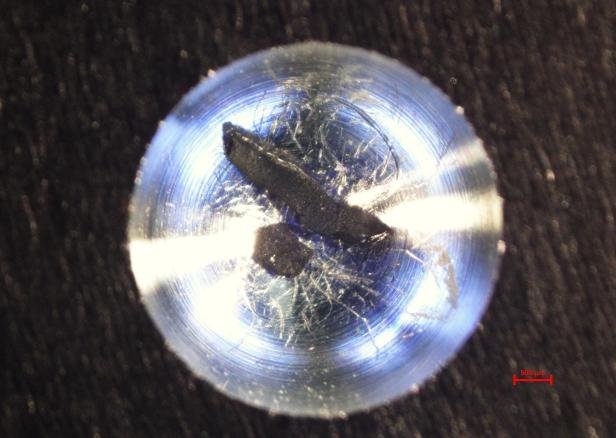
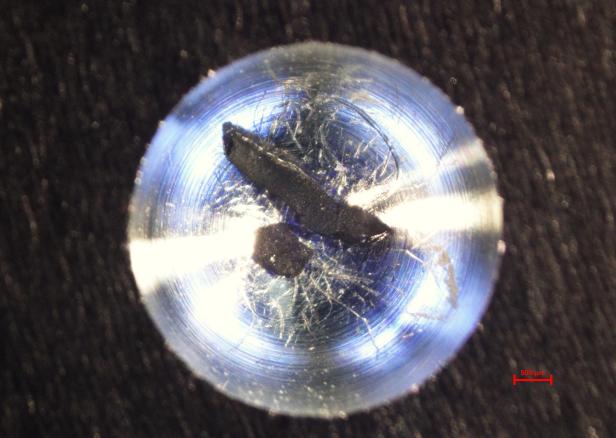
Enlarged image of a microplastic sample collected from an urban stream
These droplets flowing into San Francisco Bay contain particles that appear to be from car tires.
Preliminary research by the San Francisco Estuary Institute found that plastic particles caught in the bay were 10 times smaller than previously measured, about the width of a human hair.
These tiny microplastics can make up the majority of the microplastics present in water. The study could inform broader research into plastics and human health, coastal ecosystems, and the ocean’s ability to capture carbon from the Earth’s atmosphere.
Diana Lin, chief scientist at SFEI, said the term “microplastic” encompasses a variety of materials.
“It contains tire wear particles and fibers from clothing,” Lin says. “It comes from the food we eat and the air we breathe. It’s also found in dust from carpets and entangled tiny particles from tearing up plastic items.”
SFEI has so far measured particles as small as 0.1 millimeter.
“Here we’re down to 20 microns (0.02 millimeters),” Lin said of the pilot study.
The goal of the study is to test a standardized method to accurately monitor small microplastics in surface waters like the Gulf, said Sierra Garcia, science communicator at SFEI.
Garcia said a statewide plastic monitoring project will begin this summer under the California Marine Conservation Council, a cabinet-level state agency that works in collaboration with state and federal agencies and organizations. If the study is successful, ultra-small particle tracking could be incorporated into statewide surveillance efforts, she said.
A 2019 SFEI study found that urban stormwater runoff contains hundreds of times more microplastics than wastewater, and that San Francisco Bay water and sediment contain higher levels of microplastics than comparable areas around the world.
“When it rains, all the rainwater flows through the storm drains into the receiving water area,” Lin said. “San Francisco Bay drains much of California, so a lot of transport can occur through urban stormwater runoff.”
Microplastics flowed through the Golden Gate and entered the base of the food chain in the Greater Farallones and Cordell Bank National Marine Sanctuaries.
Jaime Jahncke is director of the California Current Group a Point Blue Conservation Science, a nonprofit research organization based in Marin County. For more than 20 years, his team of researchers has worked with the National Oceanic and Atmospheric Administration to monitor the health of the preserve, which stretches from San Francisco to Point Arena.
“We have been using seabirds as samplers to assess particle incidence in the fish and krill they eat,” Jahnke said, adding that approximately 69% of northern anchovies and more than 90% of juvenile rockfish sampled contained plastic particulates. The particles they discovered can only be seen under a microscope, he said, and cannot be seen with the naked eye.
According to NOAA data, the ocean is the world’s largest carbon sink, storing 20% to 35% of the carbon in the atmosphere.
Phytoplankton are microscopic plant-like organisms that float in the sunlit upper layers of the ocean and absorb carbon through photosynthesis. Globally, phytoplankton populations account for 40% of the world’s annual carbon emissions. Krill eat phytoplankton, and fish eat krill. When an animal defecates or dies, the carbon in its body falls to the ocean floor, where it can be stored for thousands of years. Consider a tree that takes carbon from the air and returns it to the soil in the form of fallen leaves.
A 2020 study published in the Marine Pollution Bulletin found that ingesting microplastics can affect the growth and reproduction of krill and other fish at the base of the food chain, with potentially toxic effects. A 2024 study conducted at the University of New Hampshire found that microplastics can attach to carbon-rich phytoplankton, increasing their buoyancy and slowing their descent to the ocean floor.
California Attorney General Rob Bonta sued Exxon Mobil, the world’s largest plastics producer, in 2024 over concerns about plastic pollution. The lawsuit alleges that the company engaged in a decades-long campaign of deception that created and exacerbated the global plastic pollution crisis. The company appealed to have the case filed in federal court, but in May a federal judge agreed with the state that the case should be heard in the U.S. District Court for the Northern District of California.
Source link
