


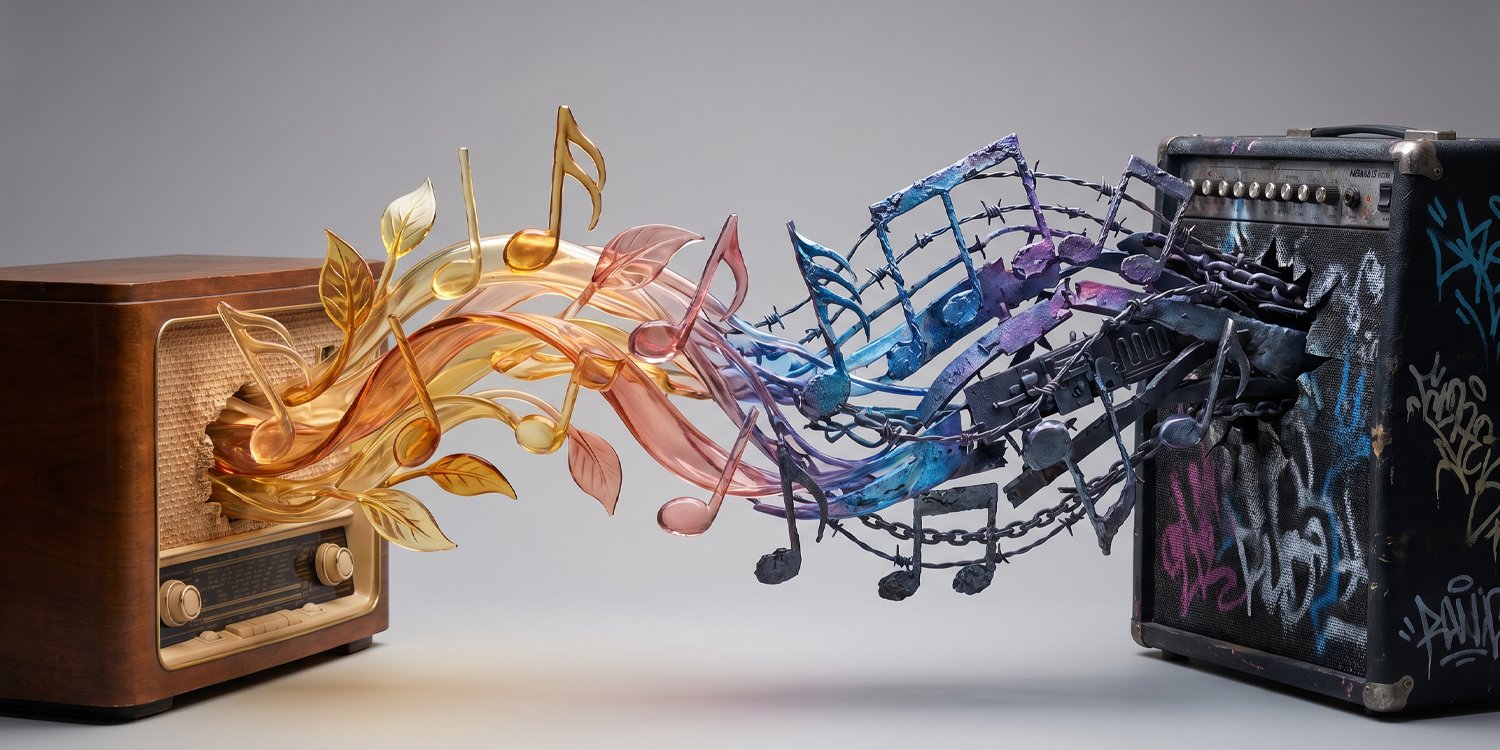
Recent analyzes of popular music over the past 60 years suggest that song lyrics increasingly focus on negative moral concepts such as harm and rebellion. Over the same period, expressions of positive virtues such as compassion and purity declined. The findings provide evidence that mainstream music reflects a broader societal shift toward darker, more emotionally intense themes. This study was recently published in the journal scientific report.
Music has always served as a cultural mirror, capturing the political, social and emotional climate of its time. Previous analyzes of popular music have shown a growing trend toward individualism and self-promotion in contemporary lyrics. Research also shows an overall decrease in positive emotions such as joy, and an increase in words expressing anger, fear, and sadness.
This relationship between art and society inspired the project, lead author Vijosa Pleniki, a researcher at Queen Mary University of London, said in a press release. “Music is more than just entertainment,” Plenicki said. “This is one of the ways societies tell stories about themselves. By analyzing lyrics over several decades, we begin to understand how emotional expressions and moral narratives evolve over time.”
To better understand these cultural shifts, researchers turned to a psychological framework known as Moral Foundations Theory. This framework proposes that human morality is based on five fundamental dimensions. Each dimension has positive virtues and corresponding negative vices.
The first dimension is care and harm, which deals with empathy and cruelty. The second section, “Fairness and Cheating,” deals with justice and deception. The third dimension is loyalty and betrayal, which concerns group cohesion and rebelliousness.
The fourth dimension is Authority and Subversion, which focuses on submission and rebellion. The final dimension is purity and degradation, which involves holiness and corruption. By mapping these moral aspects to song lyrics, scientists can track how values evolve in popular culture.
Charampos Saitis, assistant professor of digital music processing and head of the Communication Acoustics Laboratory at Queen Mary University of London’s Digital Music Center, explained why the team focused on these particular moral aspects. “Music is one of the most widely shared cultural forms (music sociologist Tia De Nora beautifully describes music as a ‘technology of the self’), so it has long been studied as a barometer of cultural change, but such studies typically rely solely on musical audio content,” Saitis told PsyPost.
“When lyrics were considered, this was primarily focused on mood and theme. And we wanted to ask a different question: What do the songs express about our ideas and concepts of right and wrong? And has that changed?” Saitis continued. “Although a growing body of research explores moral representation in news articles, fiction books, and social media, no previous study has examined how moral narratives are constructed in popular song lyrics or popular entertainment media.”
To conduct their analysis, the researchers collected text from two large collections of lyrics. This major collection included 377,812 English songs released between 1960 and 2010. This extensive dataset included music from 7,131 solo artists and 4,294 musical groups.
This first database lacked recent songs, so the researchers created a second collection of 5,580 highly successful songs from Billboard’s year-end charts. This secondary dataset covered the period from 1960 to 2023. This allowed the researchers to compare a large general catalog with a narrow list of commercially successful hits.
To process the lyrics, the researchers utilized a specialized artificial intelligence model fine-tuned for text prediction. The computer program scanned the lyrics and generated probability scores for each of the 10 moral polarities. Higher scores indicate greater confidence that the lyrics contain a particular moral theme.
The researchers also made this analysis tool available to the public. They created a web app known as MoralBERTApp based on the artificial intelligence language model used in the paper. Users upload a spreadsheet file containing text and lyrics, and the app automatically assigns probabilities for 10 moral categories.
Scientists did not just observe morality in isolation. They also investigated the songs’ emotional tone and thematic content. They used an established digital dictionary that assigns emotional values to thousands of words, allowing the team to measure emotions such as joy, anticipation, and disgust.
Additionally, we used statistical methods to group words based on how often they occur together. This process identified broad themes within the text, which the researchers gave titles such as Violence and Darkness and Love and Emotion. The team then looked at mathematical correlations between moral scores and these emotional themes.
This analysis reveals a consistent shift in the moral tone of popular music over the past 60 years. Expressions of moral virtues, particularly compassion and purity, showed a gradual decline in both datasets. At the same time, there was a significant increase in lyrics related to moral vices such as harm, cheating, subversion, and degradation.
“What we found was a gradual shift from words associated with virtues like consideration and civility to themes that reflected conflict, harm and other moral concerns,” Plenicki said. “These patterns depend on a variety of factors, such as genre and shock factor, but provide an interesting window into changing cultural values and emotional expressions.”
The shift towards moral vices was quite pronounced in the primary database. Statistical modeling revealed a 52% increase in lyrics related to degradation. Harm themes increased by 49 percent, and cheating themes increased by 48 percent. Subversion also showed a significant increase of over 40%.
In contrast to the increase in these vices, the moral virtue of caring decreased by 24% over the analysis period. We observed these general patterns in the small Billboard dataset. Popular hits saw an additional 70% increase in depictions of cheating.
The authors found that these moral expressions were strongly associated with specific emotions and themes. Songs that scored high on compassion and loyalty tended to feature positive emotions, expressing themes of joy and love. Lyrics that scored high on harm, wrongdoing, and subversion were strongly correlated with negative emotions such as sadness, disgust, and anger.
The researchers also briefly examined specific historical periods known for social unrest. They compared music from the Vietnam War era to music released during the War on Terror. They found that expressions of degradation, cheating, subversion, and harm were significantly higher during the War on Terror era compared to the Vietnam War era.
When researchers tested computer models on specific music genres, they found that certain moral themes were more predictable within certain styles of music. The concept of purity was most strongly present in religious music. Themes of harm and degradation have been very predictable in metal music, which often includes controversial and rebellious themes.
“Over the past 60 years, the moral themes in popular lyrics have changed: themes such as harm, wrongdoing, and rebellion have appeared more frequently, while expressions of empathy and decency have declined, and negative emotions have increased more broadly,” Saitis said. “We found differences in the moral expressions of lyrics that were related not only to musical style and storytelling tradition, but also (we believe) to the artist’s gender. However, these must be interpreted in light of the binary classification of artists and the substantial artist gender imbalance in the dataset we used.”
As Saitis pointed out, this study categorized artists’ gender using a strictly male or female binary based on available database information. Female artists tended to express slightly higher levels of consideration in their lyrics, while male artists were more likely to perform songs with themes of harm and degradation. However, binary classification systems cannot capture nonbinary identities, which limits the interpretation of these gender-based patterns.
The authors note that their approach has several other limitations. This analysis relied heavily on Western pop music recorded in English. This focus limits how these findings apply to other cultures with different musical and moral frameworks.
Additionally, major datasets have seen a sharp decline in the number of available songs since 2010. This means that trends observed in recent years may be influenced by a lack of data rather than true cultural change. Billboard’s dataset reflects only commercially successful tracks shaped by industry marketing and radio airplay, thus introducing its own biases.
Additionally, the machine learning models used to read lyrics aren’t perfect. Complex human expressions, including sarcasm, slang, and metaphors, can confuse computer algorithms. The authors note that while their study emphasizes mathematical correlation, it cannot prove causation.
It remains unclear whether music actively shapes the moral values of society or merely reflects changing attitudes of the listening public. “More generally, the important thing to keep in mind is that this piece describes what the song represents, not what the listener believes,” Saitis said. “Enjoying a song doesn’t mean sharing its morals, but it can have an impact on the song, and that’s something we plan to study next, including extending our analysis to music audio signal data.”
To allow the general public to experience the technology, the researchers launched a web app based on the AI language model used in the study. Users upload a CSV or Excel file containing text or lyrics, and the tool automatically assigns probability scores across 10 moral categories.
The study, “The Evolution of Moral Expressions in Song Lyrics,” was authored by Vjosa Preniqi, Andreas Kaltenbrunner, Kyriaki Kalimeri, and Charalampos Saitis.
