


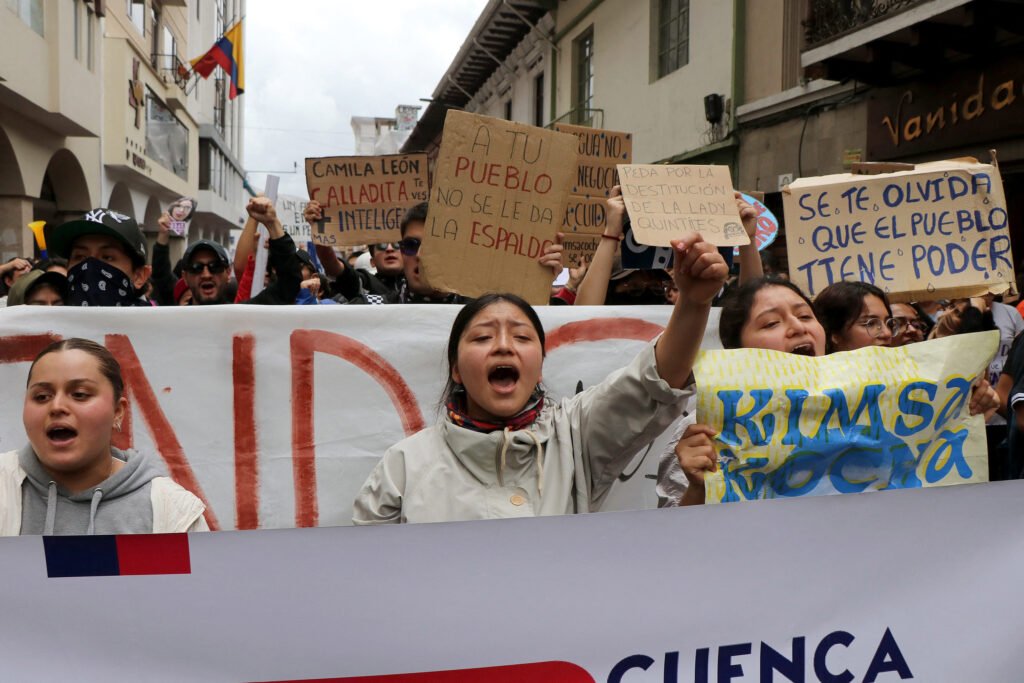
Environmental and indigenous rights defenders remained among the world’s most targeted human rights defenders in 2025, despite landmark rulings by international courts affirming the obligation of governments to protect both the environment and the people who protect it.
At least 358 human rights defenders were killed last year, according to a report released last week by Frontline Defenders, a Dublin-based group that supports human rights defenders around the world.
Almost a quarter, or 84 people, were targeted for their unpaid work to protect land and the environment. These killings have been recorded in Brazil, Colombia, Ecuador, France, Honduras, Guatemala, Mexico, India, Indonesia, Peru, the Philippines, Turkey, Somalia, and Palestine.
Indigenous rights defenders (who often work on environmental issues but are tracked separately from environmental defenders) accounted for a further 17 percent of the killings recorded by the group.
In addition to killings, many more defenders faced threats and attacks, ranging from surveillance and smear campaigns to arbitrary detention, enforced disappearances, torture and killings.
The report said there were nearly 4,000 non-lethal attacks against human rights defenders in 119 countries last year, including multiple violations against the same person. The authors said this number is likely a significant underestimate, as many attacks go unreported and attackers are rarely held accountable.
The report says that “internet blackouts, media repression, targeting of document creators, self-censorship, or invoking the complete closure of civic space” has made it impossible to document some incidents, highlighting countries that are politically restrictive, in conflict, or both, such as China, the Democratic Republic of the Congo, and Iran.
Human rights defenders are people who act peacefully to promote and protect some or all of the rights enshrined in the United Nations Universal Declaration of Human Rights.
Environmental activists are often on the front lines of conflicts over mining, oil and gas development, logging, and agribusiness, making them particularly vulnerable to retaliation from governments, corporations, and other legal and illegal actors.
Ecuadorian environmental activist Efrain Juérez was among those killed last year. The 46-year-old community leader took part in nationwide protests last fall amid a wave of pro-extractive industry and authoritarian moves by the government.
Video posted on social media shows Juérez being shot during the march. A military vehicle then approached Mr. Juerez, who collapsed on the road with his companions kneeling over his body. Armed police surrounded the men and repeatedly kicked their companions.
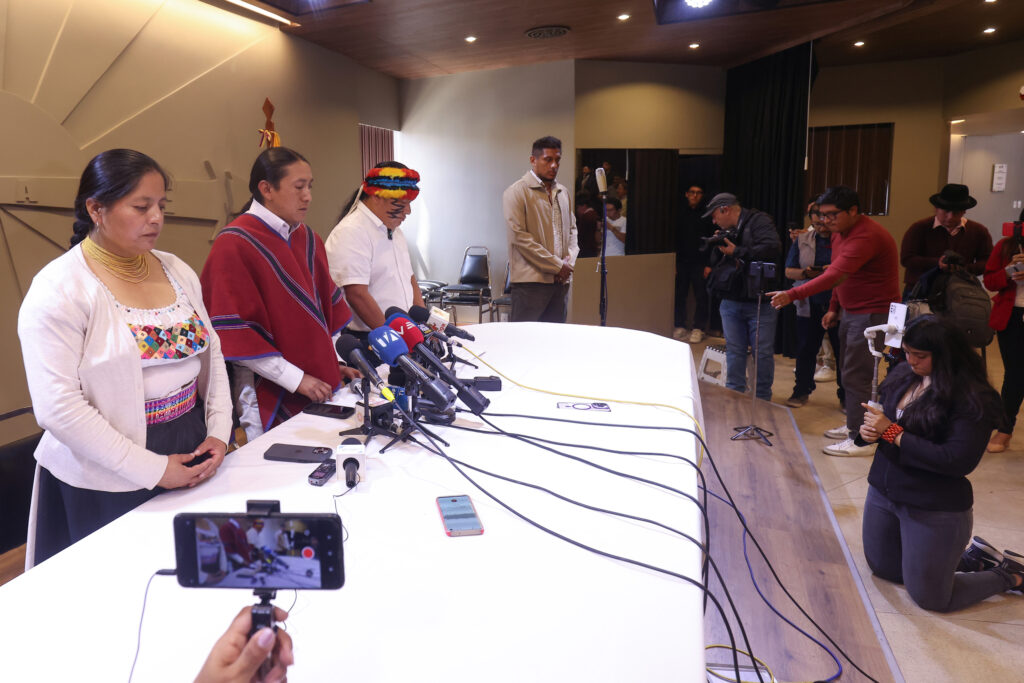 CONAIE members offer a moment of silence in honor of Efrain Juérez on September 29, 2025 in Quito, Ecuador. Credit: Franklin Jacome/Agencia Press South, Getty Images
Neither the Ecuadorian consulate in Washington, D.C., nor the country’s prosecutor’s office responded to requests for comment.
The court recognized the legitimacy and importance of the work of environmental defenders, affirming that a healthy environment is a prerequisite for all other human rights and that governments have a legal obligation to address climate change and to protect environmental defenders accordingly.
In its landmark advisory opinion on climate change, the Inter-American Court of Human Rights said last year: “Respecting and guaranteeing the rights of environmental human rights defenders is particularly important because they carry out a mission that is fundamental to strengthening democracy and the rule of law.”
The court noted that the role of environmental advocates is particularly important during the ongoing climate crisis, given the scale of the challenge and the need for public involvement in decision-making.
These court decisions build on broader changes in the law, with more than 165 countries now recognizing the human right to a clean, healthy and sustainable environment, providing a stronger legal basis for communities to challenge environmental harm and the systems that promote it.
Still, environmentalists are increasingly encountering overlapping networks of government officials, corporations, criminal organizations, and private security forces whose activities revolve around extractive industries and land development – what the report calls an “economy of violence.”
“Advocates challenging land grabs, extractive industries, and illegal economies often faced the same networks of power, regardless of whether those activities were formally legal or criminalized,” the authors write.
In Ecuador, environmental advocates told Inside Climate News that resource extraction has created tensions within divided communities in remote areas where illegal miners often work within areas designated for legal mining.
The country is also emblematic of the global trends highlighted in the report. Governments and businesses increasingly rely on criminal charges, retaliatory lawsuits, and other forms of legal harassment to stifle opposition.
The authors of the new report said that in Ecuador, “the majority of criminalization cases occur in the context of socio-environmental conflicts, where mining projects are imposed without the free, prior and informed consent of local populations.”
This story is funded by readers like you.
Our nonprofit newsroom provides free advertising for our award-winning climate coverage. We rely on donations from readers like you to continue our work. Donate now to support our work.
donate now
Last year, Ecuadorian authorities suspended the accounts of some of Ecuador’s most prominent environmental advocates, citing investigations into “unjust enrichment” and “terrorist financing.” As a result, some of these advocates have lost access to banking services.
Globally, an increasing number of governments are condemning the practice of labeling human rights defenders as terrorists or national security threats, stripping them of legal protection and shutting down their work, the report said.
According to the report, the deadliest country for human rights defenders last year was Colombia, with 165 deaths. The violence was driven by competition for land, resources and economic control in areas at the intersection of armed groups, illegal mining and other extractive activities, the report said.
The authors focus on the assassination attempt of Misael Socarras Ipuana, a leader of the indigenous Wayuu tribe, whose car came under fire from armed assailants while traveling in La Guajira, on Colombia’s north coast. Frontline Defenders said he was likely targeted because of his work documenting environmental damage and rights violations related to the expansion of Latin America’s largest open-pit coal mine.
Glencore, the mine’s owner, said in a written statement that it rejects “any acts of violence or intimidation against individuals acting in their legitimate role to represent their communities and enforce their rights” and that following the attack, the company had “activated its established procedures for dealing with threats against community leaders.”
 People do chores near the Rancheria River, which runs next to Colombia’s Cerrejon coal mine. Credit: Lis Mary Machado/Anadolu, Getty Images
The report said Colombia’s conflict resolution and peacebuilding efforts have been severely weakened by significant aid cuts, particularly with the Trump administration’s dissolution of the U.S. Agency for International Development. The UK and Germany also reduced funding to civil society organizations and vulnerable communities.
Aid cuts also weaken global institutions designed to protect human rights defenders, the authors said.
The report further noted that the Trump administration withdrew from the United Nations Human Rights Council in February 2025 and objected to language on gender rights in international negotiations. The move coincided with growing concerns from rights groups that women’s empowerment and the protection of marginalized communities are increasingly under threat.
Women, particularly indigenous women, are often on the front lines of environmental protection and face unique and diverse threats.
“President Trump has done more for human rights than our front-line defenders have ever done,” White House Deputy Press Secretary Olivia Wales said in a written statement, insisting that “the United States remains the most generous nation in the world.”
In August, Inside Climate News reported that the U.S. State Department, which publishes annual human rights reports on countries around the world, removed references to “indigenous peoples” from those reports, completely removing references to alleged mistreatment of indigenous peoples.
These sections have previously highlighted credible allegations that some governments do not formally consult indigenous communities on oil, gas, mining, and other extraction projects that affect them. These sections also highlighted how illegal activities such as land invasions and logging affect indigenous communities, and the risks faced by indigenous land defenders.
Frontline Defenders is working with 14 partner organizations to verify the killings through interviews with family members and other local stakeholders, cross-checking with local and international groups, and open source research.
Frontline Defenders separately tracks non-lethal attacks against defenders and counts human rights violations reported to defenders.
About this story
As you may have noticed, this article, like all news we publish, is free to read. That’s because Inside Climate News is a 501c3 nonprofit organization. We don’t charge subscription fees, keep our news behind paywalls, or fill our website with ads. We provide climate and environmental news free to you and anyone who wants it.
That’s not all. We also share our news for free with dozens of other news organizations across the country. Many of them cannot afford to do their own environmental journalism. We’ve established bureaus across the country to report on local news, partner with local newsrooms and co-publish stories to ensure this important work is shared as widely as possible.
The two of us started ICN in 2007. Six years later, we won the Pulitzer Prize for national reporting and now run the nation’s oldest and largest dedicated climate newsroom. We tell the story in its entirety. We hold polluters accountable. We expose environmental injustice. We debunk misinformation. We explore solutions and inspire action.
Donations from readers like you fund all aspects of our work. If you haven’t already, will you support our ongoing work, our coverage of the biggest crises facing our planet, and help us reach more readers in more places?
Please make a tax-deductible donation. Each one makes a difference.
thank you,

Katie Sarma
pittsburgh reporter
Katie Sarma is a reporter for Inside Climate News covering the natural rights movement and international environmental justice. Her work focuses on the intersection of human rights and the environment. Prior to joining ICN, he worked as an attorney specializing in commercial litigation. Her journalistic work has been recognized by the Overseas Press Club, the International Association of Journalists, and the Business Editors and Writers of America, among others. Katie holds a master’s degree in investigative reporting from Arizona State University’s Walter Cronkite School of Journalism, an LLM in international rule of law and security from ASU’s Sandra Day O’Connor School of Law, a J.D. from Duquesne University, and a major in art and architectural history from the University of Pittsburgh. Katie lives in Pittsburgh, Pennsylvania.
