


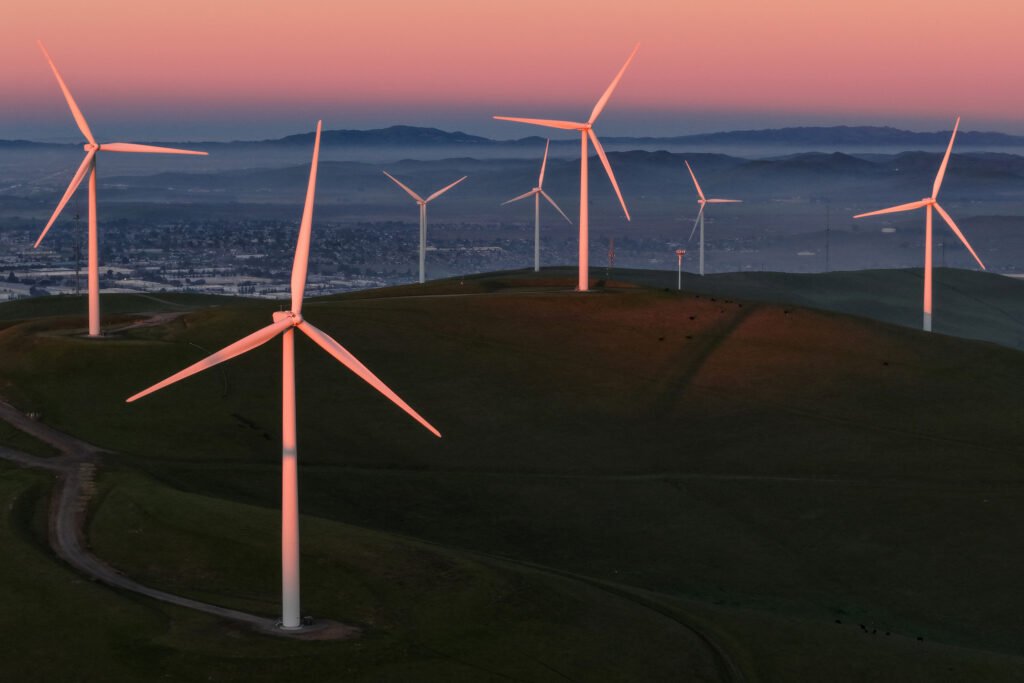
The Trump administration has abandoned efforts to halt wind energy projects across the United States, dropping its challenge to a court ruling that struck down President Donald Trump’s order to freeze federal permits and leases for wind energy projects. States that challenged the order hailed the development as one of the most important legal victories for President Trump’s campaign against the energy transition.
On Monday, the U.S. Court of Appeals for the First Circuit rejected the appeal after the Justice Department filed a June 10 motion for voluntary dismissal.
The lawsuit against President Trump’s executive order was filed in May 2025 by a coalition of attorneys general from 17 states and Washington, DC, led by New York Attorney General Letitia James.
Monday’s ruling confirms a Dec. 8 ruling by U.S. District Court Judge Patty Sarris, which concluded that President Trump’s January 2025 executive order was illegal, finding that a blanket ban on wind energy projects was “arbitrary and capricious” and beyond the president’s authority.
Environmental and wildlife groups praised the move. Sierra Club Senior Advisor Nancy Pine said renewable energy continues to gain popularity and growth despite President Trump’s relentless attacks.
“Ordinary Americans face rising bills and volatile prices, but renewable energy provides an affordable, common-sense solution to lower costs and protect our health and environment,” she said.
This latest victory in a series of legal setbacks for the administration comes as clean energy production continues to surge despite numerous policy, permitting and procedural hurdles imposed by the White House.
A new report from the nonprofit Environmental Defense Fund and Atlas Public Policy predicts that a record 79.7 gigawatts of clean electricity will come online in the United States in 2026, despite the cancellation of about 8 gigawatts of clean energy projects in the first quarter of this year.
The project pipeline remains strong, with 222GW of clean energy capacity planned or under construction nationwide, of the 693GW announced through the first quarter, the report found. Developers have announced plans to invest an estimated $377 billion in new projects by 2031, according to the report’s key findings.
The country already has 471 gigawatts of clean electricity online and will add a record 51.6 gigawatts in 2025, “the equivalent of approximately 25 Hoover Dams,” the report said. Solar power and battery storage currently account for 85% of the planned pipeline.
Monday’s court ruling came about a week after another federal court reinstated a key tax credit pathway for wind and solar power developers.
On June 6, the U.S. District Court for the District of Columbia struck down an August 2025 financial rule that would make it harder for wind and solar projects to qualify for federal tax credits. The change eliminated the long-standing practice of developers locking in tax credits by showing that more than 5 percent of the total cost of the project was spent. Judge Colleen Koller-Kottery ruled that the government failed to show a good reason for the change and sent the rule back to the IRS for reconsideration.
“We see a strong correlation between high cancellation rates and the Trump administration’s anti-renewable energy policies, from aggressive executive orders to attempts to roll back pollution control measures,” said David Villagrana, lead attorney for Clean Energy Tax Solutions at EDF. Villagrana said in an email response that the Trump administration has significantly delayed the project through executive action. “The development of any industry requires consistency, but when it comes to clean energy, the Trump administration has ensured a lack of consistency.”
This story is funded by readers like you.
Our nonprofit newsroom provides free advertising for our award-winning climate coverage. We rely on donations from readers like you to continue our work. Donate now to support our work.
donate now
He cautiously welcomed the court’s overturning of the revised 5% rule, saying that while the administration may decide to appeal the district court’s decision, “that would require a careful and thorough analysis by the district court of the many legal deficiencies contained in the IRS notice.”
EDF’s report also tracked a sharp increase in gas projects. “Total natural gas capacity planned and under construction increased from 44.8GW in the fourth quarter of 2025 to 65.5GW by the end of the first quarter of 2026, an increase of 20.7GW,” the authors wrote. This is more than four times the combined growth rate of solar power, energy storage, and onshore wind power over the same period. The share of fossil fuels in planned electricity generation has increased to 27% from 9% at the end of 2022, the report said, “which is a three-fold increase and represents an increase in investment in fossil fuel power generation.”
John Gordon, senior policy director at clean energy advocacy group Advanced Energy United, said in an interview with Inside Climate News that the gas buildup is “very concerning, especially from an environmental perspective,” and warned that new plants “will likely operate for 30 years or more once built.”
“A big reason why we’re seeing a surge in natural gas is because of this administration, which is putting obstacles in place for renewable energy and giving incentives to fossil fuels,” he said.
The challenge is real for a clean energy state like Maryland, he said, because gas plants are “the slowest to build,” even though “many of the problems are very short-term. We need new supply immediately.” Mr Gordon argued that the economics increasingly favor a clean energy path, as the cost of building gas plants has “nearly doubled in just a few years”, while the cost of solar power and batteries continues to fall.
The EDF-Atlas report also found that 80 percent of the nation’s existing, planned, and under-construction clean power capacity is in congressional districts represented by Republicans. Of the 30 districts with the cleanest electricity capacity, only five are Democratic. Texas leads all states with 164 GW, about twice as much as California, and comes in second with 83 GW.
Abe Silverman, an assistant research fellow at the Ralph O’Connor Sustainable Energy Institute at Johns Hopkins University, cautioned against reading the map from a partisan perspective. In an interview with Inside Climate News, he said the first thing to look at is “where is the land cheap?”
“Is it really the state’s red and blue, or is it the underlying land cost and density?” he asked. Much of the growth will be in areas where land is cheap, he said, and that growth will be further shaped by interconnection policies.
About this story
As you may have noticed, this article, like all news we publish, is free to read. That’s because Inside Climate News is a 501c3 nonprofit organization. We don’t charge subscription fees, keep our news behind paywalls, or fill our website with ads. We provide climate and environmental news free to you and anyone who wants it.
That’s not all. We also share our news for free with dozens of other news organizations across the country. Many of them cannot afford to do their own environmental journalism. We’ve established bureaus across the country to report on local news, partner with local newsrooms and co-publish stories to ensure this important work is shared as widely as possible.
The two of us started ICN in 2007. Six years later, we won the Pulitzer Prize for national reporting and now run the nation’s oldest and largest dedicated climate newsroom. We tell the story in its entirety. We hold polluters accountable. We expose environmental injustice. We debunk misinformation. We explore solutions and inspire action.
Donations from readers like you fund all aspects of our work. If you haven’t already, will you support our ongoing work, our coverage of the biggest crises facing our planet, and help us reach more readers in more places?
Please make a tax-deductible donation. Any of those things make a difference.
thank you,

Aman Azhar
washington dc reporter
Aman Azhar is a Washington, DC-based journalist who covers environmental justice for Inside Climate News, focusing on the Baltimore-Maryland area. He has previously worked as a broadcast journalist and multimedia producer for the BBC World Service, VOA News and other international news organizations, reporting from London, Islamabad, the United Arab Emirates and New York. He holds a postgraduate degree in media anthropology from the School of Oriental and African Studies (SOAS), University of London, a master’s degree in political science from the University of the Punjab, and is the recipient of a Chevening Scholarship from the UK Government and an Academic Scholarship for Postgraduate Studies from the Australian Government.
