



A 20-year German study found no widespread decline in quality of life after constructing nearby turbines, but suggests that concentrated turbines may convey mental health signals that siting policies should not ignore.

Study: Wind turbine proximity and health-related quality of life in Germany from 2002 to 2022. Image credit: Below the Sky / Shutterstock
In a recent study published in the journal scientific reporta group of researchers investigated whether the construction of wind turbines near residential areas was associated with changes in the physical and mental health-related quality of life (HRQoL) of German residents.
background
As countries race to reduce carbon emissions, wind energy has become one of the fastest growing renewable energy sources. But does living near wind turbines affect people’s daily lives and well-being?
Many people living near these developments report having problems with sleep, stress, and irritability, while others report no effects at all. Studies conducted in the past have yielded conflicting results, perhaps because they have primarily used short-term observational or cross-sectional surveys, which have limited causal inferences about health problems.
Determining how wind energy infrastructure impacts human health is important for balancing the need for clean energy with the well-being of local communities. Further research is needed to determine the long-term effects on population health that may be associated with wind turbines.
About research
The researchers analyzed data collected through the German Socio-Economic Panel (SOEP), a longitudinal survey that follows a representative sample of the German population. Researchers collected HRQoL data using the Short Form-12 Health Questionnaire (SF-12). The SF-12 produces scores based on physical and mental health criteria: the Physical Component Summary (PCS) and the Mental Component Summary (MCS). Higher scores indicate better physical or mental health.
Information on wind turbines was obtained from the German Core Energy Market Registry (MaStR). It contains detailed records about the turbine’s location, commissioning date, hub height and technical characteristics. After extensive data cleaning and validation, researchers identified 23,600 onshore wind turbines installed in Germany between 2002 and 2022.
The researchers used a longitudinal study design to select participants who had experienced wind turbine construction within 1.5 to 6 kilometers of their home during the study period, focusing on turbines with a hub height of at least 50 meters.
These individuals were matched with participants with wind turbines 10–15 km away and no wind turbines within 10 km during the relevant observation period, and with comparable baseline demographics, health status, and geographic characteristics.
They used a difference-in-differences matching method to compare health-related quality of life before and after wind turbine construction. Statistical modeling techniques were used to assess both turbine density and proximity, as well as participant demographics, health status, and geographic characteristics.
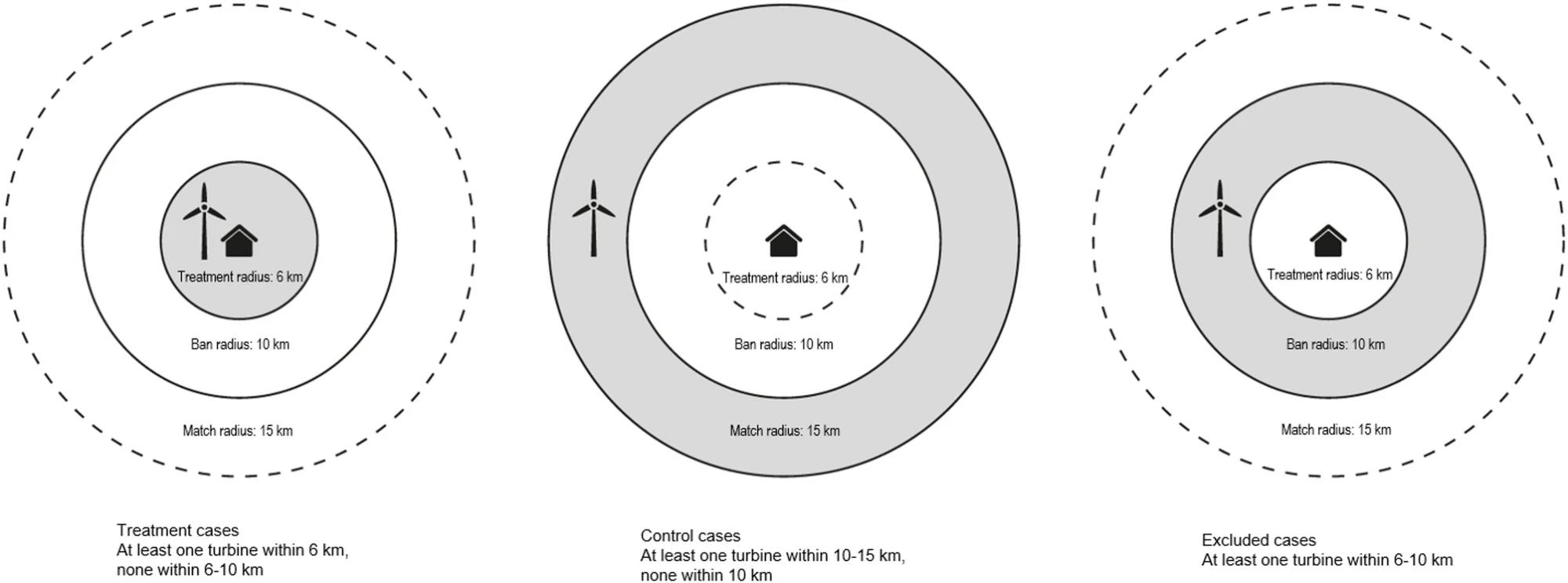
Illustration of the assignment to treatment and control groups based on the placement of turbines within the treatment radius (r” rel=”noopener”>http://www.w3.org/1998/Math/MathML”>r” role=”Presentation” tabindex=”0″>=6 km), ban radius (10 km), match radius (15 km).
Research results
The number of wind turbine installations across Germany increased significantly during this study. By 2020, the proportion of rural and non-rural households located within 6 km of at least one wind turbine has increased, demonstrating the country’s transition to renewable energy and highlighting the need to consider possible impacts at the local level.
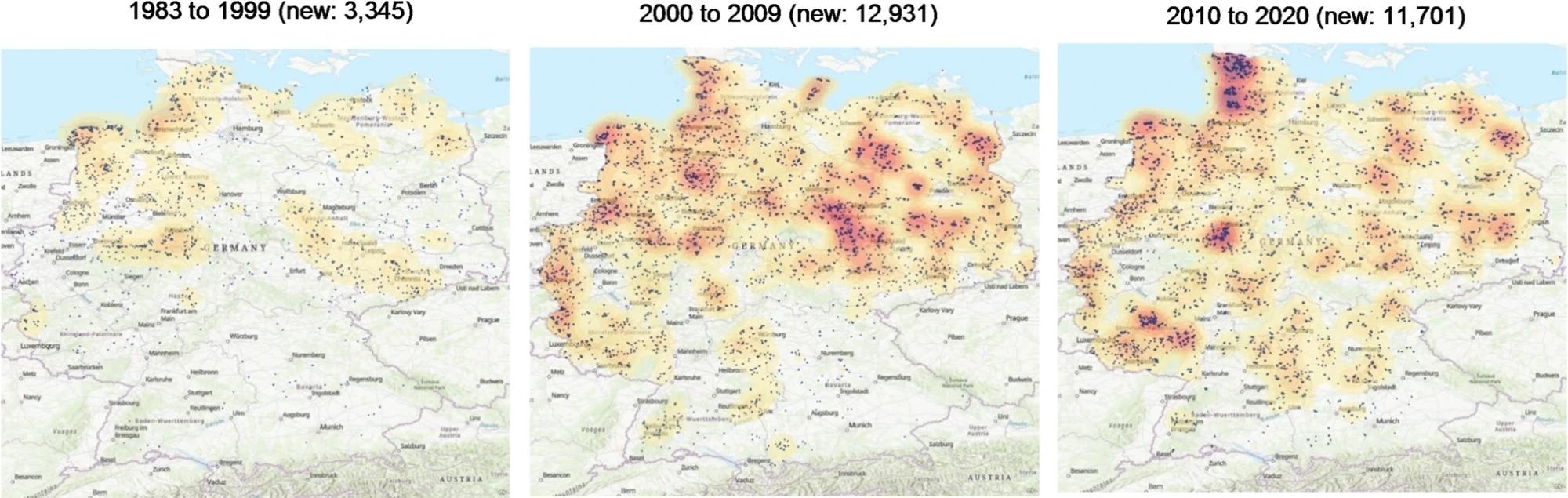
German wind turbine expansion from 1983 to the end of 2020.
Our primary analysis found no strong evidence in the FDR of an average adverse change in HRQoL when wind turbines are operated within 6 km of residences. Data showed that estimates of two separate SF-12 component summary scores, PCS and MCS, over treatment distances ranging from 1.5 to 6 km were generally small and not statistically significant. Although one analysis showed positive estimates of the physical health of residents living within 2 km of newly constructed turbines, this result did not remain significant after FDR adjustment for multiple comparisons and could not be interpreted as evidence of health benefits.
The researchers then investigated whether cumulative exposure was more important than the presence of a single turbine. Many wind farms are built in clusters, and some people may find themselves living near many turbines at the same time. They found that higher turbine density showed a clearer association with mental HRQoL than the presence of binary turbines alone. Each additional turbine within 3 km of a home measurably reduced the MCS score. This result remained statistically significant after FDR correction for multiple testing, making it the strongest finding of this study.
A similar pattern was found within 4 km but was not statistically significant. There was no statistically significant association between increased turbine density and PCS score. Similarly, analyzes examining the distance to the nearest turbine yielded mostly weak and inconsistent results. One estimate showed a slight decline in the overall physical health of people living in close proximity to turbines, but this effect did not survive FDR adjustments.
The researchers also conducted additional sensitivity analyzes to investigate whether variations in turbine definitions, distance criteria, and statistical adjustments affected the results. Although these alternative models produced several independent and conventionally significant results, none consistently survived correction for multiple comparisons. Similarly, preconstruct analyzes showed no systematic differences between prospective treatment and control groups, supporting but not proving the validity of the study.
conclusion
This study found little evidence that the construction of nearby wind turbines was associated with average adverse changes in HRQoL over a wide range of residentially stable German residents. Mean estimates of physical and mental well-being were generally small and inconsistent.
The most notable finding was that higher turbine density, rather than simple proximity, was associated with lower psychological HRQoL. These findings suggest that the overall number and concentration of wind turbines may be more important than proximity to residents alone when assessing the potential impacts of wind development on local communities. However, the findings are limited to short- to medium-term changes before and after commissioning of residential non-mobile objects and turbines, and the study did not directly measure noise, shadow flickering, lighting, visibility, annoyance, sleep disturbance, etc.
Finally, although this study does not suggest widespread HRQoL harm among residentially stable residents, it does highlight the need to consider local patterns of cumulative exposure and its potential impact on HRQoL.
Click here to download your PDF copy.
