


Written by Will Atwater
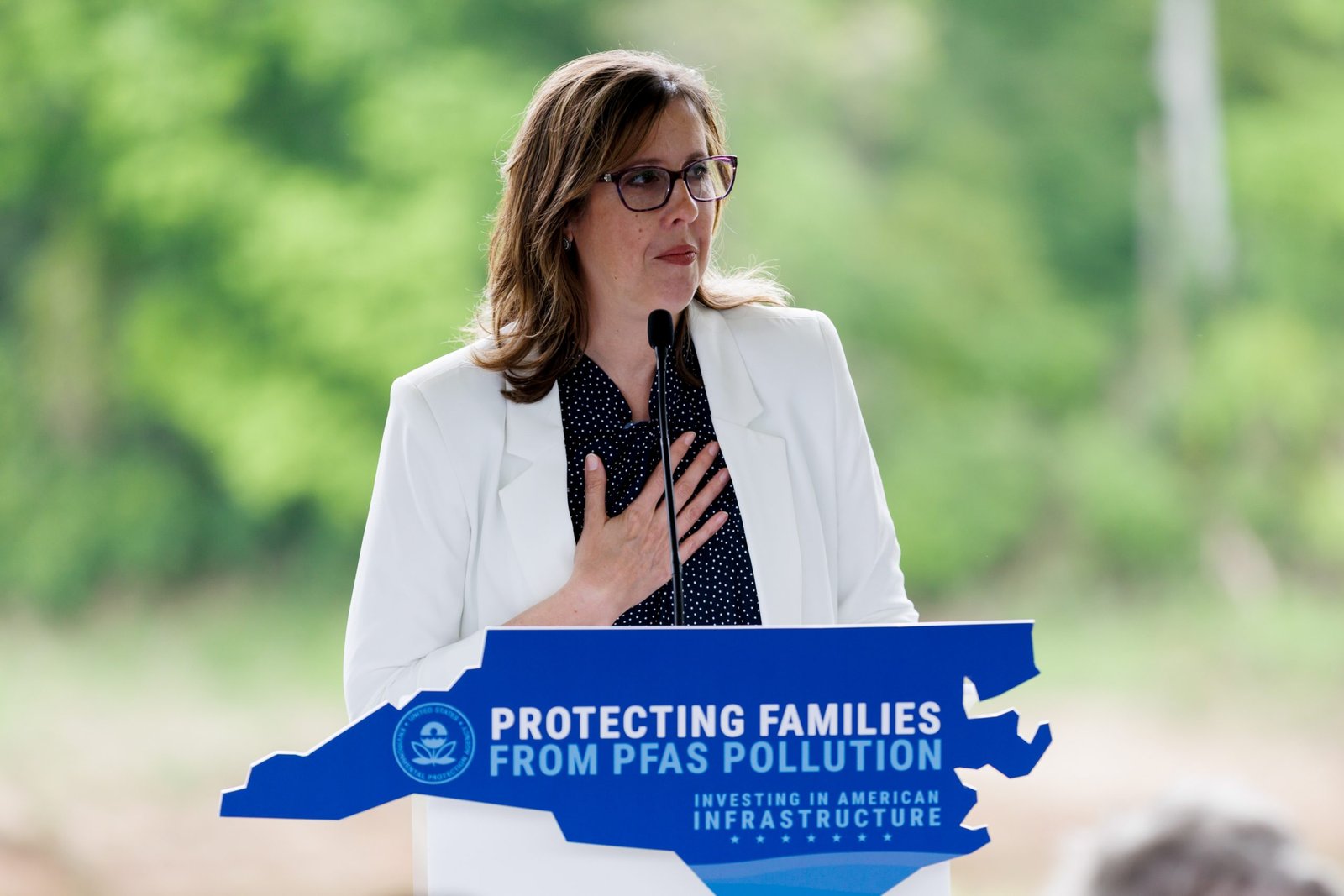
Two years ago, Emily Donovan took to the stage in Fayetteville to introduce then-Environmental Protection Agency Secretary Michael Regan.
Regan, who was director of the North Carolina Department of Environmental Quality before being tapped by the Biden administration to lead the EPA, returned to the region in 2017 where the public first learned that the Cape Fear River was contaminated with per- and polyfluoroalkyl substances (PFAS) and issued the first-ever national drinking water standards for six of the rivers.
This 2024 rule established legally enforceable limits on some of these substances, known as “permanent chemicals” because they persist in the environment. The regulated chemicals were PFOA and PFOS (traditional PFAS), as well as PFHxS, PFNA, HFPO-DA (GenX), and mixtures of the three with PFBS.
Last month, current EPA Administrator Lee Zeldin announced plans to roll back key parts of that rule. The agency moved to rescind drinking water standards for PFHxS, PFNA, and GenX, as well as PFAS blend standards, including PFBS. Zeldin also said the agency intends to give water systems time to comply with maximum contaminant levels for PFOA and PFOS.
Nine years after GenX and other PFAS in the Cape Fear River made headlines, and two years after she helped introduce Regan in Fayetteville, North Carolina Health News interviewed Donovan about the EPA’s latest decision.
Q: What is your reaction to that? EPA’s proposal?
answer: We are very sorry. For communities in Wilmington and across North Carolina, this is like a slap in the face.
This administration is primarily focused on two legacy PFASs and not on the broader current PFAS problem. Meanwhile, places like Fayetteville have already exceeded proposed drinking water limits for multiple PFAS. Their water quality report acknowledges these exceedances but still frames the water as “okay” because the standards are not yet fully enforced.
This type of message creates a dangerous disconnect. People are drinking contaminated water, but power companies can hide behind the idea that they are “technically compliant.” We experienced the same thing in Wilmington 9 years ago. Tap water was said to meet all guidelines, when in fact no meaningful standards were in place.
Q: EPA highlighted $2 billion in funding to help address PFAS. Wouldn’t that support the community in a meaningful way?
answer: This money is important, but it’s not new. Also, the way it is framed is misleading.
The funding currently being touted comes from a bipartisan infrastructure bill. The bill was passed early in the Biden administration and was designed to last five years. This year is the final year of that funding period. The EPA is essentially winning by passing funding that Congress has already appropriated.
At the same time, this EPA proposed to Congress significant cuts to its own budget and to its very funding. They publicly say, “Look at the funding we’re providing,” but privately they’re not fighting to extend or expand it.
The community deserves that funding, and more. Simply spending old money should not be confused with true leadership on PFAS.
Q: Utilities often argue that meeting strict PFAS standards is too expensive. What should their role be?
answer: Currently, many utilities operate based on a cost and liability mindset rather than a public health mindset. That’s a problem. Instead of demanding weaker standards, utility companies and their lobbyists should come together in Washington, D.C., and demand the funding they need to protect public health.
When the banking and airline industries are in trouble, huge bailouts are given. Safe drinking water is far more fundamental than stock prices, yet water utilities are less enthusiastic about making large, ongoing investments. Their job is to act as stewards of public health and the environment. That means fighting for funding to meet strict standards, not lobbying to circumvent them.
Q: Although the EPA has identified approximately 15,000 PFAS chemicals, most of the health and regulatory focus remains on a small number of chemicals, such as PFOA, PFOS, and GenX. How should you plan given this gap?
answer: Wilmington is an example of why you can’t just chase contaminants in your faucets.
Our utilities have spent nearly $92 million on treatments to remove PFAS. These upgrades are still not compatible with 1,4-dioxane. They are now considering another major investment to address the chemical. And we haven’t even gotten serious about microplastics yet.
We don’t have enough money to treat these pollutants one at a time. The only sustainable solution is to control pollution at its source. PFAS and similar chemicals should never be allowed into drinking water supplies in the first place.
Now, polluters are forcing communities to pay for the cleanup. Businesses with the least resources will be hit the hardest. That’s the real injustice.
Q: I have expressed concern about Chemours consent order. What is happening to private well owners?
answer: There is a significant loophole.
Although some homeowners have PFAS levels associated with chemicals in excess of 10 parts per trillion, the specific PFAS in their wells is not included in the final list of chemicals subject to the consent order. These residents are told they are not eligible for treatment, even though the contamination is clearly linked.
The list of chemicals should have been set as evergreen. Will be updated regularly as the science reveals more about what Chemours has announced. Rather, nine years after this crisis erupted, we are still finding people who have failed because the list has not kept pace with scientific advances.
We connected at least one homeowner in this situation to the Southern Environmental Law Center. But the fact that residents must fight on a case-by-case basis to be recognized under a narrow list of chemicals is a structural flaw.
Q: Are there other communities that explain how these policy gaps play out on the ground?
answer: One example is a group in Brunswick County that works with the local NAACP and EarthRights International.
Brunswick County approved the large-scale development, but many longtime residents saw their wells deteriorating, causing problems such as turbidity and dry wells. In addition, some residents have received letters and test results from Chemours indicating PFAS contamination in their wells.
As such, the county resists connecting them to public waters because they are dealing with both development-related hazards and chemical contamination. This is an excruciating situation that illustrates how planning decisions, environmental regulations, and equity are all intertwined.
Q: What do you want from the country? environmental management committee?
answer: We oppose the Commission’s current 1,4-dioxane and PFAS minimization plans and are calling for even more major reforms.
Hundreds of people attended the public hearing in Wilmington, and dozens commented. Almost everyone opposed the minimization plan. Our petition, which currently has around 10,000 signatures, goes further and calls for the commission to be abolished.
Other states do not have this additional fee tier. Environmental authorities can create and enforce rules more directly. We believe this commission represents a structural barrier to strong environmental protections in North Carolina. That’s one reason our state lags behind states like New Jersey, which have already secured large PFAS settlements from the same companies we’re still fighting.
On June 15, the Southern Environmental Law Center, which represents 13 environmental organizations, submitted formal comments opposing the Environmental Stewardship Commission’s proposed PFAS and 1,4-dioxane rules.
The rule requires industrial facilities and wastewater treatment plants to sample emissions and develop pollution reduction plans, but does not require actual reductions or impose penalties on facilities that fail to reduce emissions.
SELC’s lawyers argued that the proposed rules were “written by polluters” and invalid. Lawyers are asking EMC to abandon its monitoring-only approach and adopt enforceable “health-protective” water quality standards, according to a news release.
The next Environmental Management Committee meeting is scheduled to be held from July 8th to 9th.
EPA will accept written comments on the proposed PFAS drinking water rule until July 20, 2026 at www.regulations.gov (Docket ID: EPA-HQ-OW-2025-0654).
thisarticleteeth,north carolina health newsFirst published in and republished here. Creative Commons Attribution-NoDerivatives 4.0 International LicenseBased on.
