


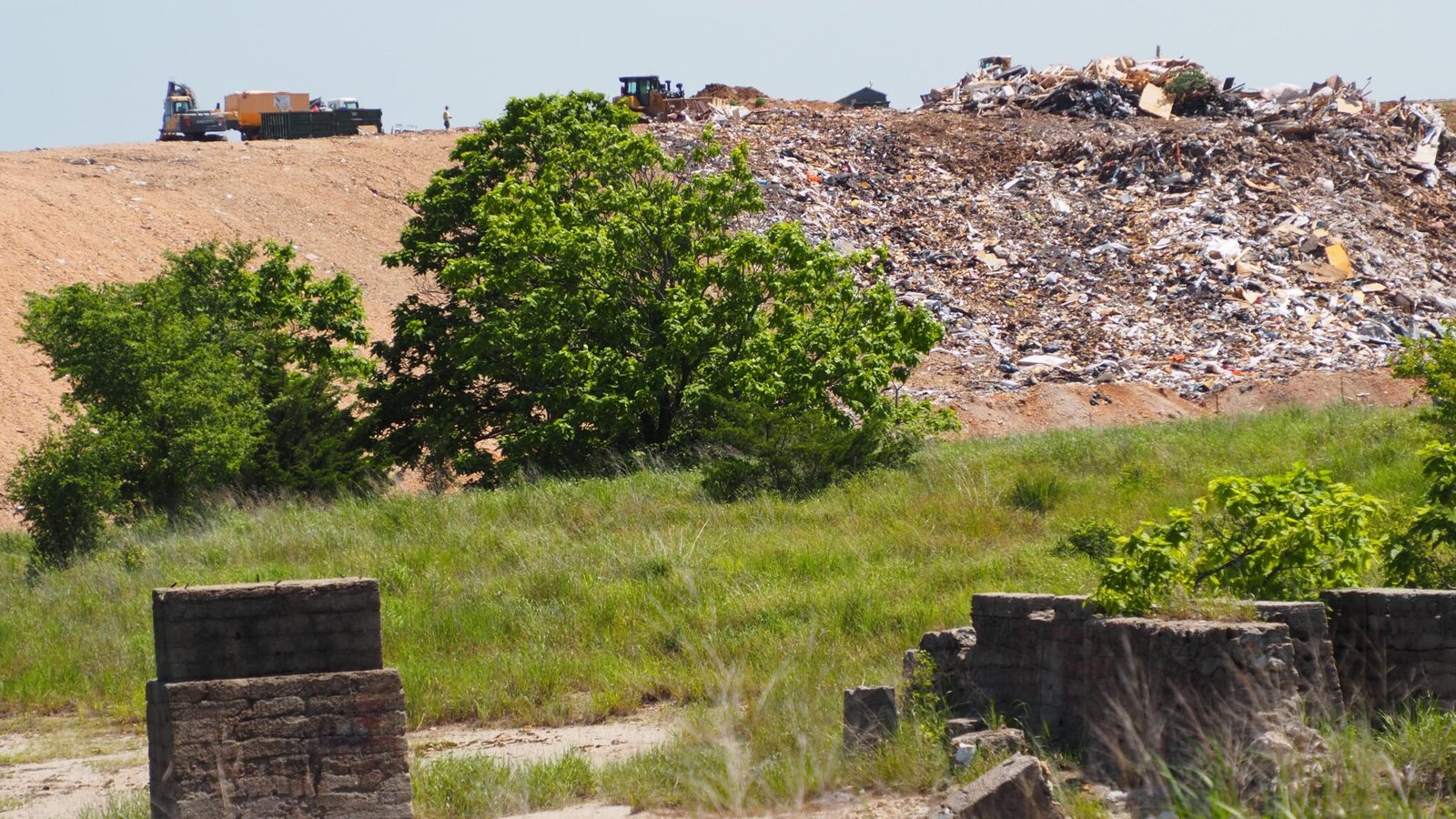
GALENA — Tammy Allen’s front porch overlooks the trash-strewn hills of the Galena Landfill, built in an area once known as Hell’s Half Acre.
Over the past three years, Allen’s home has become filled with random odors that seem to be causing headaches, nausea, and vomiting.
“The smell comes and goes, so you never know when it’s going to happen,” Allen said. “Some smell like a dirty garage, others like stale cigarette smoke.”
Allen, who has lived near the site for decades, said problems with smoldering fires and odors at the landfill have increased in the past few years.
Allen is part of the Galena resident group Neighbors for Clean Air, which is fighting for additional oversight and remediation of the landfill operated by Jordan Disposal LLC.
Ashley Wells, who lives near the landfill, founded the group because people across the small town in southeastern Kansas were sharing concerns and complaints about the health problems and noxious odors that sometimes flood downtown.
Two Galena residents have filed a lawsuit in federal district court seeking recognition as a class action lawsuit. Wells said multiple people have filed environmental complaints with the Kansas Department of Health and Environment, as well as city and county officials and even the U.S. Environmental Protection Agency.
The landfill is located several blocks from downtown Galena and is surrounded by residential and child care facilities. The southeastern Kansas town of about 2,700 people is a stop on Route 66, and the landfill is next to a tourist destination crowded with tourists taking photos as the iconic highway approaches its 100th anniversary.
Wells said her family didn’t notice any foul odor at first, but that changed about three years ago.
“What we were smelling was hydrogen sulfide and now tests have confirmed it is hydrogen sulfide. It’s a very strong rotten egg odor,” she said. “Every year, it gets worse and worse. This winter of 2025 was really bad. Just one example: One week, my house smelled like hydrogen sulfide for four out of seven nights in a row. Sitting there smelling that smell makes it hard to sleep. My stomach hurts and my head hurts.”
Representatives for family-owned Jordan Disposal said they could not comment on the situation because the lawsuit is pending.
 Ashley Wells said she worries about her family’s health being affected by air pollutants from the Galena Landfill. She started the Galena KS Neighbors for Clean Air group on Facebook to communicate about the issue. (Photo by Morgan Chilson/Kansas Reflector)
Superfund site
KDHE certified the landfill in 1997 and became an agent. record show. KDHE and the EPA approved expansion of the landfill to serve as a debris dump in 2011 after an EF-5 tornado struck the city of Joplin, Missouri, killing nearly 160 people.
Jordan Disposal did not take over the landfill operations until 2019, according to the company’s court filings.
The landfill is designated as a construction/demolition landfill, and the items that can be dumped are limited to exactly what the name suggests: solid waste from the construction, renovation, repair, and demolition of structures, roads, sidewalks, and public facilities, as well as untreated wood and sawdust. According to , such landfills do not need liners. KDHE.
Because the Galena Landfill did not have a liner, permits to place tornado debris there required two stages of waste testing, one conducted by the EPA in Joplin and a second conducted at the landfill before the debris was dumped, according to KDHE’s website.
But residents claim it would have been impossible to sort through the debris effectively. Reported from Columbia, Missouri. In 2012, 350 trucks came every day, dumping 12 tons of trash every minute.
“In the (2025) August fire, a propane tank that wasn’t supposed to be at the (construction and demolition landfill) actually exploded. That tells you that things are being overlooked,” Wells said. “You know that’s going to happen.”
Ms Wells said she didn’t believe anything “malicious” was done, but that she believed the emergency situation made it easier for items that shouldn’t be in the unlined landfill to be overlooked.
Local residents are concerned about the history of the area and other contaminants known to be present there. The area was once a Superfund site and was home to 599 mine hazards in and around Galena, many of them at Hell’s Half Acre. According to the Kansas Geological Survey.
From the 1800s to 1970, a 115-mile area was mined for lead and zinc, leaving behind significant contamination. According to the EPA.
“A hundred years of mining also left serious environmental problems in the area,” the Kansas Geological Survey said. “When the mine was closed, the pumps stopped and the abandoned tunnels filled with water. The water in these tunnels was contaminated by iron sulfide (from pyrite and marcasite) and other metal sulfides, which were left on the walls of the mine and In addition to being highly acidic, the water contained dissolved metals, some of which were highly toxic. This water, in turn, contaminated local groundwater, springs, and surface waters.
The EPA said millions of cubic yards of mine tailings (crushed rock and wastewater from the mining process) were brought to the surface and left in a pile covering more than 4,000 acres.
“Tailings from these mines contaminated soil, surface water, sediment, and groundwater with lead, zinc, and cadmium, the primary contaminants of concern,” the EPA document said.
According to the Kansas Geological Survey, restoration work is ongoing throughout the area that began in the 1980s. EPA divided the county into six subsites, including Galena, Baxter Springs, and Trees.
Wells said the EPA recently tested the soil in her garden and found enough lead to require remediation. Anyone in the county can get tested, and the EPA will remove the top few inches of soil and replace it with clean soil, she said.
Wells said residents still have many questions about the mine shaft and how it will affect the landfill.
“We want a very thorough investigation,” she said. “What could be in the mineshaft? What’s going on below the surface? From what I understand, they’re only measuring surface temperatures in hot spots. We want to see ground-penetrating radar. How big is this fire? I’ve asked the City Council multiple times and I’m not getting an answer.”
 Cherokee County Health Officer Peyton Kessler said she is concerned that the meadows around the landfill do not support wildflowers or trees and that residents see few animals there. (Photo by Morgan Chilson/Kansas Reflector)
environmental pollutants
Peyton Kessler, a registered nurse and Cherokee County health officer, is concerned about the health effects and the limited-time air quality testing conducted by KDHE and the EPA. According to KDHE’s website, officials installed the monitor on March 12, 2025 and removed it the next day.
The August 2025 fire heightened Kessler’s concerns, especially as the landfill continues to smolder, she said. Kessler said shredded sleepers have been approved as an acceptable form of covering for landfills and are fine as long as they are in solid form.
However, when it burns, the creosote in the sleepers becomes airborne as a gas. Kessler said he called KDHE about another situation and was told there was a plan to light a bonfire in town on top of the sleepers, and was told that “the sleepers should not be placed in the bonfire under any circumstances and should be removed as they could be very dangerous to anyone standing around or downwind.”
Kessler said she doesn’t understand why people aren’t more concerned about the fire smoldering at the landfill, where railroad ties are burning, given the stark warnings about possible health problems.
KDHE installs Drager health monitors near landfills and Post daily updates About environmental air quality. Kessler said he purchased an EPA-recommended air quality monitor and began collecting his own data because it only tracks hydrogen sulfide. You can find these online at PurpleAir by zooming in. Map to Galena District.
KDHE spokeswoman Jill Bronaugh said KDHE is working with the city of Galena and the Jordan Landfill to assess and monitor conditions at the landfill. In a May 19 letter to both entities, KDHE warned Jordan Waste to complete the work set out in the KDHE Action Plan by June 19.
“Jordan The disposition will provide KDHE with regular updates on the work completed,” she said.
In a letter, KDHE informed the city and Jordan Treatment Authority that hydrogen sulfide concentrations above 1 ppm were recorded at the landfill on March 16, requiring the owner or operator to begin a month of assessment monitoring.
“Further exceedances were recorded on April 18, May 2, May 7 and May 11,” the letter said. “The landfill remains under evaluation monitoring while KDHE determines what actions to take.”
KDHE believes the high hydrogen sulfide readings were made worse by a fire that started in March, the letter said. Citing the ordinance, KDHE said Jordan Disposal and Galena City officials were required to use appropriate fire extinguishing methods when a fire was discovered, until “all smoldering, smoking, and combustion ceased.”
Jordan Disposal submitted a fire suppression plan, which KDHE approved on March 25th.
“The approved plan specifies that Jordan Disposal will continue excavating the smoldering waste for five business days, or approximately 40 working hours,” the letter said. “However, KDHE has not set a date by which the excavation work must be completed.”
As of May, Jordan Disposal had not performed “excavation work as required by the plan,” the letter said.
Once the company completes efforts to extinguish the underground fire, it must submit a report to KDHE by June 19 indicating whether the fire is completely extinguished, according to the letter.
“If the fire remains smoldering underground beyond June 19, 2026, Jordan Disposals and the City of Galena shall engage a qualified consultant and submit a long-term fire mitigation and suppression plan to KDHE,” the letter states.
 Jordan Disposal took over operations of the Galena Landfill in 2019. Two Galena residents sued the company for mismanaging pollutants. (Photo by Morgan Chilson/Kansas Reflector)
pending litigation
The proposed class action lawsuit was filed in U.S. District Court on May 26, 2026, alleging that Jordan Disposal of the Galena Landfill has failed to properly manage pollutants, including hydrogen sulfide gas and liquid waste called leachate, using appropriate remediation techniques.
Galena residents Stacey Hendricks and Opal Barry filed the lawsuit, represented by Pittsburgh attorney Patrick C. Smith and Detroit attorney Steven Riddle, known for leading environmental class action lawsuits.
In her initial filing, Hendrix said her family did not want to spend time outside in the garden or let their daughter play outside.
“I don’t want to burn it because it’s so smelly that I can’t eat it,” she said.
In a response filed June 2, Jordan Disposal’s attorneys said the company denies all allegations in the lawsuit.
Hendrix and Barry are proposing that homeowners and renters within 2.4 miles of the landfill be included in the class action lawsuit because they are harmed by the noxious odors and have had their property values reduced.
They estimate there are more than 1,300 homes in the class action area.
Independent journalism for everyone
As a nonprofit newsroom, our stories are free and accessible to everyone. Readers like you make that possible. Will you help keep Watchdog Report Today?
support
