


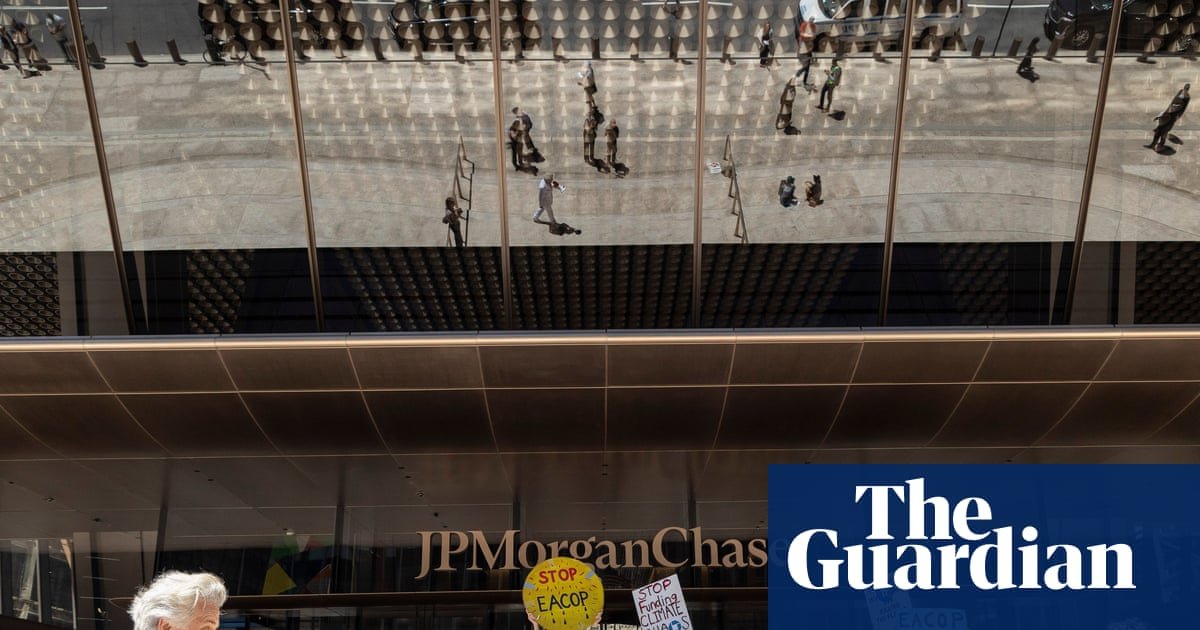
The world’s biggest banks pledged $906 billion in loans to the fossil fuel industry last year, a new report reveals, an “incalculable” increase in investment to secure coal, oil and gas production for many more years as the world continues to heat up.
The surge in new fossil fuel financing is an increase of $64 billion (about 8%) compared to 2024 and shows that the world’s 65 largest banks are making decisions that are at odds with international agreements to limit global temperature rise, according to a coalition of environmental groups behind the new analysis.
JPMorgan Chase invested $58 billion in the sector last year, a 13% increase from 2024, making it once again the world’s leading financier of fossil fuels, according to its annual Banking on Climate Chaos report.
Bank of America was the second-largest investor in fossil fuels last year, followed by Japanese banks MUFG and Mizuho Financial. Fellow US bank Citigroup was in the top five, while Barclays was the highest ranked UK bank at number eight.
October 11, 2025, Bank of America Tower in New York. Photo: Bloomberg/Getty Images
“Last year was the first year where we expected a continued decline in historic numbers, but we actually saw an increase, and that continues into this year,” said Caleb Schwartz, a policy analyst with Rainforest Action Network, one of the groups that authored the report. “So this is a worrying trend.”
Asked for comment on fossil fuel financing, a JPMorgan Chase spokesperson said: “As one of the world’s largest energy financiers, we support a full range of energy solutions and technologies with a focus on reliability, affordability, safety and long-term resilience. We believe our data reflects our activities more comprehensively and accurately than third-party estimates.”
In 2015, countries agreed in the Paris Climate Agreement to try to avoid global temperatures rising by more than 1.5 degrees Celsius above pre-industrial levels, beyond which the world would experience more devastating heat waves, floods, droughts and other climate change disasters.
Enbridge terminal and pipeline next to the Suncor Energy refinery in Alberta, Canada, August 23, 2023. Photo: NurPhoto/Getty Images
To avoid such a threshold, global warming emissions from fossil fuel production must be reduced to near zero. But since the Paris Agreement, the world’s biggest banks have pumped $8.7 trillion into the fossil fuel industry to drill more coal, oil and gas.
Scientists now predict that the 1.5°C limit will soon be breached, with the recent string of record-hot years set to be exceeded further this decade.
Some of the world’s biggest fossil fuel companies have reported soaring profits this year as the global cost of oil and gas soars in the wake of the U.S. and Israeli attack on Iran.
“The fossil fuel establishment is not going to sit on its hands,” said Nico Luciani, a climate and energy expert who compiled this year’s report. “They are doubling down on expanding our increasingly fragile, unreliable and dangerous energy systems.”
A new report finds that fossil fuel financing is becoming more concentrated among a select group of large institutions, with what environmental groups call the “Dirty Dozen” responsible for 40% of all industry funding. Nearly all fossil fuel financing comes from six jurisdictions: the United States, Canada, Japan, China, the United Kingdom, and the European Union.
A total of 26 of the top 65 major banks cut fossil fuel lending last year, with European banks BNP Paribas, UBS and La Caixa leading the way.
Seabirds fly around the Venture Global LNG facility at Cameron Pass, near Cameron, Louisiana, on April 13, 2022. Photo: Washington Post/Getty Images
But major oil and gas operators are not short on available cash, with major banks last year pledging $508 billion to expand existing fossil fuel facilities, a 27% increase over 2024. Three U.S. oil and gas companies, Venture Global, Enbridge and Energy Transfer, were the biggest borrowers in 2025.
Several large banks have previously announced goals to reduce emissions and limit financing for particularly dirty energy, such as coal. But amid a political resurgence by Donald Trump, who calls the climate crisis “bullshit” and calls for unfettered fossil fuel extraction, banks are turning their backs on previous environmental commitments.
Last year, the Net Zero Banking Alliance, a United Nations-backed plan aimed at aligning bank lending with a net-zero emissions scenario by 2050, disbanded after a number of high-profile membership withdrawals.
“We have seen many banks quietly or more loudly turn their backs against the backdrop of political pressure, especially in the United States,” Rugiani said.
He added: “The era of voluntary commitments is not working at the scale we need. This signals a more active role for financial regulators, legislators and policy makers, especially in the six largest financial centres.”
In response to a request for comment, a Bank of America spokesperson said the bank “supports a broad range of customers across both renewable and conventional energy sectors by providing capital and advice to achieve their goals, including advances in clean energy technology and ensuring energy affordability and security in an increasingly complex and dynamic environment.”
Meanwhile, a Citi spokesperson said the company is “supporting our customers’ low-carbon transition, recognizing the real need for safe, affordable and reliable energy today. We are committed to achieving net-zero financed emissions by 2050 and advancing our $1 trillion sustainable finance goal, with a focus on balancing the transition and global energy resilience.”
