


Hidden Gem Collector 13,800 feet above sea level Burj Khalifa 2,720 feet Empire State Building Length 1,450 feet Return Pipe Length 3,940 feet Hidden Gem Collector Sediment Plume
The unusual ship Hidden Gem set sail in late 2022 to test a bold idea: how to mine precious minerals from the ocean floor.
The unusual ship Hidden Gem set sail in late 2022 to test a bold idea: how to mine precious minerals from the ocean floor.
The ship headed for the vast waters of the Pacific Ocean. There, there may be more nickel, cobalt and manganese under the sea floor than all known land-based deposits combined.
The ship was designed to collect metals essential for everything from weapons to electric cars. But critics say the mining could harm vulnerable marine life.
Hidden Gem’s mission was to lower a bus-sized collection vehicle to a depth of more than two miles in one of the least studied locations on Earth.
Such testing is becoming more important this year because the United States is doing something no other country is doing. The Trump administration is widely expected to soon issue the world’s first commercial license to mine on the high seas, waters that no country can claim.
However, seabed mining is not only technically complex but also expensive. And environmentalists say more research is needed before industrial activity begins on the ocean floor.
The United States is moving forward despite opposition from other countries that have tried for decades and failed to agree on global standards for mining on the high seas. Experts say Trump’s plan to boost U.S. mining last year could encourage other countries to abandon the international status quo to keep up in the race to the ocean floor.
At the heart of all this is the Clarion-Clipperton Zone, which spans 1.7 million square miles of the Pacific Ocean and covers the ocean floor with precious fist-sized nodules filled with important minerals and mysterious marine life.
The expedition there was operated by The Metals Company, a Canadian company at the forefront of the seabed mining race. The company sent “Hidden Gem” to one of the world’s first modern deep-sea mining efforts to test its complex technology.
Hidden Gem Collector 13,800 feet above sea level Burj Khalifa 2,720 feet Empire State Building Length 1,450 feet Return Pipe Length 3,940 feet Hidden Gem Collector Sediment Plume
The first step in the 2022 trial was to lower the collector to the ocean floor more than three miles deep.
The first step in the 2022 trial was to lower the collector to the ocean floor more than three miles deep.
This world is dark and quiet, and the ocean floor is covered in precious polymetallic nodules.
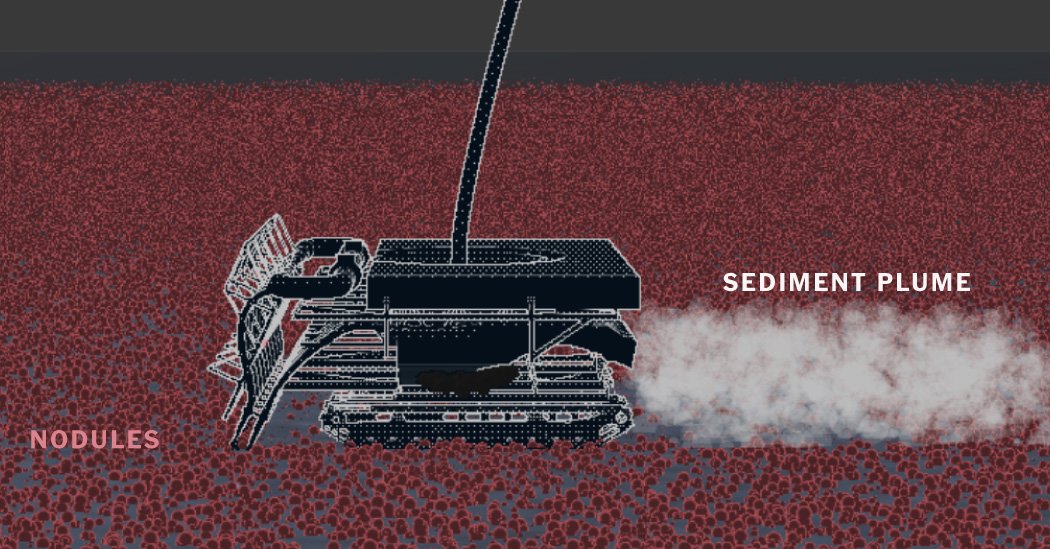
As the collector sucks in the nodule, it exhales a plume of sediment behind it. Environmentalists say the plume is endangering marine life.
The Trump administration’s plan to issue mining permits on the high seas is controversial. Most countries cooperate on issues concerning the high seas through a decades-old United Nations treaty called the Law of the Sea. However, the United States has not ratified the treaty and maintains that it has the right under U.S. law to issue mining permits outside its territorial waters.
The United States has received more than a dozen applications from companies wishing to mine or explore for minerals in the ocean. The National Oceanic and Atmospheric Administration recently determined that The Metals Company’s application merits consideration, paving the way for approval within a year.
The nodules that the industry is looking for take millions of years to form. They were once fragments of animal bones, shark teeth, shells, and rock fragments deposited on the ocean floor, but over time they accumulated a dense mineral coating consisting of metal particles suspended in the water. Billions of tons of these mineral-rich nodules are thought to exist.
Although they are difficult and expensive to mine, the arguments for doing so are simple. The world needs more metal. Demand for nickel, cobalt and manganese is likely to increase as countries invest in clean energy technologies such as batteries and other emerging industries.
“There is no sustainable mining. You are essentially extracting a finite resource,” said Michael Clarke, environmental manager at The Metals Company. But in almost every way, offshore mining is more ethical compared to the pollution and human rights abuses associated with land-based mining, he said.
Critics dispute these claims, arguing that environmental damage from deep-sea mining can last for decades or more. The deep ocean floor is one of the least studied and understood regions on Earth, with scientists estimating that less than 0.001 percent of it has been observed in this part of the world.
Scientific studies, including those funded by the Metals Company and other mining groups, show that bottom life in the Clarion-Clipperton Zone is beautiful, diverse, and slow to recover.
Hidden Gem Collector 13,800 feet above sea level Burj Khalifa 2,720 feet Empire State Building 1,450 feet Return Pipe Length 3,940 feet Hidden Gem Collector Sediment Plume Sponge and Sea Star 5 inches
Many species live in nodules. And when the nodule is removed, the animal is also removed.
Many species live in nodules. And when the nodule is removed, the animal is also removed.
To reduce the pressure on the soft ocean floor, engineers added giant blocks of foam to the heavy collectors to give them buoyancy.
Still, the collector left footprints up to 2 inches deep, shallower than other devices, but enough to kill or displace the animals that live there.
A scoop of deep-sea sediment reveals that many of the organisms previously unknown to science are tiny.
“In the past, people thought it was impossible for anything to survive in the deep sea,” says Eva Stewart, a deep-sea biologist at the Natural History Museum in London, who participated in the Metals Company-funded research expedition. Scientists like Dr. Stewart suspect there are thousands of animals waiting to be discovered. “We just haven’t seen them yet,” she said.
What we saw was otherworldly. A kaleidoscope of corals, sponges, insects, and other animals inhabit the nodule itself.
In the surrounding abyss, scientists have discovered molluscs, snails, worms, sea cucumbers, isopods, starfish, and more.
A study published independently by Dr. Stewart and colleagues in the journal Nature Ecology and Evolution found that mining reduces the abundance and diversity of some deep-sea animals by more than 30 percent. Preliminary results from other researchers indicate that mining may occur where some animals live.
Proponents of deep-sea mining argue that the oceans are vast and that the effects found in the 2022 test are isolated. Environmentalists say commercial mining will take place on an even larger scale. Hidden Gem recovered approximately 3,000 tons of nodules. If the industry does well, it could collect millions of tonnes a year, the company says.
Hidden Gem Collector 13,800 feet above sea level Burj Khalifa 2,720 feet Empire State Building Length 1,450 feet Return Pipe Length 3,940 feet Hidden Gem Collector Sediment Plume
The nodules were aspirated into the collector through a series of nozzles.
The nodules were aspirated into the collector through a series of nozzles.
Then they entered the hopper inside the collector.
From there, the nodules were sucked up to the surface through a miles-long industrial straw.
A small amount of sediment also reached the ship. It was pumped back into the water at about 4,000 feet, creating a second plume.
Potential pollution from the mine, particularly the two sediment plumes, has been a flashpoint of speculation and concern.
Critics once worried that the initial plume – the one that forms behind the collector as it moves along the ocean floor – could create a billowing cloud of mud that could travel long distances and suffocate life along the way. Several studies, including one during the 2022 Hidden Gem expedition, found that the majority of plumes are deposited within mining sites, although some particles can travel for miles. The impact was smaller than experts expected, but could still affect some marine life.
Scientists who studied a second plume produced from sediment pumped aboard the ship found that the mud particles could starve small zooplankton, causing cascading effects throughout the ocean food web. Metal companies disputed this claim, arguing that the plume spread too quickly to cause any problems.
The company said it plans to avoid this risk during commercial operations by emitting plumes thousands of feet farther than during testing to avoid most animal lives. But researchers say the effects of the plume at that depth have not been studied.
Even if U.S. regulators grant a license this year, commercial mining would likely still be years away. Mining fleets do not yet exist, and few refineries have proven capable of converting nodules into something usable. Environmental groups are expected to challenge any U.S. license in court, and a future U.S. administration could withdraw support for the industry.
Despite all these challenges, the deep-sea mining industry continues to press forward with the determination to build technology that is straight out of science fiction for generations.
In 1870, Jules Verne wrote 20,000 Leagues Under the Sea, the story of Captain Nemo, who sails an electric submarine to the lost city of Atlantis, powered by batteries made from elements extracted from the sea.
Captain Nemo said, “The sea is everything,” and while it is a treasure trove of vast resources ripe for exploitation, it is also “a vast wilderness in which man is never alone, because he can feel the pulse of life all around him.”
The collector used in the test mission was half the size of the 250-ton, 39-foot-long commercial version shown in this article. The size of the nodule was increased to improve visibility. The collection vehicle is lowered by a cable and the nodules are returned to the surface by another pipe. For clarity, the figures in this article do not show both at the same time.
Source: Global Fishing Watch vessel tracking data. Allseas ships and collectors 3D models. Photographs of marine life from the Natural History Museum and the University of Gothenburg.
