


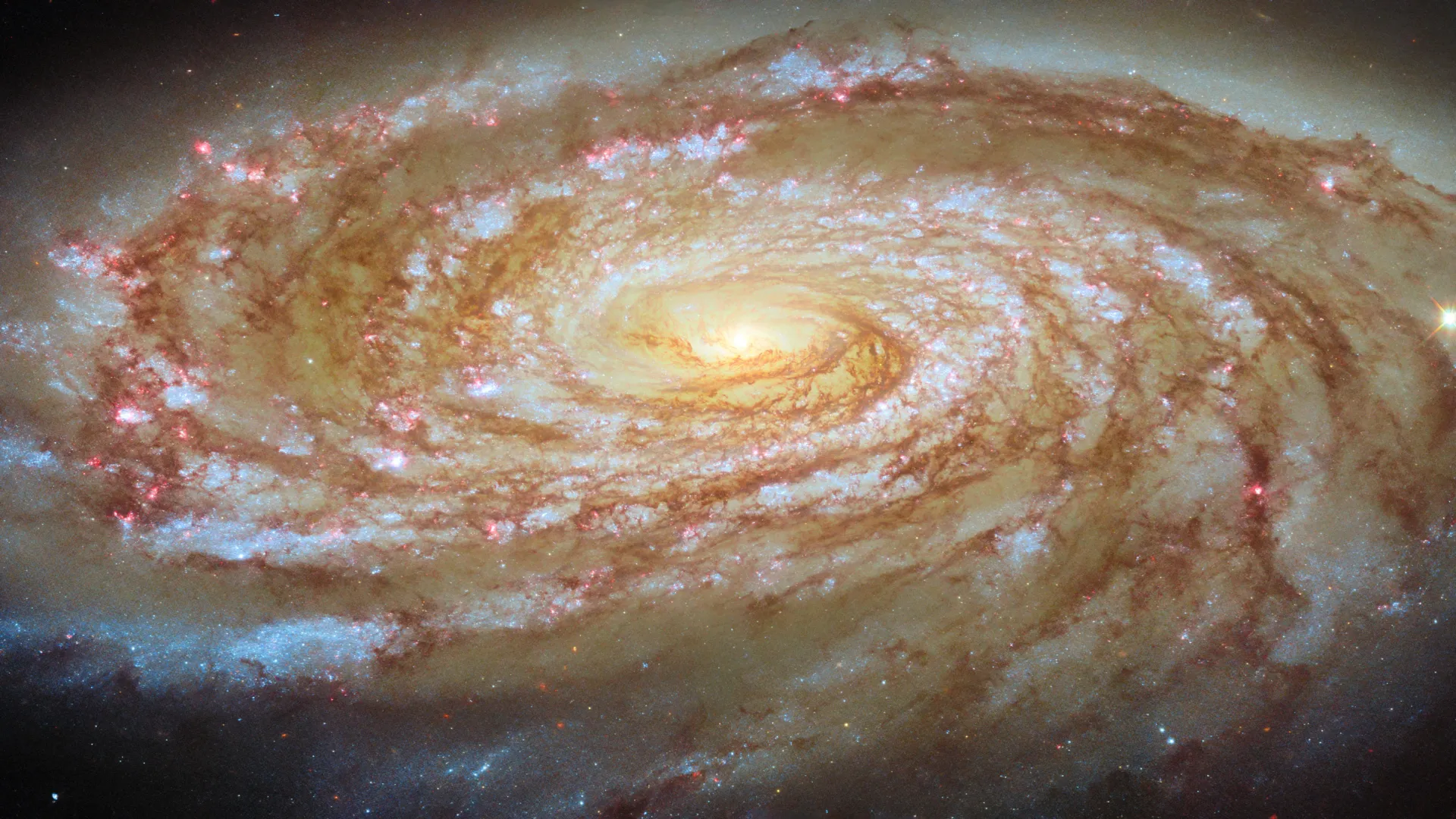
A striking new image from the NASA/ESA Hubble Space Telescope highlights Messier 88 (M88), a spiral galaxy embarking on a journey that will unfold over hundreds of millions of years. M88, also known as NGC 4501, is located approximately 63 million light-years from Earth in the constellation of Coma.
M88 is classified as an active galaxy because the supermassive black hole at its center is actively consuming gas and dust. Scientists estimate that this black hole contains about 100 million times the mass of the Sun. As it feeds, it appears to push streams of gas outward from the galaxy’s center.
The black hole is surrounded by a cluster of old, reddish stars that create a warm glow at the galaxy’s center. Extending outward are several tightly wound spiral arms arranged in a strikingly symmetrical pattern. These arms are lined with bright pink and blue star clusters and dense clouds of dust. Because M88 is viewed obliquely from Earth, the galaxy appears elongated, its spiral structure extending gracefully across space.
M88’s Journey to the Virgo Cluster
M88 is part of the Virgo Cluster, a vast collection of more than 1,000 galaxies held together by gravity. Within this huge cosmic collection, galaxies are constantly moving as they orbit the cluster’s center of mass.
This movement placed M88 on a long path toward the inner regions of the cluster. The journey will take hundreds of millions of years, but astronomers expect it to have a major impact on the galaxy’s future.
Future encounter with Messier 87
M88 is currently about 2 million light-years away from the center of the Virgo cluster. Moving inward, it is expected to approach Messier 87 within approximately 200 million to 300 million years. M87 is a giant elliptical galaxy that dominates the galaxy cluster.
As M88 approaches this gravity giant, it will encounter a violent process known as ram pressure stripping. This happens as galaxies move through the hot gas that fills the galaxy cluster. The pressure created by that movement could wipe out large amounts of gas in the galaxy itself.
Signs of change are already visible
Astronomers have already found evidence that ram pressure separation is influencing today’s M88. Observations show that the galaxy’s rotating disk of gas appears to be shortened and compressed along its leading edge. There, gas and dust pile up like snow in front of a snowplow.
The researchers also found that M88 contains significantly less cold gas than would be expected for a galaxy of its size, especially in its outer regions. Cold gas acts as the raw fuel needed to create new stars. This deficiency suggests that M88’s journey through the Virgo cluster has already changed its ability to form stars, shaping its long-term evolution.
Hubble studies the evolution of galaxies
Scientists observed M88 as part of the Hubble Observation Program (#18103; Principal Investigator: D. Thilker), which focuses on understanding how spiral galaxies evolve in the crowded space environment.
The project will use Hubble’s Wide-Field Camera 3, an instrument that can resolve individual star clusters and nebulae in galaxies tens of millions of light-years away. By studying galaxies in such detail, researchers can better understand how movement within galaxy clusters affects star formation and causes long-term evolutionary changes.
