


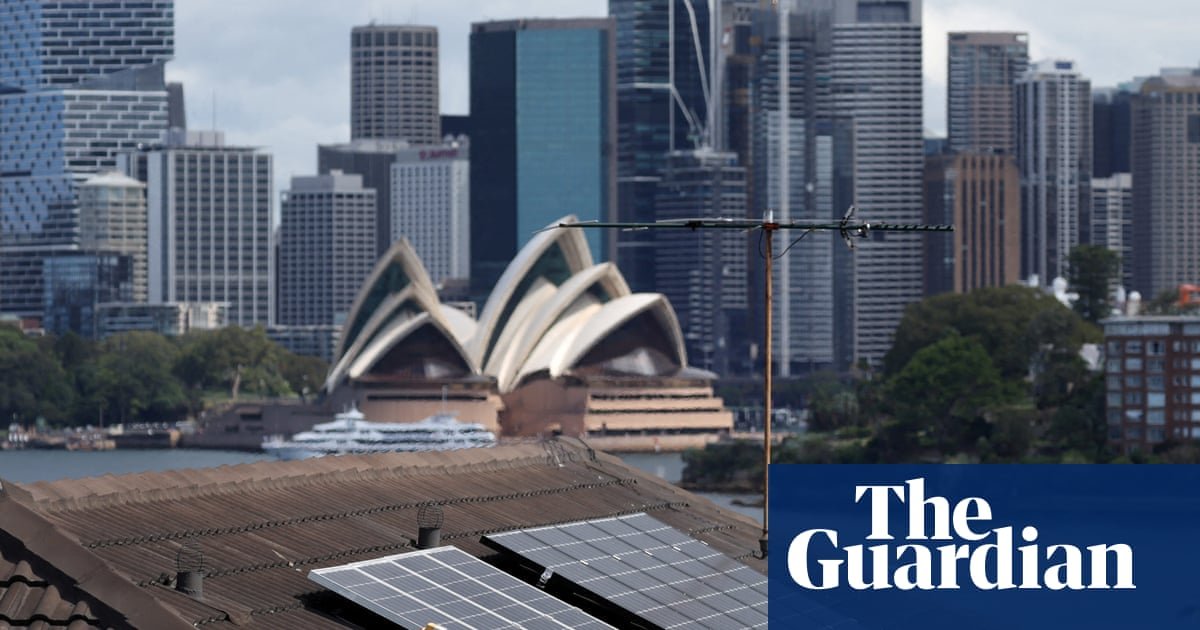
The timing was rich in symbolism. Two large chimneys at one of Australia’s biggest power stations are being demolished as an intense heatwave sweeps across Europe and Asia, sending oil markets around the world soaring and into disarray. Meanwhile, Australia’s energy minister held a press conference to praise benchmark electricity prices that had fallen by up to 10% in some parts of the country.
Quietly, and with surprisingly little fanfare from the rest of the world, Australia is pioneering a revolution in home renewable energy and battery usage, proving what is possible with the right policies. The country is already one of the world leaders in domestic solar power generation, with one in three households having panels installed. However, the country remains a major contributor to the climate crisis through its vast fossil fuel exports. But it’s batteries that are bringing new speed to Australia.
According to a recent analysis, nearly 60% of the installed household battery capacity in around 200 countries (all countries except China) will be installed in the southern continent this year. Approximately 415,000 people have connected since July. This equates to one unit in every 25 homes in Australia.
Industrial-scale batteries are also being manufactured at about the same pace, and Australia (population 27 million), where connectivity more than doubled last year, trails only China (1.4 billion) and the United States (350 million) in new production capacity. Increased use of batteries, both large and small, is starting to bring down the cost of electricity from the country’s long, narrow power grid. The grid includes more than 40,000 kilometers (24,850 miles) of power lines and cables between the tropical far north state of Queensland and the southern island state of Tasmania.
The chimney of the decommissioned Liddell power station has collapsed during controlled demolition. Photo: AGL
“This is surprising,” said Tristan Edith, author of the analysis and director of consultancy Green Energy Markets. “It shows us once again that if you go big with technology and start big from the beginning, you can really make a big difference. If you’re a battery manufacturer focused on residential right now, you need to focus on Australia.”
Battery storage counters the long-standing argument against renewable energy that renewable energy is unpredictable and intermittent, placing extra strain on the country’s power grid, which must install expensive backup sources such as gas. Instead, batteries mean that solar power can be stored and used when needed.
From the beginning of the renewable revolution, batteries were envisioned as a key piece of the puzzle. Homes will have panels on their roofs to capture and convert solar energy, and batteries inside the home to store energy and use it when needed. But while the price of solar panels dropped rapidly several years ago, it’s only in recent years that batteries have become similarly available and affordable. The US-Iran war and subsequent rise in energy prices have highlighted the benefits of such renewable technologies, and the number of installations around the world is on the rise from a meager number a few years ago (Arsenal’s soccer field is an unlikely pioneer). China is far ahead, spending more than all other countries combined. But among the rest, Australia stands out.
Australia is a world leader in solar energy generation per capita. Photo: Bloomberg/Getty Images
Previously, electricity prices would spike in the evenings as gas-fired power generation, the most expensive form of energy generation on Australia’s grid, was turned on to meet peak demand. Currently, nearly half of the country’s electricity is provided by solar and wind power, with coal-fired power plants gradually being shut down and gas being used to fill the gap after sunset.
But batteries are increasingly taking over that role. Total gas-fired power generation was down 24% during the three months of this summer compared to a year ago. “It’s completely changed the way electricity prices are formed,” said Tennant Reid, director of climate change and energy at Australian Industry Group, which represents more than 60,000 companies.
“Earlier, the role of gas was played in the evening to coincide with the evening peak, which was costly as gas is not a cheap fuel. But increasingly, it is batteries that flood the market at 6pm every day,” he says. “Gas still plays a backup role, but on average batteries are not as expensive as gas peaks, so batteries are displacing them (gas plants) even as electricity demand increases.”
To be fair, increased battery usage has been possible in part because Australia is the world leader in home solar power per capita, but no government is making this happen. By the happy accident of uncoordinated policies, more than a third of homes now have panels installed. Easy and quick permitting and widespread public support. Of course, Australia is blessed with sunshine, but in warmer countries solar power production may not be as productive.
As the price of solar panels has become cheaper, the number of solar panel installations around the world is rapidly increasing. Photo: Fairfax Media
But Dave Jones of energy analysis organization Ember says this is a global story. “Home battery storage is in the midst of a revolution, with large, grid-scale batteries plummeting in price over the past two years, their quality has improved significantly, they contain significantly less important minerals, they have a much longer lifespan, and they pose almost no fire risk. That is now reflected in the home battery market, and today’s home batteries are much better than the home batteries of a few years ago.”
“Already in California, throughout 2025, batteries produced more solar power in the evening than during the lunch hour,” Jones said. “Batteries are now powerful enough to provide 24×365 power, and the largest 1GW 24×365 plant is under construction.”
The battery revolution wasn’t free. It was driven by large taxpayer subsidies from Anthony Albanese’s Labor government. Since July last year, it has pledged to spend A$2.3bn (£1.4bn) over four years to cut upfront costs for households by 30%.
The rebate was expected to support the installation of one million batteries by 2030, but it quickly became clear that this was unrealistic. More than 1,000 batteries are installed every day, and usage is far exceeding expectations.
Solar power household battery and inverter installed on the wall of the house. Photo: Douglas Cliff/Getty Images
Facing calls from political opponents to cut the program to cut costs, the government announced in December that it would cut rebates on large batteries but increase total funding to A$7.2 billion to continue until the end of the decade. The overall objective was now doubled to a 2m battery.
Some critics saw this revamp as a missed opportunity. Western Sydney University senior researcher Thomas Longden, who has studied where batteries have been installed, said the government should have used batteries to ensure they were rolled out across the country, rather than favoring the wealthy.
“Do we care where these batteries go? I think we should,” Longden says. “We need to have batteries across the country, not just in some of the biggest cities. If that means this plan is better targeted, albeit slower, as part of a rapid and fair transition, then that’s something we should consider.”
Climate Change and Energy Minister Chris Bowen has acknowledged that the program does not directly reach everyone, with renters in particular effectively excluded. But he said the system had been embraced in and around the Western Sydney constituency, which is not an affluent part of the city, and insisted the program was an investment for the whole country. “If people[with batteries]don’t ask for gas at night or use less gas, it lowers rates for absolutely everyone.”
The government is also seeking to harness surplus solar power and quell anger over rising living costs by announcing a “solar sharer” program that will require electricity retailers to provide three hours of free electricity a day to all customers, including renters. While the move has been widely welcomed, there are concerns that the savings will be eroded if utilities respond by raising other rates.
A battery tower inside a residential garage in Byron Bay, New South Wales. Photo: James D. Morgan/Getty Images
Emma Hewitt is also one of the beneficiaries of the battery scheme. The single parent, who lives with her seven-year-old daughter in Perth’s south, was in the process of electrifying her home by installing solar panels, replacing her gas stove and leasing an electric car through her employer when the grant was announced. This prompted Mr. Hewitt, a local government employee, to obtain an interest-free loan to cover the remaining cost of the 16kWh energy storage unit. This has allowed us to reduce our dependence on the power grid and save hundreds of dollars on our quarterly electricity bills.
“I don’t have a lot of savings, but I can afford to pay for everything from my paycheck,” she says. “This is something I’ve wanted to do for a while because I’m concerned about the planet that my daughter will inherit and the incredible damage that burning fossil fuels is doing to it.”
This large-scale battery facility was operated in the Australian state of Victoria and was intended to transform Australia’s electricity grid to replace fossil fuels with clean electricity. Photo: Bloomberg/Getty Images
The battery revolution has also given solar panels a boost, just as some state subsidies have been eliminated. Against all odds, records for Australian solar installations were set in March as people replaced aging panels with new, larger panels to get the most out of their energy storage systems. That record was broken again in April.
Australia’s emergence as a household energy powerhouse has not changed its continued support for fossil fuel expansion. Albania’s government has approved 36 polluting developments since elections four years ago and remains one of the world’s leading exporters of coal and gas.
It also faces challenges in deploying large-scale wind and solar power plants. Industry lobbying group the Clean Energy Council warned this week that while multiple records will be broken in 2025, commitment to new development is at its lowest level in a decade due to uncertain investment markets and grid connection delays and rising costs.
This means that the government’s goal of getting 82% of its electricity from renewable sources by 2030 remains in doubt.
But battery manufacturing shows little sign of slowing down. That change is evident at the site of the now-destroyed Liddell coal stack, which collapsed spectacularly this week.
Energy company AGL, long Australia’s most polluting fossil fuel company, has commissioned a 500 megawatt, two-hour battery system to replace it. Full-scale commercial operations are scheduled to begin next month.
Alison Reeve, director of the energy and climate change program at the Grattan Institute think tank, says this is a stunning example of how the energy system has been rewritten almost overnight. In the new model, households are not just consumers, but also producers and market players. Older forms of power generation are increasingly being phased out. And the advent of longer-lasting batteries means that previous criticisms of solar energy that the sun doesn’t shine at night will be “blown out of the water.”
“This is a big change in the way energy markets operate. The message is that if you can make rooftop solar happen, you can make a lot of other changes very easily. And storing energy makes the system even more flexible,” she says. “We just found a new way to do it.”
