


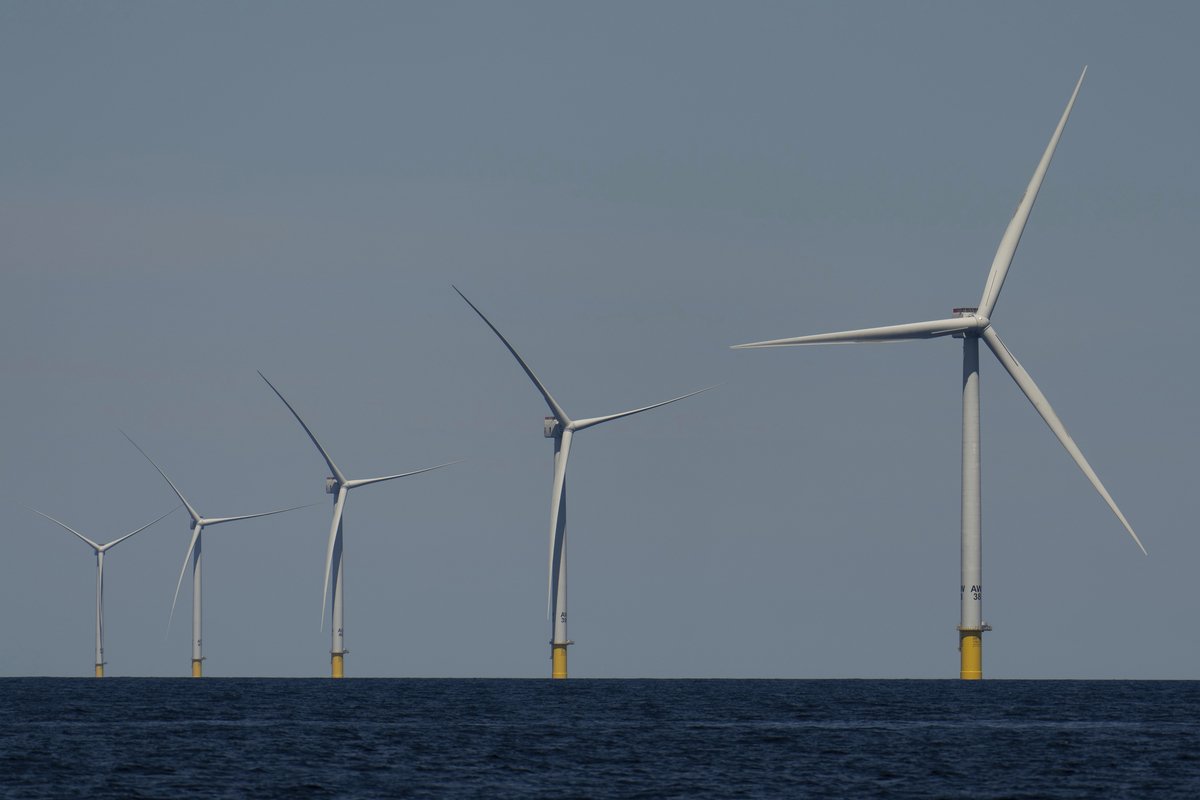
House Republicans’ Interior Department spending bill includes massive new fees that could be another blow to the struggling offshore wind industry.
The fiscal year 2027 environmental spending bill proposed by the House Appropriations subcommittee last week would impose various fees on offshore wind projects. These are divided into annual membership fees and physical inspection fees.
Annual fees range from $7,300 for an onshore inspection visit to an offshore wind project’s control center to $15,400 for a visual inspection of a wind turbine. Further physical inspection of the wind turbine or substation will cost $72,800.
The new fees largely reflect the White House’s Interior budget proposal released in March. The language requires turbine-by-turbine inspections, and given that wind farms contain large numbers of turbines — 62 for the new Vineyard Wind project off the coast of Massachusetts and more than 170 expected for the project under construction off the coast of Virginia — the fee could be much higher than what offshore oil companies pay for inspections.
“This appears to be another direct effort to rein in the offshore wind industry,” Timothy Fox, managing director of Clearview Energy Partners, said in an email. “The Trump administration has already placed significant restrictions on proposed offshore wind projects and may be hoping that inspection costs will undermine the viability of projects already in operation.”
Inspection fees and other similar charges are common in the energy sector, and wind industry officials have long expected a tariff structure to be introduced soon. Offshore wind power did not take off in the United States until the Biden administration, and several projects are currently under construction along the East Coast. Vineyard Wind completed construction in March and is working to have all turbines operational. Meanwhile, Revolution Wind off the coast of Rhode Island has nearly installed all 65 turbines and is beginning to send power to the grid.
But the Trump administration has hurt wind energy by canceling leases, trying to block projects currently under construction and paying companies to abandon plans.
A Home Office spokeswoman declined to comment on the wording of the fee. A spokesperson for the Republican appropriator did not respond to a request for comment.
The fee will be overseen by the government’s planned new agency, the Marine Minerals Authority. The agency combines the Office of Ocean Energy Management and the Office of Safety and Environmental Enforcement to oversee offshore oil and gas and wind power generation.
Officials wrote in the administration’s budget justification that the new fees were necessitated by the expansion of offshore wind power under the Biden administration.
“Based on this expansion, the MMA is proposing an inspection fee to offset the cost of the MMA to ensure that offshore wind operators are not subject to different standards than oil and gas companies,” the administration wrote in its budget justification.
But Congressional Democrats, analysts and former officials are skeptical that the rates are intended to level the playing field, saying they instead appear to reflect President Donald Trump’s antipathy toward wind energy.
At last week’s Interior and Environment subcommittee hearing, ranking member Rep. Cherry Pingree (D-Maine) criticized the bill for not thwarting the Trump administration’s efforts to crush the wind industry, noting that the bill appears to be “loaded with additional fees for offshore wind companies.”
Pingree said in an email that the Trump administration needs to answer questions about the language of the fees, including why offshore wind farms have higher physical inspection fees than oil and gas companies and how the fees are implemented.
“This proposal does not appear to be designed with fairness to taxpayers in mind, and appears to be layering yet another barrier to renewable energy on top of the government’s broader efforts to support fossil fuels,” she said.
The bill’s language is also unclear about when visual and physical inspections would be required. The Office of Management and Budget, which oversees the White House’s budget proposals, did not respond to questions about how the fees would work.
“The lack of clarity and predictability around offshore wind inspection costs is concerning,” said Pasha Feinberg, offshore wind strategist at the Natural Resources Defense Council.
Analysts quickly realized that fees for certain projects could quickly become expensive if collected on a per-turbine basis.
For example, utility company Dominion Energy is installing 176 turbines at an offshore wind project off the coast of Virginia. On a per-turbine basis, if all turbines are included, the project could cost anywhere from $2.7 million to $12.8 million, depending on the type of inspection.
Dominion did not respond to a request for comment.
By contrast, annual fees for offshore oil and gas operations under the bill have remained roughly the same over the years and are not charged on a per-well basis.
Current annual fees for offshore oil and gas projects maintained in the House Republican spending plan amount to $10,500 for structures with no wells, $17,000 for structures with one to 10 wells, and $31,500 for structures with 10 or more wells. Drilling rigs have other charges depending on water depth. A shallow water rig inspection costs $16,700 and a deep water rig inspection costs $30,500. Testing a well operating without a rig under this bill would range from $4,470 to $13,260, depending on water depth.
Under the bill, offshore wind developers could pay millions of dollars to have BSEE employees board helicopters and visually inspect dozens of turbines, said Elizabeth Klein, who led BOEM in the Biden administration.
“That’s crazy,” she said, adding that oil and gas rates “are nowhere near what we can offer here.”
Klein also said the fee for a physical inspection of the turbine, which is more than double the cost of inspecting the rig, also seems odd given how large deep-sea drilling rigs can be.
Other critics said the fees did not reflect the potential environmental damage from the accident. Offshore wind power generation also suffers from accidents such as broken turbine blades, but the environmental damage caused by oil spills is often far greater.
Jeremy Firestone, a professor at the University of Delaware’s School of Ocean Science and Policy, said offshore oil and gas rates and wind energy rates are not comparable “given the much greater risks associated with catastrophic failure.”
“Different amounts of energy produced by each turbine and each rig will result in different economic outcomes,” Firestone said. “The fees seem to be very high.”
Spokespeople for the U.S. Clean Power Association and the National Marine Industry Association, two trade groups representing major clean energy developers, declined to comment. The American Petroleum Institute also did not comment on the proposed wind energy rates and how they compare to oil and gas rates.
Other offshore wind developers – including Equinor, the builder of New York’s Empire Wind. Ørsted, builder of several projects. Vineyard Wind, a company jointly owned by Avangrid Renewables and Copenhagen Infrastructure Partners, did not respond to a request for comment.
NRDC’s Feinberg said fees for the wind industry are appropriate, but they should be “commensurate with the cost and risk of testing.”
“The potential impact of offshore oil and gas failures has far-reaching implications,” Feinberg said.
“Given the current administration’s relentless attacks on renewable energy, it is concerning that offshore wind prices are so much higher than oil and gas prices,” she added. “If these fees are intentionally excessive and used as a weapon by governments to harm wind energy projects, then the clean energy we need now will be cut even further than ever before.”
Jennifer Yachnin contributed to this report.
