


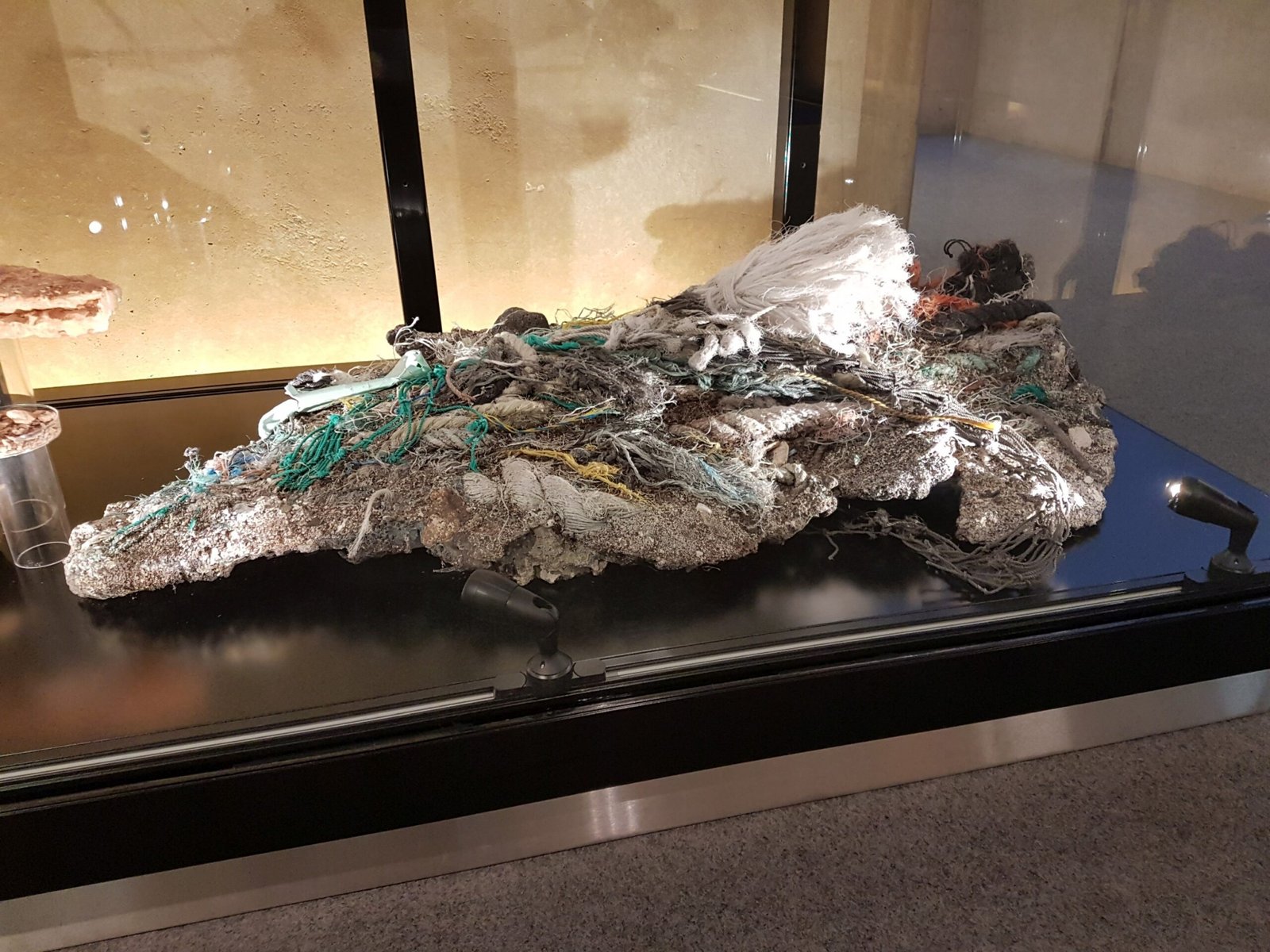
- Researchers have documented evidence of a plastic-rock hybrid at Divegarh Beach in Maharashtra.
- The plastic filaments embedded in the rock were found to be made of nylon, suggesting they came from discarded fishing nets.
- This discovery highlights a significant shift in that plastics are no longer just pollutants, but are actively involved in the deposition process.
See all ideas that matter
In May 2024, the research group set out along the coast of Divegarh Beach in Raigad district, Maharashtra, in search of rare rock formations. As they walked, they carefully carved out rock outcroppings where the plastic waste was trapped, collecting samples and later transporting them to a lab for analysis. One of these samples had a green plastic net embedded in the rock, which researchers recently reported as the first evidence of “plastistone” (a plastic rock layer) from India’s west coast.
Plastic rock structures have been recorded all over the world, including on the coasts of the Andaman and Nicobar Islands and Tamil Nadu. The geological formations previously discovered in India were mainly plastiglomerates and pyroplastics formed by anthropogenic burning of plastics. In contrast, the researchers suggest that plastone formed through natural processes, where the combination of plastic debris with sediment and biological components was triggered by ultraviolet light, high temperatures, and waves.
This research discover the oceanThey also discovered that the plastic filaments protruding from the rock were polyamide in nature, suggesting that they originated from discarded nylon fishing nets.
Punyaslok Bhaduri, a professor at the Indian Institute of Science Education and Research (IISER) in Kolkata and corresponding author of the study, said plastistone is likely a “new form of sedimentary rock”, adding that this is the first plastistone formation reported from the Indian subcontinent.
According to a 2024 study, India generates an estimated 9.3 million tonnes of plastic pollution every year, accounting for almost one-fifth of the world’s plastic emissions. Widespread plastic production is driving the formation of these plastic-rock complexes, which persist in ecosystems for thousands of years, Baduri explained. “We are seeing increasing records of human signatures on geological structures,” he told Mongabay India.
 In May 2024, researchers discovered the first evidence of plastone (a plastic rock formation) along the coast of Divegarh Beach in Raigad district on India’s west coast. The photo here is a sample collection site. This beach is located near a fishing village and is also visited by tourists. Image courtesy of ITMERG, IISER Kolkata.
When plastic fuses with rock
Baduri was part of the team that discovered plastiglomerates in the Andaman Islands in 2023. The team then focused on Maharashtra, a state known for high coastal pollution loads due to rapid urbanization, tourism, and fishing activities. A 2020 study found higher accumulation of micro and macro plastics on beaches in Maharashtra compared to Karnataka and Goa.
The research team that reported the plus stones collected samples along a 10-kilometre stretch of Devegar Beach. These samples were screened and analyzed using microscopy and spectroscopy. By enlarging the sample, the researchers confirmed that the plastic filaments were integrated with the rock. They then passed infrared light through the plastic to determine its chemical characteristics, explained Nirupama Saini, a PhD student at IISER Kolkata and lead author of the study.
The chemical analysis revealed that Plasstone is made of polyethylene, polypropylene, polyethylene terephthalate (PET), and polyamide polymers. “All of this has an impact on the human body somewhere (health). So there is a biomagnification angle that needs to be understood,” Baduri shared.
Furthermore, the samples showed no signs of burning and were found in low-tide areas, where there is little chance of human-caused fires, suggesting a natural formation process.
During this process, biogenic material, in this case mollusc shells, barnacles, and single-celled organisms called foraminifera, is deposited on top of the plastic waste washed up on the shore and slowly integrates with the rock. This three-way biological and chemical interaction between plastic, biogenic material, and rock is what sets PlusStone apart, Baduri explained. “There’s a direct biological interaction here, so it’s going to be even more magnified in terms of additional damage,” he added.
Further observations showed that some cross sections showed plastic filaments combined with sediment and biological components, likely reflecting the early stages of lithification, the process by which sediment turns into rock. “(This) suggests that plastolith formation is a continuous and gradual process, making this study highly relevant for understanding evolving coastal depositional systems,” said Anish Kumar Warrier, professor of geology at Manipal Institute of Technology. Warrior was not involved in the study. He added that plastone could serve as an indicator of environmental degradation.
Warrior also noted that the formation “highlights a critical transition in which plastics are no longer just pollutants, but are actively involved in the deposition process.”
 Plastistone is formed when plastic debris is integrated with sediment and biological components, possibly through natural processes. In this case, the biogenic materials attached to the plastic-rock complex included mollusc shells (blue circles) and foraminifera (red). The samples also contained microplastics (blue arrow). Image courtesy of ITMERG, IISER Kolkata.
ghost gear problem
The study also highlighted alarming levels of ocean plastic pollution from abandoned, lost or discarded fishing gear (ALDFG), which was previously estimated to account for around 10% of the world’s ocean plastic waste, although some researchers suggest this figure is much higher. Often known as Ghost Gear, it makes up almost half of the Great Pacific Garbage Patch. “The findings in this (plastistone) paper are strongly in line with what we have observed in the field: ghost gear acts as a structural and geochemical factor within coastal ecosystems, rather than just debris,” said N. Pravin Kumar, senior program coordinator at WWF India, who was not involved in the study. These field studies have repeatedly recorded ghost gear deposited along rocky seafloors and trapped in crevices of coral reefs.
“Of particular concern is that these buildups are not temporary,” Kumar said. Modern fishing gear is made from highly durable polymers that are designed to resist deterioration. Only some of this material breaks down into microplastics and enters the food web. The rest remains intact and continues to interact with the environment over long timescales, he explained.
Plastistone can act as a reservoir for microplastics and toxins that slowly leach into the surrounding environment, Kumar added. Saini said that when plastics are incorporated into rocks, their chemical composition and ability to retain heat change. Plastic tends to trap more heat, which can increase the temperature of rocks and affect the breeding behavior of marine life such as crabs and turtles. Research also points out that plastone alters the surrounding microbial community.
The damage these formations could cause is currently speculative, but it will likely be localized, Badoury warned, stressing the need to study their ecological impact.
 Plasstone samples found along the coast of Maharashtra had green plastic webs embedded in the rock. The red circles in the image indicate the points at which this filament is fully integrated with the rock when viewed under a microscope. Figure courtesy: ITMERG, IISER Kolkata.
Need for more awareness
Baduri said plastic waste management and coastal health monitoring needed to be robust, adding that public awareness and participation remained key to the process. “These learnings about plastic-rock complexes are critical to implementing effective implementation and policy. These issues will also help us find new and innovative technological ways to address them.”
The researchers are also planning ways to communicate with state governments on the issue. They have started reaching out to Raigad’s local communities, NGOs, civil society and other organizations working along the coast across India to inform them about this phenomenon and encourage them to report similar findings.
Badoury’s team also plans to expand their research not only inland but also along the coastline. “My hunch is that we’re going to see more of these, and they’re not going to be limited to marine environments. I wouldn’t be surprised if they end up in freshwater ecosystems,” he says.
Banner image: The first plastic-rock hybrid structure, plastiglomerate, discovered at Hawaii’s Kamilo Beach in 2014, is on display at a museum in The Hague, Netherlands. Image by Aaikevanoord via Wikimedia Commons (CC BY-SA 4.0).
Read more: Plastic-rock hybrid discovered in Andaman Islands

