


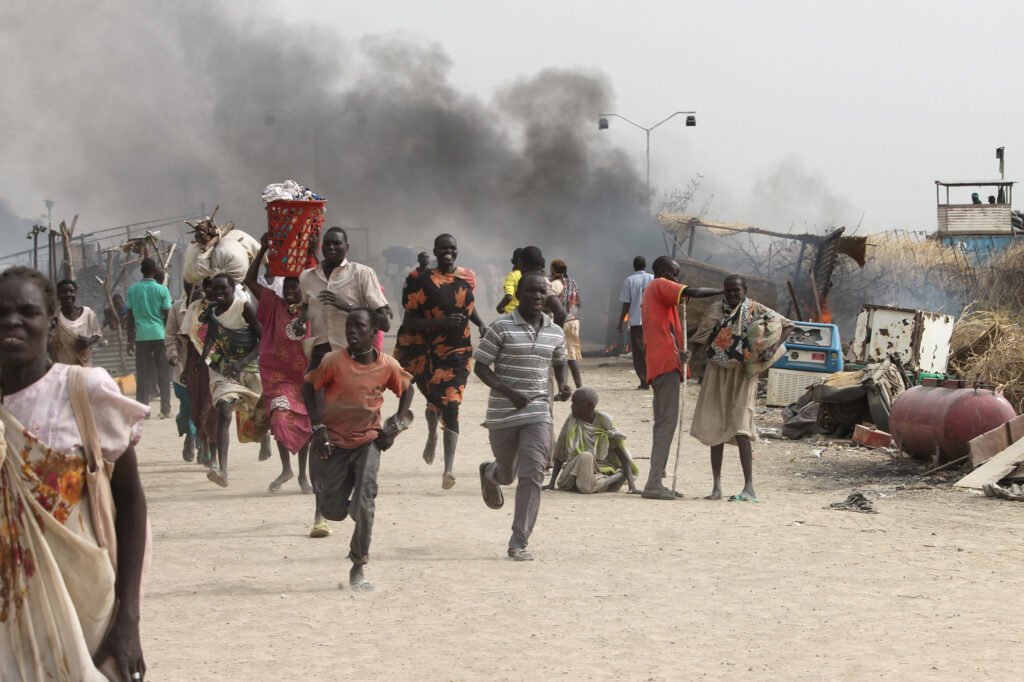
New research supports scientific evidence that extreme weather can increase the risk of armed conflict, especially if drought conditions exceed critical thresholds in vulnerable regions, including parts of Africa and Southeast Asia.
The study, published today in the Proceedings of the National Academy of Sciences, analyzed detailed climate and armed conflict data from 1950 to 2023. The researchers said they found a statistically significant association between conflict and climate impacts from two well-documented natural climate cycles: El Niño in the Pacific Ocean and dipole in the Indian Ocean.
Both are periodic changes in ocean temperature that alter patterns of rainfall, storms, and drought across much of the planet. Scientists say man-made global warming is intensifying many of its extreme effects. Severe climate change has shaped societies for millennia, but disentangling climate effects from factors such as demographic changes, national history, and other economic and social pressures has been difficult.
A new study seeks to clarify the link by treating climate change as a natural climate experiment spanning decades of conflict data. This analysis found associations between climate patterns and changes in conflict risk at both global and regional scales, with three main findings related to El Niño.
First, the risk of armed conflict generally increased during El Niño compared to La Niña periods. Second, conflict risk did not gradually increase as climate impacts intensified. The data suggest that the likelihood of violence increases only when drought conditions exceed a certain threshold. However, the signal varied depending on whether large national regions or smaller local regions were analyzed. Third, the increased risk of conflict is primarily related to El Niño-induced droughts, with regions such as Central America and southern Africa particularly vulnerable.
Droughts are key because human well-being requires water above all else, said study co-author Justin Mankin, an associate professor at Dartmouth College and principal investigator in the school’s Climate Modeling and Impacts Group.
“Dry conditions are inherently stressful,” Mankin said in an email. “The paleoclimate and archaeological record is littered with stories of social stress due to prolonged or severe drought,” he said. Prolonged dry conditions can damage local economies and livelihoods, making it easier for armed groups to recruit in already volatile regions.
He added that the key takeaway from this study is that “we’re not very well adapted to the climate that already exists,” not to mention climate change exacerbated by anthropogenic warming.
On the conflict front, he said the most important work on violence prevention and peacebuilding is being done outside of climate research because socio-political, economic and demographic factors are much stronger determinants of conflict risk than climate. A 2019 study published in the journal Nature found that socio-economic development, state capacity and inequality between groups are likely to cause conflict, he added.
“Climate change means when and where existing vulnerabilities can turn into violence,” he said, warning against broadly framing climate impacts as a security issue, “leading to militarized responses to what should be development, governance and humanitarian issues.”
Mankin said attributing conflict primarily to climate impacts shifts focus away from more important factors such as poor government planning, corruption and institutional failures that determine whether environmental stresses cause violence.
Understanding the effects of known climate change modes like El Niño “is a stepping stone toward predictability in a chaotic climate system,” he said. “With better forecasts, we can imagine faster, proactive humanitarian funding focused on drought-vulnerable areas, rather than waiting until livelihoods are disrupted and people evacuated.”
The climate patterns tracked in this study are part of a much larger Earth system that remains surprising, said co-author Sylvia Dee, director of the Climate and Water Laboratory at Rice University.
Dee, who specializes in comparing data from climate models, said studying even just one part of the puzzle, such as conflicts caused by regional climate change, requires collaboration across research fields, and this paper is a step in that direction.
“People have long argued that climate change is contributing to conflict,” she says. But to really pinpoint the cause, she added, requires input from climate scientists, statisticians, political scientists and social scientists who work directly with those affected.
“I have no doubt that it can be resolved,” Dee said. “But I don’t know if that’s going to happen until people put everything that’s going on in their heads together.”
She added: “Humanity has proven that we can solve really serious problems if we are pushed with enough urgency.”
About this story
As you may have noticed, this article, like all news we publish, is free to read. That’s because Inside Climate News is a 501c3 nonprofit organization. We don’t charge subscription fees, keep our news behind paywalls, or fill our website with ads. We provide climate and environmental news free to you and anyone who wants it.
That’s not all. We also share our news for free with dozens of other news organizations across the country. Many of them cannot afford to do environmental journalism themselves. We’ve established bureaus across the country to report on local news, partner with local newsrooms and co-publish stories to ensure this important work is shared as widely as possible.
The two of us started ICN in 2007. Six years later, we won the Pulitzer Prize for national reporting and now run the nation’s oldest and largest dedicated climate newsroom. We tell the story in its entirety. We hold polluters accountable. We expose environmental injustice. We debunk misinformation. We explore solutions and inspire action.
Donations from readers like you fund all aspects of our work. If you haven’t already, will you support our ongoing work, our coverage of the biggest crises facing our planet, and help us reach more readers in more places?
Please make a tax-deductible donation. Any of those things make a difference.
thank you,

bob berwin
reporter, austria
Bob Barwin is an Austria-based reporter who has covered climate science and international climate policy for more than a decade. Previously, he reported on the environment, endangered species, and public lands for several Colorado newspapers, and also worked as editor and associate editor for community newspapers in the Colorado Rockies.
