


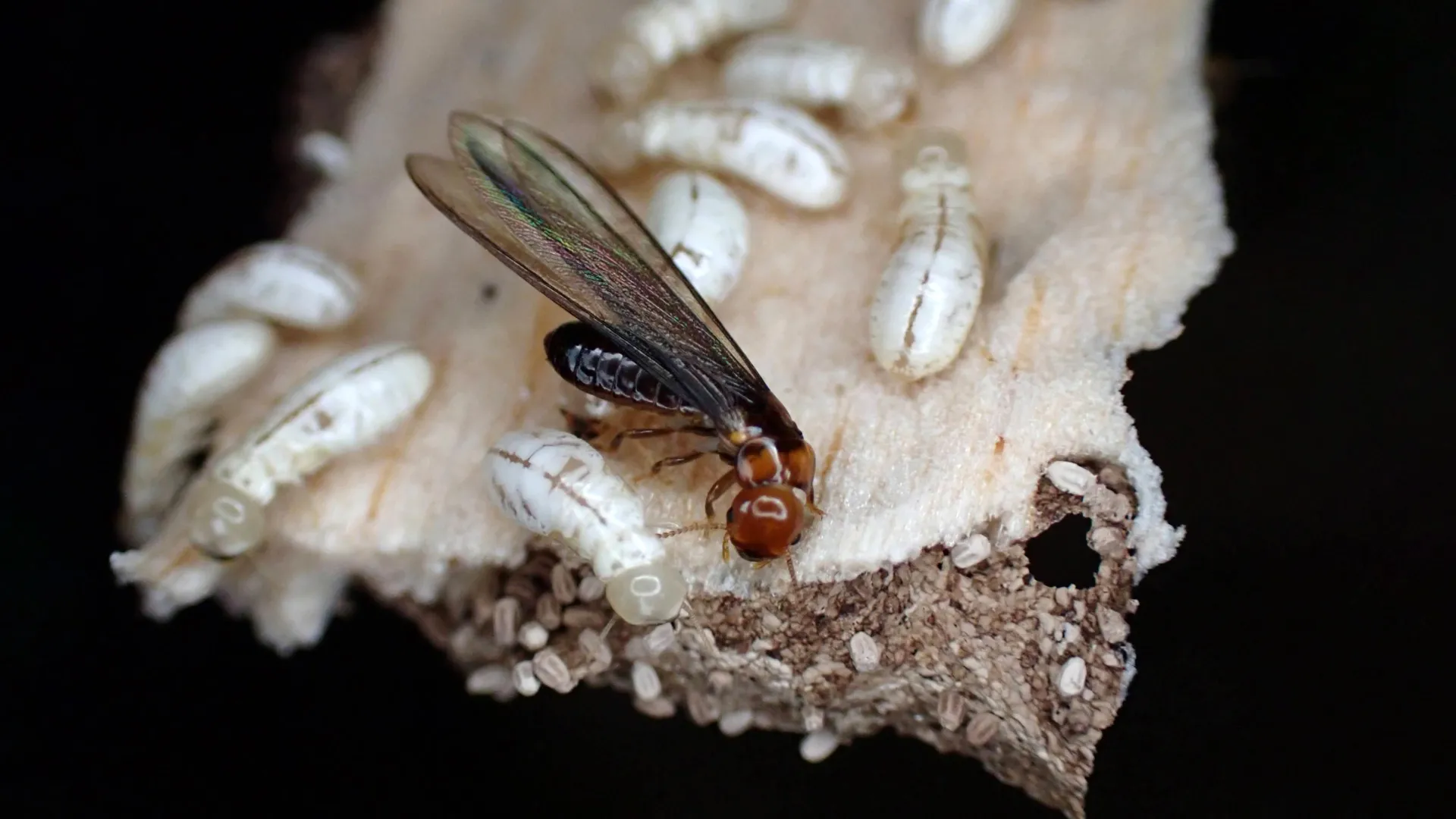
Drywood termites are good at staying hidden. They live in wooden structures, silently feeding and expanding their colonies in areas that homeowners may not notice until the damage begins. But their covert lifestyle also relies on a fragile biological process: molting.
Researchers at the University of California, Riverside have shown that bistrifluron, a chemical that prevents the formation of new termite exoskeletons, can destroy termite colonies in dry wood by interfering with the insect’s ability to grow. The survey results are Journal of Economic Entomology. In clinical testing, this treatment killed approximately 95 percent of colonies and did not pose mammalian toxicity concerns associated with many traditional termite control methods.
Safer way to target termites
“This chemical is more environmentally friendly than those traditionally used for drywood termite infestation,” said Nicholas Pross, corresponding author of the paper and a doctoral student in the UCR Department of Entomology. “This is unique to insects and is not harmful to humans.”
The reason this chemical is so targeted is because of the termites’ body plans. There are bones in the human body. Termites wear a support system on the outside in the form of an exoskeleton. Its outer shell is mainly made of chitin. Chitin is a durable natural material found in the cell walls of fungi, the scales of fish, and even the beaks of squid and octopus.
Chitin is essential for insects. It gives the exoskeleton strength, protects the body, and provides an anchor point for muscles. As termites grow, they must shed their old exoskeleton and build a new one. Drywood termites repeat this process approximately seven times during their lifetime.
Bistrifluron interrupts that step. Rather than poisoning the termites with a broad, fast-acting method, it prevents them from producing the chitin needed for their next protective shell.
“When termites reach a certain stage, they have to molt. They can’t avoid it,” said Dong-Hwan Choe, UCR professor of entomology and senior author of the paper. “When they ingest a lethal dose of this chemical, they try to shed their old exoskeleton and are unable to prepare a new exoskeleton to protect themselves.”
Termites spread the treatment themselves
The effects will not be visible immediately. Researchers confirmed that bistrifluron first reduced termite activity and reduced termite feeding. Over time, the chemicals prevented successful molting and the insects died.
A 2025 study tested three chitin synthesis inhibitors against the Western drywood termite, Incisitermes minor. Bistrifluron worked faster than chlorfluazuron and noviflumuron at the rates tested. In one open-ended trial, bistrifluron resulted in a 99 percent mortality rate over 60 days. A selection test using a rate of 0.1 percent resulted in a 96 percent mortality rate over the same period.
The most important part may be how the chemicals move. After the termites ate the treated wood, they passed the material on to other members of the colony. In transfer studies, group mortality reached 100% by day 90, even when only 5% of the termites were exposed. This study reported that food materials were transferred from exposed donor termites to unexposed recipients within 24 to 48 hours.
This finding is consistent with new research from the University of California, Riverside that highlights how western termites share food and essential gut bacteria through rectal trophotropy, a mouth-to-anal feeding behavior that is difficult to observe because the termites live almost entirely in wood. These covert social behaviors can make infestations difficult to detect, but may also help the treatment spread when termites come into contact with treated materials.
“We have successfully used it against subterranean termites, which are also important structural pests,” Choe said. “But the native Western drywood termite is also important, especially in California.”
Significant benefits can be gained by slowing down decay.
When dry wood termites consume treated wood, compounds can move through the colony as the termites interact. Complete colony collapse takes about two months, which is slower than traditional methods. But the trade-offs, including the possibility of localized treatments that are less toxic, have more targeted action, and don’t require tenting the entire house, may be worth it.
“We believe this spot treatment method can kill larger colonies and spread more easily than current termite control methods,” Choe said. “You don’t need to apply too much to get very good results. Chitin synthesis inhibitors show promise as topical treatments for drywood termites.”
Traditional fumigation remains a significant burden for homeowners. It can be toxic, destructive, and stressful. People often have to bag food, leave their homes, and wait until they return. It also won’t prevent termites from coming back later.
“Such a low-impact strategy would be an attractive option in many cases. Additionally, the chemical may remain active within the wood for some time, protecting it from future invasions,” Cho said.
Chemical seduction may enhance treatment
The UCR team also explored other smart ways to improve termite control. It uses scent to attract termites to treated wood. In previous research, Choe’s lab studied pinene, a pleasant-smelling chemical released by forest trees. Pinene is a food cue for Western xeric termites.
When termites follow their scent and invade insecticide-treated wood, the treatment becomes more effective. UCR’s 2025 patent application describes the use of pinene to improve topical insecticide injections against western termites. It states that adding pinene to topical treatments killed termites faster and increased ultimate mortality compared to insecticide alone. The application also suggests that the use of pinene allows for greater spacing between drill holes, potentially reducing the amount of time, labor, and pesticides required for treatment.
“We saw a significant difference in mortality rates when using insecticides alone and when using insecticides and pinene together,” Choe said. “Without pinene, the mortality rate was about 70%, but with the addition of pinene, it increased to over 95%.”
Practical use at home
Bistrifluron studies used acetone to dissolve the chemical before applying it to wood. While this worked well in research, acetone is flammable and has a strong odor, making it not ideal for real-world use.
“We are working to make practical application more feasible in real-world scenarios,” Ploss said.
Western drywood termites are serious structural pests, so the next steps are important. It is native to northern Mexico and California, where it is especially important. According to a 2025 study, the species has also been introduced to other regions, including Hawaii, New York, Florida, Canada, China, Japan, South Korea, and Australia. Moving wood and other wood products helps transport termites, but termites live hidden in wood, making them difficult to control.
Climate change could make the problem even worse. As temperatures change, termites may be able to invade areas that were previously unsuitable for their habitat.
“As we transport wood around the world, termites are constantly transported to new locations. If the termites find the climate there acceptable, the problem will grow,” Choi said. “In areas where these termites are common, it’s only a matter of time before your home becomes infested with termites, so this study is a good first step towards alternative strategies to control termites.”
