


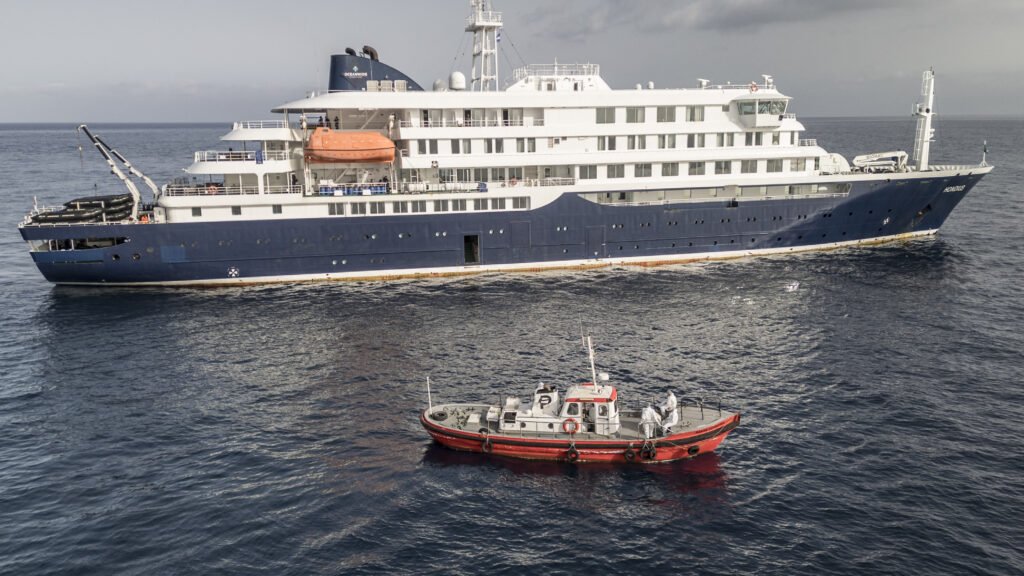
The outbreak of hantavirus on a cruise ship anchored off the west coast of Africa has shocked a world that is increasingly wary of the next coronavirus-like event after recent harrowing experiences. No wonder. People trapped on a ship with a potentially deadly disease spreading triggers flashbacks to the early days of the coronavirus.
Scientists and public health experts are also troubled by the hantavirus situation, but for different reasons. They are concerned that hantaviruses have not been studied enough. They fear more passengers could become ill. They’re not afraid that MV Hondius is ground zero for their next big project.
“This is not the next pandemic,” said Michael Osterholm, director of the Center for Infectious Disease Research and Policy at the University of Minnesota.
“This is an issue where everyone should take a breath and know that we are going to get this resolved,” he said. “With proper respiratory protection, there is a good chance that we can stop all future infections.”
Don’t get me wrong. The spread of infection on a cruise ship requires a careful response and thorough investigation. Although rare, hantavirus infections cause serious illness and a high mortality rate. The fact that at least some of the eight potential cases (so far) were likely infected through human-to-human transmission, which is extremely rare for hantaviruses, highlights how important it is that contacts of known cases are traced and that passengers and crew still on board are followed for weeks after they are allowed to disembark. The number of confirmed infections is likely to increase further.

Spread of hantavirus infections on cruise ships is a warning sign for the US
However, there is a difference between an outbreak that is of scientific and public health importance and one that poses widespread risk to the entire population. The current spread of infection is the former, not the latter.
Martin Cetron, a longtime director of global migration and quarantine at the U.S. Centers for Disease Control and Prevention, said the public may not fully understand what the World Health Organization and others are trying to convey when they say (as they do now) that the overall risk to the population is low.
“What they’re trying to say is…that in rare cases, something major and significant can happen, and the stories you hear about it may be scary. But that’s not necessarily the same as discovering something that is highly contagious through the airborne route and…has the superpowers that SARS coronavirus No. 2 had,” Cetron, who retired from the CDC about four years ago, told STAT in an interview.
Florian Kramer, a virologist at the Icahn School of Medicine at Mount Sinai in New York City and director of the Ignace Semmelweis Institute at the Medical University of Vienna, said part of the reason for the increased concern may be the fact that hantaviruses are not particularly well known, despite their widespread presence around the world.
“Three days ago, no one knew what hantavirus was, and I think that’s part of the reason,” he said.
Given this fact, a little background may be in order.
There are many different types of hantaviruses, and different types are found around the world. The virus is transmitted by rodents. Infected people become infected through exposure to the feces, urine, or saliva of infected rodents. Human cases are not common. According to the CDC website, 890 cases were recorded in the United States between 1993 and 2023. About 35% of these were fatal. (STAT asked the Department of Health and Human Services to meet with hantavirus experts at the CDC, but the request was denied.)
 CDC
CDC
In the United States, cleaning sheds after winter, ie mopping up rat droppings, has been linked to hantavirus infections. And for most people living in the United States today, that type of activity poses a greater risk of infection than MV Hondius, said Gustavo Palacios, a professor of microbiology at the Icahn School of Medicine at Mount Sinai.
To date, only one type of hantavirus, Andesvirus, has been shown to have the ability to transmit from person to person in rare cases. This is the virus that caused the MV Hondius outbreak. This strain is primarily found in Argentina, where the ship departs. The first two infected people in the outbreak traveled to Argentina before boarding the ship.
Tom Ksiazek, a prominent virologist and expert on emerging infectious diseases, said Andes virus replicates in higher concentrations in the body than most hantaviruses, which may help explain the virus’ ability to spread from person to person.
Ksiazek, a professor at the University of Texas Medical Branch and director of Galveston National Laboratory’s BSL4 Laboratory (the highest level of biosecurity), is more concerned about the U.S. being removed from the WHO at a time like this than the potential for a pandemic from this situation.

What you need to know about hantavirus, a disease suspected of outbreak on a cruise ship
“Since we have no knowledge of this matter, I and other scientists who may have a direct interest in this matter rely heavily on simple reporting,” he said.
Outbreak investigations in which Palacios was involved several years ago helped reveal the Andean virus’s ability to transmit between people. The infected person from Epuen, Argentina, attended a birthday party with about 100 other people. Five people who came into close contact with this person became ill, leading to an outbreak in which 34 people were infected and 11 people died.
The outbreak was brought under control as confirmed cases were told to isolate, and those in contact with infected people were asked to self-isolate.
Epuen is the largest known outbreak of the Andean virus, with only a few other known cases of human-to-human transmission, but its size warrants special attention from scientists, Cramer said.
Palacios said cruise ships, especially cruise ships of this type, could be an ideal environment for infection if this virus were introduced into the environment. The ship, small by cruise liner standards, is bound for Antarctica. “It’s obviously set up to keep the heat in,” he says.
However, not all cases of Andean infection lead to human-to-human transmission. In 2018, a woman from Delaware was infected while traveling to Argentina, but was only diagnosed after returning home. Public health officials traced 51 contacts, including medical professionals who cared for her, family members, people who sat near her on the flight home, flight attendants and even someone she shared a hospital room with. No one was infected with the virus.
Experts STAT spoke to believe the outbreak can be contained, but all agree that much work remains to get the nearly 150 passengers and crew, including 17 Americans, off the ship and safely repatriated to their home countries.
And they point out that this event highlights the need for further research on these viruses. Palacios said that even after the Epuen outbreak, funding bodies were reluctant to approve grant applications because of the perception that the risk from this virus family was low.
Andrew Pollard, professor of infection and immunity at Oxford University’s Institute of Pandemic Science, agrees.
“This outbreak highlights the importance of recognizing new infections and taking simple public health measures to reduce spread, severe illness and death,” he said in an email. “This is also a reminder that there are many dangerous viruses out there, and sporadic outbreaks like this still leave us at risk.”
