


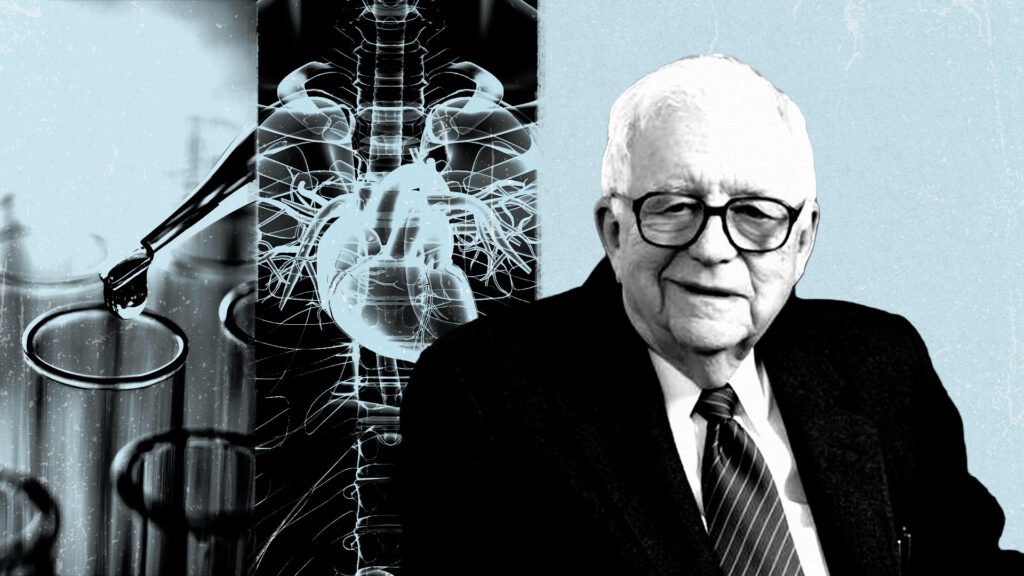
Eugene Braunwald, widely known as the “father of modern cardiology,” passed away on April 22nd at the age of 96. When I first learned of his death, I thought about the many conversations we had, especially about the two big visions he had for his career.
His initial vision was to work with other scientists to successfully transform theory into practice for preventing heart attacks and minimizing damage to the heart muscle after an attack begins. He accomplished that, becoming the most important cardiologist of his generation and fundamentally changing daily medical care.
The scandal may have made his already unrealistic second vision impossible.
Like many other doctors before and since, Braunwald never imagined that a young doctor would commit serious fraud in a laboratory. The flaws in his team’s corruption investigation not only stained his otherwise stellar record, but also forced the scientific research community to confront more openly the dirty laundry it had habitually swept under the rug.
It is difficult to overstate how much Braunwald’s major research findings changed everyday medical practice.
While working at the National Institutes of Health in 1962, he developed a test known as ejection fraction. It measures the percentage of blood that the heart’s main chamber, the left ventricle, pumps out with each beat. Doctors use this daily to determine the extent of heart failure in an individual.

William Forge, a giant of public health who helped eradicate smallpox, dies at age 89
After moving to the University of California, San Diego in the late 1960s, Braunwald challenged the prevailing theory at the time that a blood clot in one of the coronary arteries feeding the heart acted like a light switch that instantly destroyed the organ’s muscles. After carefully observing electrocardiograms recorded during patients’ heart attacks, they theorized that muscle damage from a heart attack often develops slowly over the first few hours. He likened the process to moving a rheostat switch up and down. He went on to prove this theory in experiments on anesthetized dogs, showing that restoring blood flow is the key to heart muscle recovery.
At Harvard University in 1972, Braunwald continued his research to better understand the relationship between coronary artery disease and heart attacks. Along with colleague Mark Pfeffer, he showed that drugs in the angiotensin-converting enzyme inhibitor class extend the lives of patients with reduced ejection fraction after a heart attack.
Although Braunwald’s research could not cure heart disease, it helped extend the lives of many affected patients by years and even decades. But the price of success is that many of these people develop heart failure. The main goal of heart disease research today is focused on improving care.
In the early 1980s, Braunwald simultaneously served as medical director of Brigham and Women’s Hospital and Beth Israel Hospital, two-story Boston hospitals affiliated with Harvard University. One day, he invited me to do rounds with the residents at Brigham Hospital. After examining patients in their rooms, he led his entourage into a conference room to discuss their medical problems.
As they considered the issues surrounding one woman’s care, it became clear that medically there was nothing the Harvard team could offer her other than palliative care. The only possibility, a heart transplant, was not an option because there was no one in Boston to perform heart transplants at the time. Doctors had performed a small number of heart transplants at the Texas Medical Center in Houston (and elsewhere), but her illness was too severe to transport her safely. (The first heart transplant performed in Boston occurred shortly thereafter in 1984 at Brigham and Women’s Hospital. Although he was not a surgeon, I strongly suspect that Braunwald’s influence contributed to that milestone.)
 Eugene Braunwald in his laboratory in the 1960s.US National Library of Medicine
After our discussion, Braunwald and I walked to Beth Israel Hospital, about a third of a mile away. So he led me to the roof of the hospital.
As we stood there in the strong wind, he told me about his second dream. It is the substitution of one form of scholarship for another. Private donors and taxpayers would help expand Harvard’s medical campus onto land previously occupied by a private girls’ school and a nearby university into a medical research, patient care, and education area comparable to the larger 2.1-square-mile Texas Medical Center complex in Houston.
I got the feeling that Braunwald took me to the roof because he was frustrated that he couldn’t offer a heart transplant to the woman he’d just talked to. I thought his vision was ridiculous and gently expressed my skepticism. Who would be a philanthropist? There were many wealthy families in New England, but oil did not create wealth. Why would a school already occupying the land he had his eye on agree to move from its old location? Braunwald stuck to his vision. I said I would wait and see.
Although his vision was never realized, Harvard’s campus was expanded with taxpayer and private support. But it doesn’t come close to the scale of the Houston complex.
When we stood on that roof, Braunwald could not have imagined what was about to happen in his laboratory.
In 1981, a year after he became medical director of both Harvard hospitals, John R. Darcy, a young researcher hired by Braunwald on the enthusiastic recommendation of Professor Emory and others, was caught falsifying data from experiments on dogs. Mr. Darcy admitted fraud. After an initial internal investigation, Mr. Braunwald believed this was a one-time violation and continued his participation in the study.
But potential questions have raised concerns about the integrity of Darcy’s published papers, including in the New England Journal of Medicine. Over the next few years, this concern slowly led to an independent investigation. An investigation by the National Institutes of Health found that Darcy fabricated vast amounts of data from experiments he never conducted. Other investigations found that Darcy had deceived co-authors on numerous papers dating back to his college days at Notre Dame. The NIH criticized Braunwald’s lax oversight and pressure to publish. Darcy was also barred from receiving federal research grants for 10 years and his medical license was revoked. Brigham and Women’s Hospital had to return $122,371 in research funds to the NIH. It was the first time a university had been required to repay a federal agency for research misconduct.
Such a fiasco may have deterred other scientists from training junior researchers to help them achieve their research goals. It wasn’t Braunwald who founded the TIMI Research Group (Thrombolysis in Myocardial Infarction) in 1984 with a vision to save hearts. Since then, the group has conducted 80 scientifically rigorous clinical trials involving 450,000 participants, testing the safety and effectiveness of many drugs and technologies routinely prescribed to patients today.
Braunwald continued to work for many years, but his brusque demeanor sometimes made his subordinates and colleagues uncomfortable. With the development and popularization of angioplasty, which collapses plaque that narrows coronary arteries, and stent insertion, which keeps blood vessels open, Braunwald transformed the goal of limiting muscle damage from heart attacks into the standard of care.
As I cared for patients and wrote articles for the New York Times over the years, I frequently referred to the major medical and cardiology textbooks of which he was an editor, and he was always helpful when I interviewed him on various issues.
He didn’t just want to transform the field for his colleagues; He wanted to help the public better understand heart disease. He succeeded in both.
Lawrence K. Altman is a physician, clinical professor of medicine at New York University, and former New York Times reporter and Doctor’s World columnist. He researches and writes books about the health of political leaders.
