


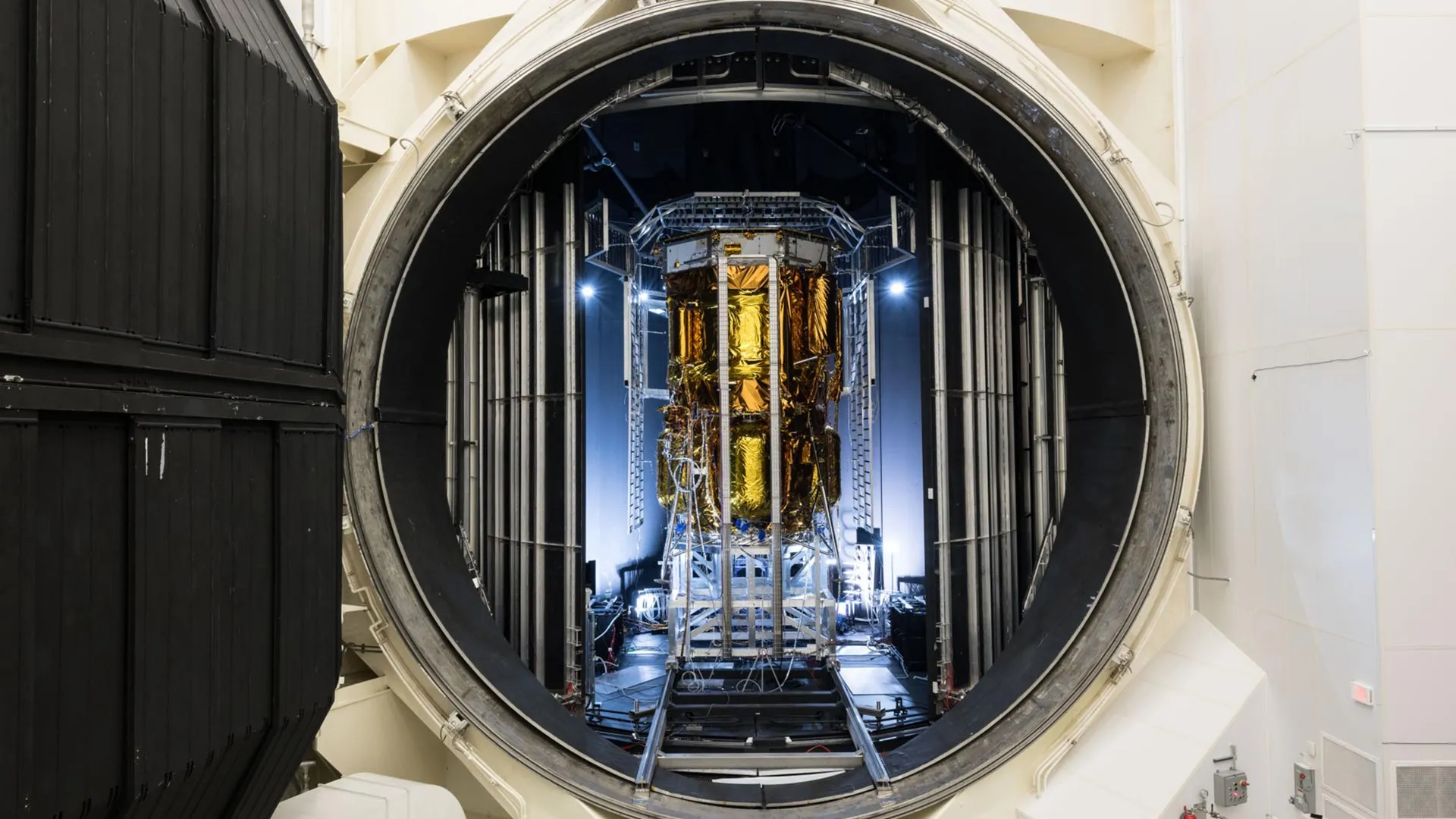
Blue Origin’s Lunar Module MK1, also known as Endurance, is an unmanned cargo spacecraft designed to test critical technologies for future lunar missions. The vehicle is part of a commercial demonstration effort aimed at enhancing the capabilities of human landing systems in NASA’s Artemis program.
This project focuses on the growing public-private cooperation model. Blue Origin conducted the testing through a reimbursable Space Act contract with NASA and leveraged the agency’s facilities and expertise to accelerate development.
Testing critical lunar landing technology
Endurance is being built to validate several critical systems needed for operations on the lunar surface. These include precision landing, cryogenic propulsion, autonomous guidance, navigation, and control.
Alongside these demonstrations, the lander is scheduled to deliver two NASA payloads to the Moon’s south pole region this year under the Commercial Lunar Payload Services (CLPS) initiative. One of the payloads, the Lunar Plume Surface Study Stereo Camera, will capture high-resolution images of how the lander’s engine plume interacts with the lunar surface during descent and landing. A second laser retroreflective array helps spacecraft in orbit determine their precise location by reflecting laser signals.
How CLPS will support future lunar exploration
Through CLPS, NASA works with U.S. companies to send science experiments and technology demonstrations to the Moon. This approach will help expand knowledge of the lunar environment while supporting the agency’s long-term goal of returning astronauts to the lunar surface as part of the Artemis campaign.
Extreme testing inside NASA’s giant vacuum chamber
Before heading into space, MK1 underwent rigorous testing inside Chamber A at NASA’s Johnson Space Center. The facility is one of the world’s largest thermal vacuum chambers, capable of simulating the near-vacuum of space and extreme temperature fluctuations.
By recreating these harsh conditions on Earth, engineers were able to assess how the lander would perform in a flight-like environment. The test also confirmed the spacecraft’s structural strength and ability to handle thermal stresses. Insights gained from design, integration, and testing will directly inform future Artemis missions aimed at returning American astronauts to the Moon.
Building towards a manned lunar lander
The MK1 program plays a critical role in mitigating risks and advancing the technology needed for larger-scale crew response systems. One of these future vehicles, Blue Moon Mark 2 (MK2), is a more advanced lander designed to safely transport astronauts between lunar orbit and the moon’s surface. The system is intended to support continued human exploration, especially in the difficult Antarctic region.
NASA’s ‘Front Door’ Approach to Commercial Partnerships
Testing at NASA Johnson was made possible through NASA’s “front door” approach, a structured process that gives commercial partners access to NASA facilities and technical expertise. This model enables faster innovation through collaboration while ensuring alignment of safety standards, mission requirements, and overall goals.
