


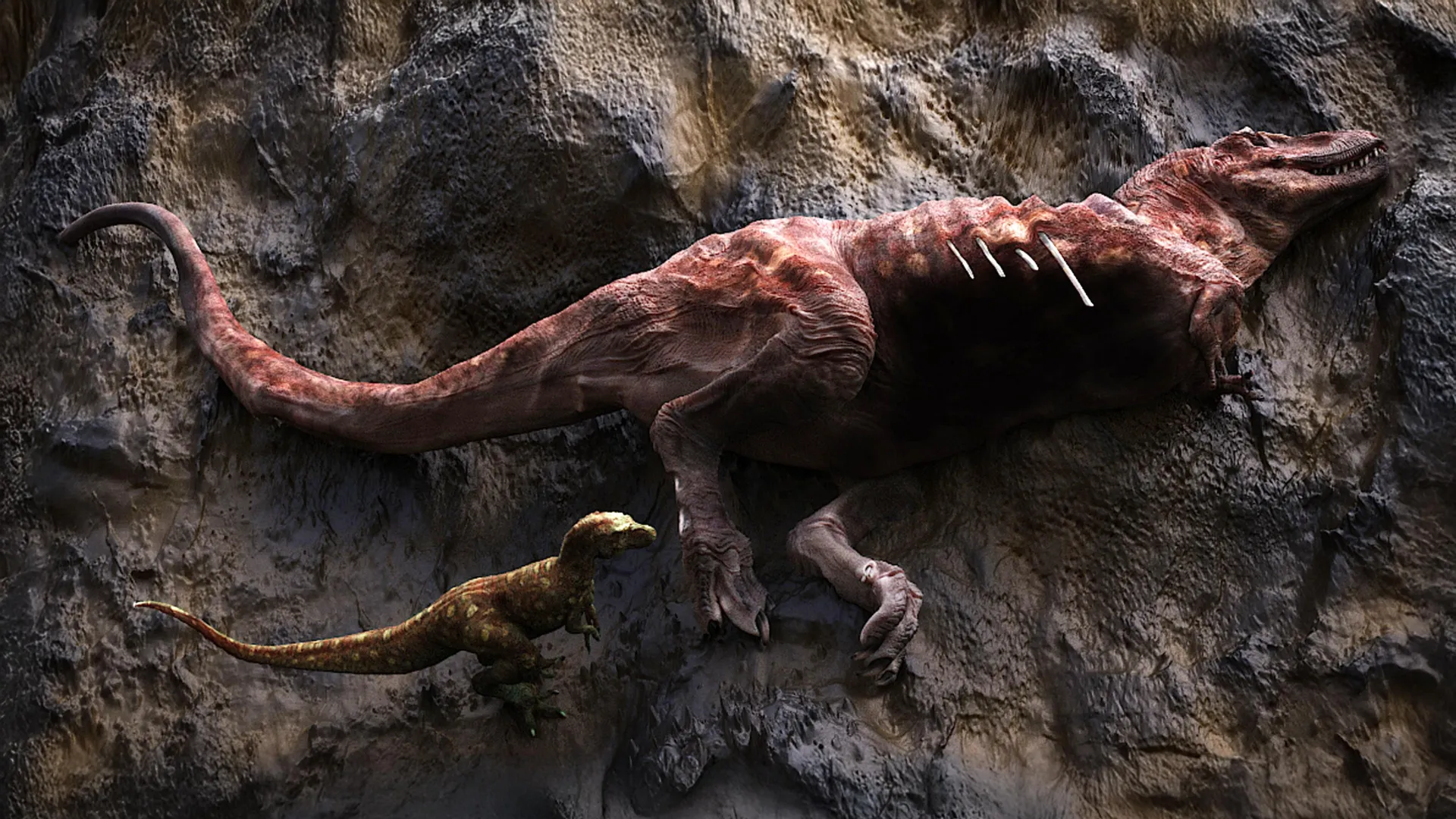
Tyrannosaurus rex is usually depicted as a powerful and merciless predator. But they also took advantage of the opportunity to scavenge, according to a new study. When food was available, they did not hesitate to eat the carcasses of animals, down to the last scraps.
The findings come from a study by Aarhus University’s Department of Geosciences, which was recently published in the journal. evolving earth.
Traces of cannibalism revealed from fossilized bite marks
The research was led by Josephine Nielsen, a master’s student in geosciences. She used advanced 3D scanning technology to examine the fossilized metatarsals (foot bones) of large tyrannosaurids that are more than 75 million years old. Her analysis revealed 16 distinct bite marks on the bone.
“By analyzing the depth, angle, and placement of the marks in a virtual 3D environment, we were able to document that these bite marks were not created by chance. They are precise marks from the teeth of a small tyrannosaurus that fed on much larger relatives,” says Josephine Nielsen.
This result suggests that Tyrannosaurus did not waste resources. Even hard bones with little meat are consumed later in the decomposition process, after most of the soft tissue has already been eaten.
“After the small dinosaur bit into the bone, the bone shows no signs of healing. The marks are on the foot, which has very little flesh, suggesting that the dinosaur was ‘scavenging’ and eating the last remnants of an old carcass,” she explains.
Digital models help decipher ancient behavior
Rather than working directly with the original fossil, Nielsen studied digital models and 3D printed versions created at Aarhus University.
“Of course it would have been a special experience to handle real bones, but it would be too dangerous to send them by post to Denmark,” she explains.
The metatarsal bones are 10 centimeters long, and belong to a tyrannosaurus that was 10 to 12 meters tall and weighed several tons when alive. The fossil was discovered by an amateur collector in the Judith River Formation in Montana, known for preserving a rich ecological record dating back 75 million years. It was then donated to the Badlands Dinosaur Museum in Dickinson, North Dakota.
The use of digital tools had important benefits. The high-resolution scans allowed Nielsen to closely examine small details that would otherwise be difficult to see.
“What makes this study special is not just the knowledge of how the food chain worked among dinosaurs millions of years ago, but the technology used to read those details. By creating a digital version, we were able to zoom in on very small details. To ensure the analysis was objective, we used a systematic CM (Category-Modifier) We used a classification system that classifies individual marks based on fixed criteria, allowing us to distinguish everything from visible teeth impacts to deep crunches. It was like solving an ancient murder mystery with metatarsal evidence.”
Technology brings new insights into dinosaur ecology
Nielsen’s research was supported by Canadian paleontologist Taia Winberg-Henzler and museum curator Denver Fowler, who served as external supervisors on the undergraduate project that led to the publication.
“While volunteering at an excavation camp in Montana in the summer of 2024, I contacted Denver Fowler and Tyre Weinberg-Henzler, which led me down the path of the project. Building international relationships while in school was invaluable,” says Josephine Nielsen.
This study highlights how modern technology can reveal detailed information about dinosaur behavior even from tiny traces preserved in fossils.
“We can now extract detailed information about their behavior from very small marks. Using the CM system, we have established a common scientific language to describe bite marks. This means we can no longer just guess that they ‘look like bite marks’, but can now record exactly when and why a small tyrannosaurus implanted its teeth into a large one,” said Josephine Nielsen.
