


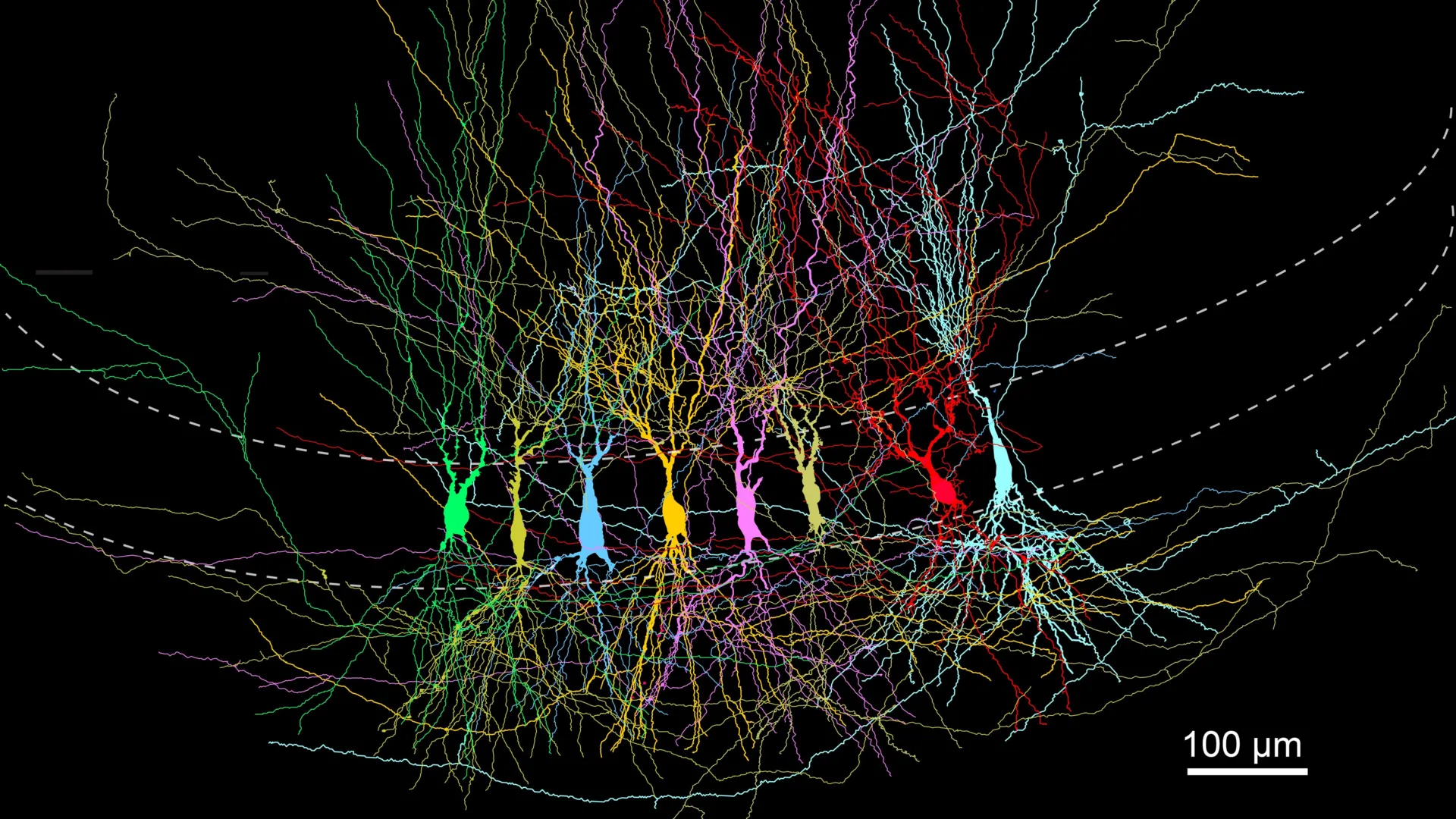
The hippocampus plays a central role in how we form memories and move through space. This helps transform short-term experiences into long-term memory, allowing you to save and build on what you’ve learned. Scientists led by Peter Jonas, the Magdalena Waltz Professor of Life Sciences at the Austrian Institute for Science and Technology (ISTA), are closely studying this area of the brain. Their new research nature communicationsLet’s explore how one of the major neural networks in the hippocampus develops after birth.
Imagine a completely empty piece of paper. Start writing there and gradually fill it with information. This idea reflects the concept of tabula rasa, or “blank slate.”
Now imagine a page that is already marked. New information must fit or replace existing information. This stands for tabla plena, or “complete state.”
This long-standing debate asks whether we start life with everything prepared in advance, or whether our experiences shape us. In biology, this problem manifests itself as a balance between genetic instructions and environmental influences that shape development.
The ISTA research team applied this idea to the hippocampus, which is responsible for memory and spatial awareness. They wanted to understand how its internal network changes after birth and whether it is close to a blank slate or in perfect condition.
Studying the brain’s memory network
The researchers focused on an important hippocampal circuit made up of CA3 pyramidal neurons. These cells are important for storing and retrieving memories. They rely on plasticity, the brain’s ability to adapt by strengthening or weakening connections or changing structure.
ISTA alumnus Victor Vargas-Barroso studied mouse brains at three developmental stages: early life (7-8 days), adolescence (18-25 days), and adulthood (45-50 days).
To investigate how these networks function, he used patch-clamp techniques. This technique measures tiny electrical signals within specific parts of neurons, such as presynaptic terminals and dendrites. The research team also used advanced imaging and laser-based methods to observe activity within cells and precisely activate individual neural connections.
From dense and random to sophisticated and efficient
The results revealed a surprising pattern. In the early stages of development, the CA3 network is very dense and the connections appear to be almost random. As the brain matures, this network becomes less crowded and more organized and efficient.
“This discovery was very surprising,” says Jonas. “Intuitively, you might expect the network to grow and become denser over time. Here we see the opposite; it follows a so-called pruning model: complete at first, then streamlined and optimized.”
Why does the brain start working at full capacity?
Researchers are still investigating why this pattern occurs. Jonas suggests that starting with highly connected networks may allow neurons to link together quickly, which is particularly important in the hippocampus. This area requires combining different types of information, such as sights, sounds, and smells, to form a coherent memory.
“This is a complex job for neurons,” Jonas explains. “Initial active connectivity followed by selective pruning may enable just this integration.”
If the brain began as a true surface plate with no built-in connections, neurons would first have to locate and connect to each other. That process can make communication slow and less efficient, making it difficult to form memories effectively.
Overall, the findings suggest that the brain does not begin as a blank slate, but as a richly connected network that becomes more precise over time by removing unnecessary links.
