


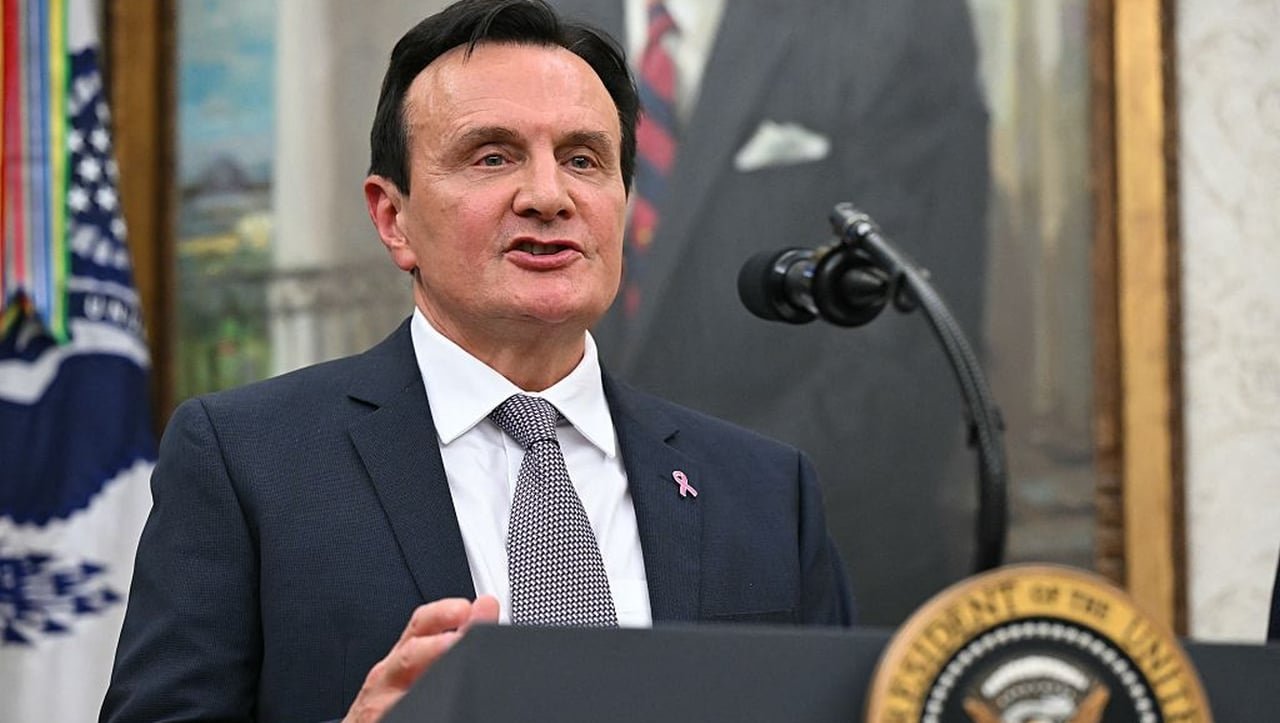
As AstraZeneca prepares for the impact of the U.S. “most-favored nation” policy, CEO Pascal Soriot has suggested excluding eight reference markets from future product forecasts as a “very conservative” way to model the impact.
Soriot offered the methodology during AZ’s first-quarter results conference, stressing that it was only a “very conservative” approach and that he didn’t think the British drugmaker would actually deliver.
“But we are working hard, not only for us but as an industry as a whole, to improve the access environment and the pricing environment in all of these countries,” Soriot said on Wednesday’s conference call, adding: “Ultimately, our goal is to launch these products in every single market and improve the access environment.”
The Trump administration’s most-favored-nation policy aims to reduce U.S. prescription drug costs by linking them to prices paid in other developed countries. The initiative typically benchmarks U.S. prices using a basket of eight high-income countries: Canada, Denmark, France, Germany, Italy, Japan, Switzerland, and the United Kingdom.
As President Trump threatens drug tariffs, 17 major pharmaceutical companies, including AZ, have so far signed on. Additional participation by other pharmaceutical companies is expected as the President has announced a policy of imposing a 100% tax on pharmaceutical imports with some exceptions, as the Department of Commerce has identified pharmaceutical imports as a risk to the national security of the United States under Section 301 of the Trade Act of 1974. MFN transactions only affect future products.
As a flip side to his administration’s most-favored-nation policy, the U.S. government and pharmaceutical industry are looking to boost spending by other countries, even as President Trump bemoans foreign “free riders” on U.S.-funded innovation. That effort may take time. Before that, Soriot’s comments suggest that drug companies may choose to skip these benchmark countries for new product launches if benchmark prices are too low. But AZ’s chief executive seems optimistic that some form of compromise can be reached.
“We have time to do this because new products aren’t coming out right away,” Soriot said. “We are already seeing some movement in the UK, and discussions based on the 301 investigation will likely begin with other countries in the coming weeks and months.”
Companies are effectively using R&D investment in each country as a bargaining chip to promote a more affordable pricing environment. As Soriot highlighted the UK’s improvements, AZ announced on Wednesday it would restart a 300 million pound ($404 million) investment program in its home country, months after freezing the plan following an impasse over drug price negotiations.
“While there has been a positive response in some countries, a wait-and-see attitude is prevailing in others,” Soriot added. “But this is going to continue for the next 18 months to two years, so I think there’s plenty of time to rebuild the environment.”
Still, Soriot suggested that the loss of the European market would not be a big blow to AZ, as it accounts for 20% of the company’s global sales.
“Take pieces out of this, it’s not that big,” he said.
With multiple new product launches underway with blockbuster potential, AZ is targeting $80 billion in revenue by 2030, compared to $58.7 billion in 2025.
Beyond Arizona, drug companies have reported mixed results from price-raising efforts in other countries.
Astellas CEO Naoki Okamura suggested in March that MFN helped Astellas secure higher reimbursement prices for its eye drug Izerbay in Japan.
As quoted by Bloomberg, Okamura said it was unclear whether Japanese authorities explicitly considered President Trump’s policies in their deliberations, but that “we took advantage of this most-favored-nation dialogue” and obtained “relatively reasonable pricing” in Japan.
But in a call with reporters on Tuesday, Novartis CEO Basu Narasimhan lamented that the Swiss drugmaker’s MFN engagement with European and Japanese governments “has not progressed at the pace we had hoped.”
“What is critically important now is that we continue to appeal to European governments to ensure that they reward innovation appropriately and to avoid policies that make it virtually impossible for companies like ours to continue to invest in clinical trials and manufacturing in Europe,” Narasimhan said. “Europe needs a healthy ecosystem, and this will require a complete rethinking of how reimbursement systems work on the continent.”
