


One of the crucial breakthroughs that distinguished quantum physics from classical physics was the realization that matter behaves quite differently on very small scales. Among the most important discoveries was wave-particle duality, the idea that particles can also behave like waves.
This concept became popular through double-slit experiments. When electrons were fired through two narrow apertures, they produced a pattern of alternating light and dark bands on the detector. This pattern revealed that each electron behaves like a wave, with its quantum wavefunction passing through both slits simultaneously and interfering with the electron itself. Scientists later confirmed this effect in neutrons, helium atoms, and even larger molecules, establishing matter wave diffraction as a key principle of quantum mechanics. However, despite these advances, this phenomenon had not been directly observed in positronium. Positronium is a short-lived two-body system consisting of a bonded electron and positron orbiting a common center of mass. Because the masses of both components are equal, researchers have long sought to understand how such systems behave when forming beams and undergoing diffraction.
First observation of wave behavior of positronium
A research team from the Tokyo University of Science led by Professor Yasuyuki Nagashima, Associate Professor Yugo Nagata, and Dr. Riki Mikami achieved this goal. They successfully demonstrated matter wave diffraction in a beam of positronium. The beams used in their experiments had the necessary energy range and coherence to produce distinct interference effects. The result is nature communicationsprovides strong new evidence for wave-particle duality in anomalous systems.
“Positronium is the simplest atom consisting of components of equal mass, and behaves as a neutral atom in vacuum until it self-annihilates. This is the first time that quantum interference in a positronium beam has been observed. This may open the way to new research in fundamental physics using positronium,” says Professor Nagashima.
Creating a high quality positronium beam
This breakthrough relies on the generation of highly controlled positronium beams. To do this, the researchers first produced negatively charged positronium ions. Precisely timed laser pulses were then used to remove the excess electrons, resulting in a stream of fast, neutral, and coherent positronium atoms.
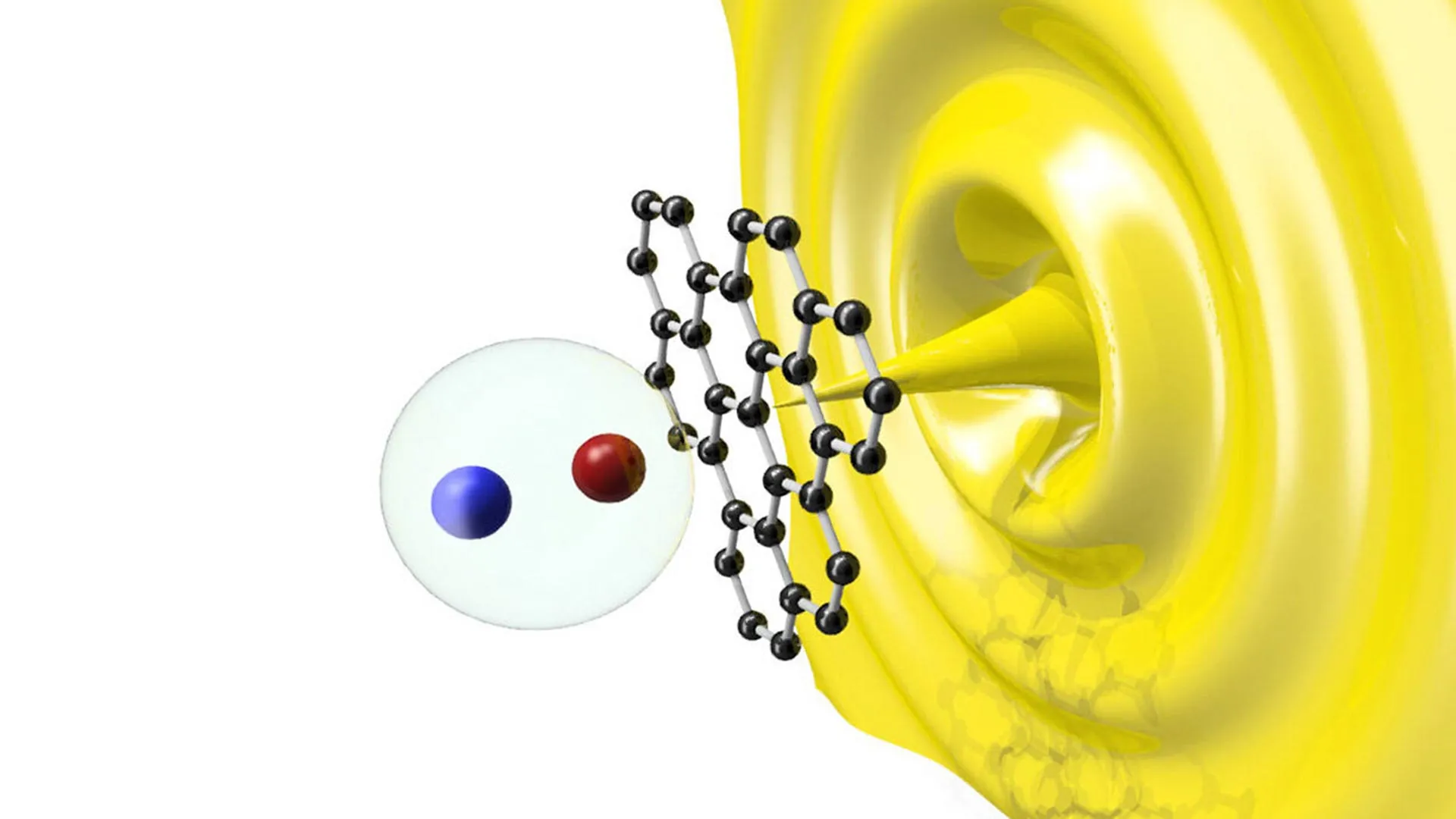
This beam was directed at a sheet of graphene. The spacing between atoms in graphene closely matched the de Broglie wavelength of positronium at the energies used in the experiment. As the positronium atoms passed through two to three layers of graphene sheets, some atoms passed through and were detected. The resulting measurements revealed a distinct diffraction pattern, confirming the wavy behavior.
Distinct diffraction patterns and quantum behavior
Compared to previous techniques, this method produces a high-energy positronium beam reaching up to 3.3 keV. Also, the energy spread is narrower and the beam direction is more precise. By conducting the experiment in an ultra-high vacuum, the surface of the graphene was kept clean, making it possible to observe the diffraction pattern more clearly.
The results showed that positronium behaves as a single quantum object, even though it is composed of two particles. Rather than diffracting separately, electrons and positrons act together as one wave.
“This groundbreaking experimental milestone represents a major advance in fundamental physics. It not only demonstrates the wave nature of positronium as a coupled lepton-antilepton system (a system that behaves like a small atom), but also paves the way for precision measurements involving positronium,” said Dr. Nagata.
The researchers also investigated whether positronium causes interference in the same way as single particles such as electrons. Their discovery confirmed that this is the case and strengthened the idea that it functions as a unified quantum entity.
Future applications in materials science and antimatter research
In addition to confirming its quantum properties, positronium diffraction may lead to practical applications. Because positronium has no charge, it can be useful for analyzing material surfaces without causing damage. This makes it particularly valuable when studying insulators and magnetic materials that can interfere with charged particle beams.
In the future, it may also be possible to test how antimatter reacts to gravity through experiments involving positronium interference. This remains an open question since direct measurements have not yet been achieved even for electrons.
About Professor Yasuyuki Nagashima of Tokyo University of Science
Dr. Yasuyuki Nagashima is a professor at the Department of Physics, Tokyo University of Science, specializing in positron and positron physics. His research focuses on the properties of positronium negative ions and positronium beams. He also studies ion desorption from solid surfaces caused by positron annihilation. In 2020, received the Hiroshi Takuma Memorial Award from the Matsuo Foundation. His laboratory conducts fundamental research on exotic particle-matter interactions while developing new positron-based experimental techniques for applied physics.
About Associate Professor Yugo Nagata of Tokyo University of Science
Dr. Yugo Nagata is an associate professor at the Department of Physics, Tokyo University of Science, specializing in positronium and atomic physics. In 2023, he received the Japan Positron Science Association Young Scientist Award.
This research was supported by JSPS KAKENHI (grant numbers JP25H00620, JP21H04457, and JP17H01074).
