


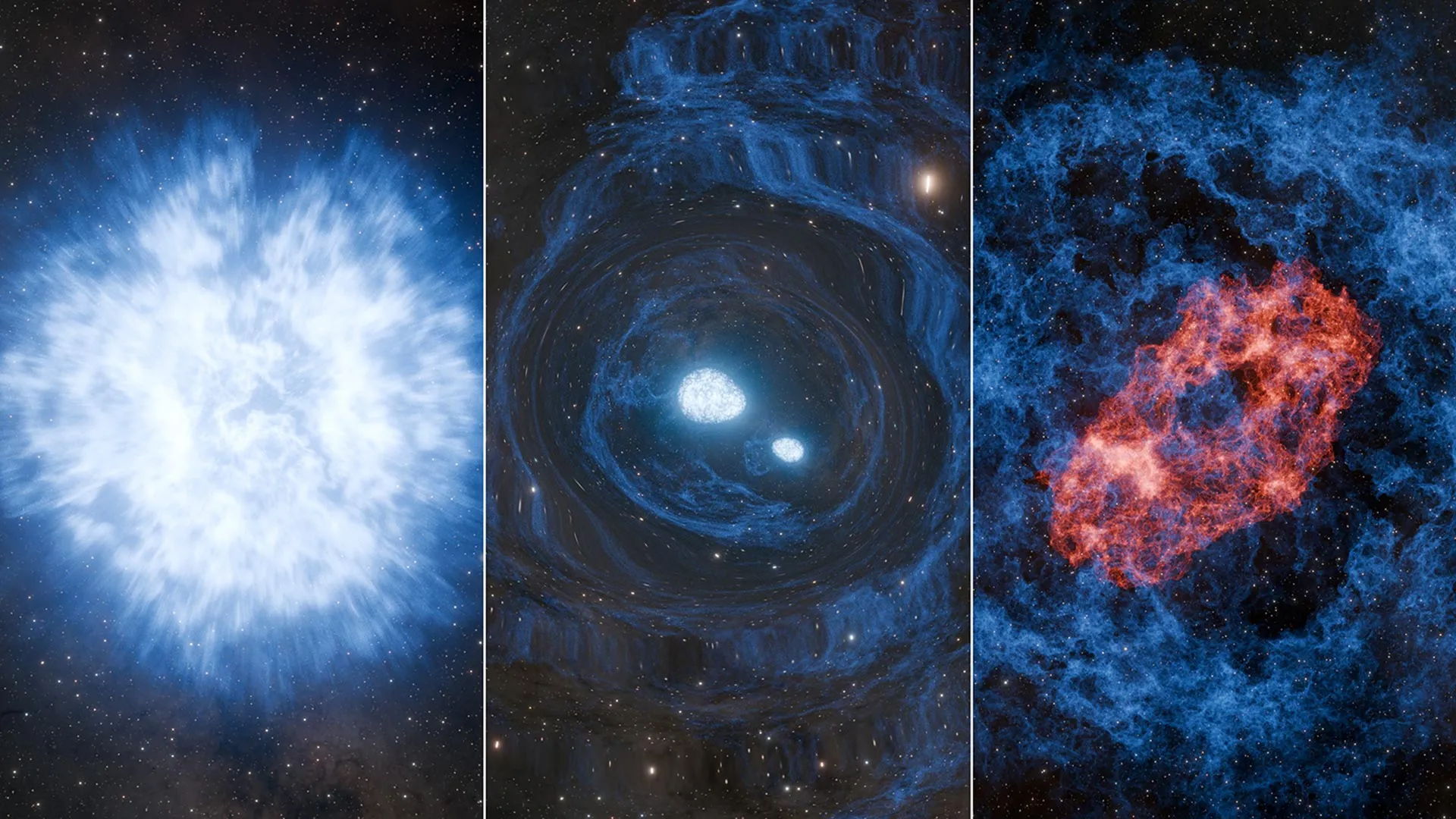
When a very massive star reaches the end of its life, it explodes as a supernova, scattering elements such as carbon and iron into space. Another, rarer type of explosion occurs when two neutron stars, the dense remains of dead stars, collide. This phenomenon, known as a kilonova, produces even heavier elements such as gold and uranium. These materials are essential ingredients for forming stars, planets, and ultimately everything around us.
So far, scientists have identified only one clear example of a kilonova. The event, called GW170817, occurred in 2017 when two neutron stars merged. The collision emitted both gravitational waves and light, allowing researchers to observe the collision in a variety of ways. The gravitational waves were detected by the National Science Foundation’s Laser Interferometer Gravitational-Wave Observatory (LIGO) and its European partner Virgo, and telescopes around the world captured the light from the explosion.
new and mysterious cosmic events
Astronomers now believe they may have found evidence of a second kilonova, but the situation is far from straightforward. The candidate event, named AT2025ulz, appears to be related to a supernova that occurred several hours earlier. Previous explosions may have hidden important details, making the event much more difficult to interpret.
“At first, for about three days, the eruption looked exactly like the first kilonova of 2017,” says Mansi Kasliwal (PhD ’11), a professor of astronomy at the California Institute of Technology and director of the Palomar Observatory near San Diego. “Everyone was watching it intently and trying to analyze it, but then it started looking more like a supernova and some astronomers lost interest. We weren’t.”
Kasliwal led the study that explains the results. Astrophysics Journal Letter. Her team suggests that this unusual event could represent something entirely new: a superkilonova, a kilonova caused by a supernova. Scientists have proposed this idea before, but it had never been observed before.
Gravitational waves indicate something unusual
The first signs of this unusual phenomenon appeared on August 18, 2025. LIGO detectors in Louisiana and Washington, along with Italy’s Virgo, have recorded new gravitational wave signals. Within minutes, astronomers around the world were alerted that the signal was likely coming from two merging objects. At least one of the objects appeared unusually small. The alert also included its general location in the sky.
“Although we’re not as confident as some alerts, this immediately caught our attention as a potentially very interesting event candidate,” said David Reitze, executive director of LIGO and a research professor at the California Institute of Technology. “As we continue to analyze the data, it is clear that at least one of the colliding objects has less mass than a typical neutron star.”
Hours later, Palomar Observatory’s Zwicky Transient Facility (ZTF) identified a fading red source about 1.3 billion light-years away, in the same region as the gravitational wave signal. The object was originally named ZTF 25abjmnps, but was later given the official name AT2025ulz.
Signals that change over time
About a dozen telescopes around the world immediately began observing the phenomenon, including the W.M. Keck Observatory in Hawaii, the Fraunhofer Telescope in Germany, and facilities associated with the Kasliwal-led GROWTH (Global Relay of Observatories for Monitoring the Occurrence of Transient Events) program.
Initial observations showed the object rapidly fading and glowing red, similar to what was seen in the 2017 kilonova. In previous events, the red color comes from heavy elements such as gold, and heavy elements such as gold absorb blue light and transmit red wavelengths.
However, the behavior of the AT2025ulz quickly changed. A few days after the first flash, it brightened again, turning bluer and showing hydrogen in its spectrum. These features are typical of supernovae, specifically “stripped-envelope collapse” supernovae rather than kilonovae. Because supernovae in distant galaxies typically do not produce detectable gravitational waves, some astronomers have concluded that the phenomenon was likely a regular supernova unrelated to the initial signal.
Clues to the possibility of super kilonova
Kasliwal and her team noticed several signs that the event didn’t fit neatly into either category. AT2025ulz did not perfectly match the characteristics of a classical kilonova or a typical supernova. At the same time, gravitational wave data suggest that at least one of the merging objects has a mass less than the Sun, raising the possibility that two unusually small neutron stars are involved.
A neutron star is the dense remnant left after a massive star explodes. It is roughly the size of San Francisco (about 25 kilometers in diameter) and typically has a mass between 1.2 and 3 times that of the Sun. Some theories suggest that even smaller neutron stars may exist, but none have been directly observed.
Scientists have proposed two ways such small neutron stars could form. In one scenario, a fast-spinning massive star explodes and splits into two smaller neutron stars through a process called nuclear fission. In another phenomenon known as fragmentation, an explosion forms a disk of material around a collapsing core, and the clumps within that disk eventually form small neutron stars, similar to the formation of planets.
Hidden collision inside a supernova
Co-author Brian Metzger of Columbia University said two newly formed neutron stars could spiral inward and collide, creating kilonovae that emit gravitational waves. When this happens, the explosion initially appears red due to the formation of heavy elements, as observed with telescopes. On the other hand, debris from the early supernova could obscure the view, hiding the kilonova within.
Simply put, a supernova could have produced two newborn neutron stars, which quickly merged and caused a second explosion.
“The only way that theorists have come up with to create a subsolar neutron star is through the collapse of a very rapidly rotating star,” Metzger said. “If these ‘forbidden’ stars emit gravitational waves and pair up, such an event could involve a supernova rather than being seen as a bare kilonova.”
further evidence needed
Although this explanation is plausible, the researchers stress that it remains uncertain. There is still not enough evidence to confirm that AT2025ulz is indeed a super kilonova.
To test this idea, astronomers will need to identify more similar phenomena. “Future kilonova events will not look like GW170817 and could be mistaken for supernovae,” Kasliwal said. “We can look for new possibilities from such data from ZTF and the Vera Rubin Observatory, as well as from upcoming projects such as NASA’s Nancy Roman Space Telescope, NASA’s UVEX (led by Caltech’s Fiona Harrison), Caltech’s Deep Synoptic Array-2000, and Caltech’s Antarctic Cryomirror. We don’t know for sure whether we have discovered a superkilonova, but this event is eye-opening nonetheless.”
Research details and funding
The study, titled “ZTF25abjmnps (AT2025ulz) and S250818k: Superkilonova candidates from subthreshold solar system gravitational wave triggers,” was funded by the Gordon and Betty Moore Foundation, the Knut and Alice Wallenberg Foundation, the National Science Foundation (NSF), the Simons Foundation, the U.S. Department of Energy, and a McWilliams Postdoctoral Fellowship. Fellowship of the University of Ferrara, Italy. Other Caltech authors include Tomás Ahumada (now at NOIRLab in Chile), Viraj Karambelkar (now at Columbia University), Chrisoffer Fremling, Sam Rose, Kaustav Das, Tracy Chen, Nicholas Earley, Matthew Graham, George Helou, and Ashish Mahabal.
Caltech’s ZTF is supported by NSF and an international partner group, with additional funding from the Heising-Simons Foundation and Caltech. ZTF data is processed and archived by IPAC, the Astronomy Center at the California Institute of Technology.
