


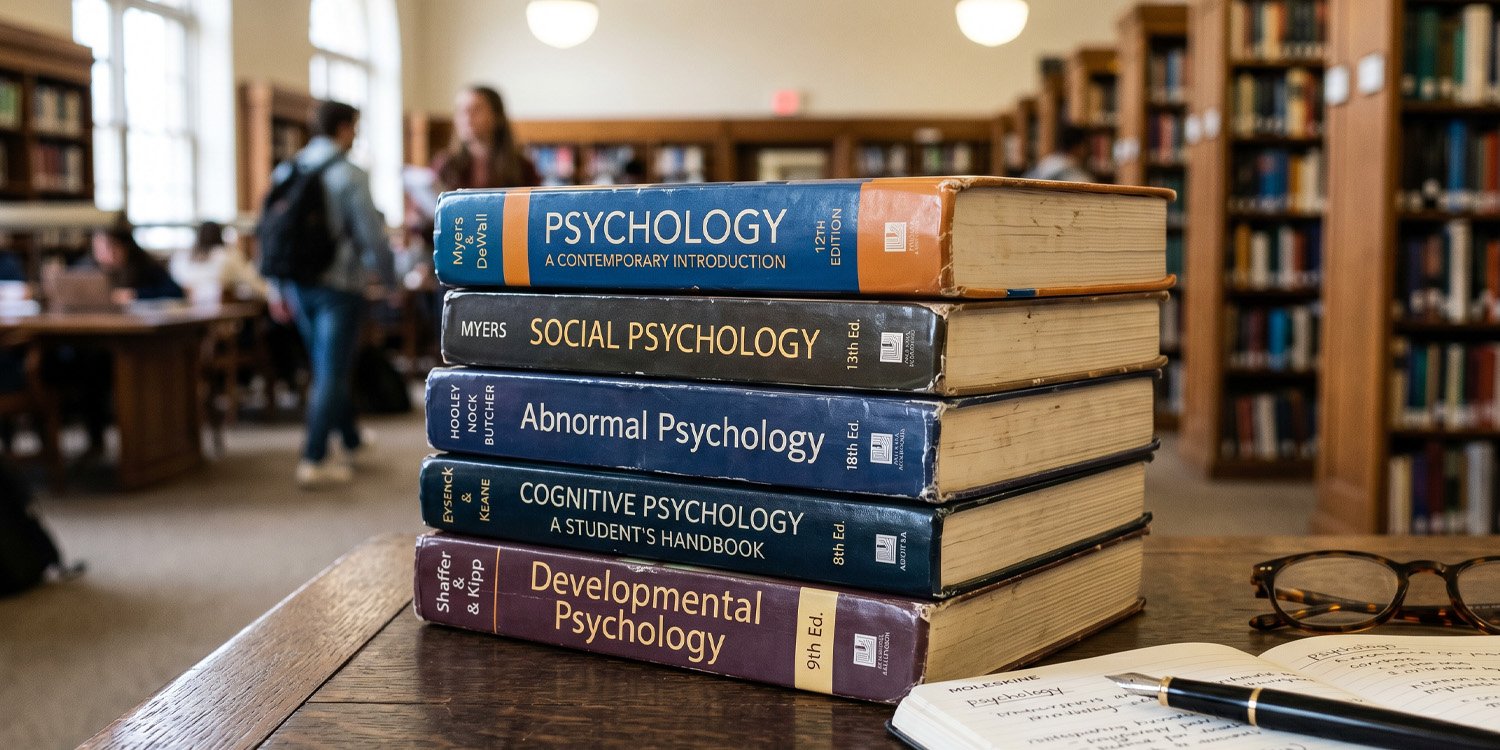
Recent research published in Journal of General Psychology Our findings suggest that many introductory psychology textbooks misrepresent scientific findings and repeat long-standing myths. Although there has been slight improvement over the past few years, this study provides evidence that textbooks still struggle to accurately represent controversial topics and historical events. This ongoing problem means that college students may be learning an overly simplified or biased version of psychology.
In recent years, scientists have noticed a problematic trend in the way psychology is taught to college freshmen. Many textbooks repeat famous but factually incorrect scientific urban legends used to explain scientific concepts. Textbooks also tend to exaggerate the level of agreement among scientists on controversial issues, often leaning toward politically progressive viewpoints.
Researchers Jeffrey M. Brown of Texas A&M International University and Christopher J. Ferguson of Stetson University wanted to track whether these known issues had been fixed. They sought to assess whether publishers updated their materials to reflect the most accurate scientific evidence.
“I was talking to a co-author and he mentioned that he was reading about how the Stanford prison study seemed to be somewhat exaggerated,” Brown explained. “Then I talked about what I had read a while back about the Kitty Genovese case and how the story had been exaggerated and omitted some facts.”
Brown noted that researchers have personal experience that topics such as video game violence are under-represented. He noted that textbook authors often misrepresent the strength and consistency of evidence on one side of an ongoing debate or simply ignore the existence of an argument.
To avoid relying solely on their own opinions, Brown and Ferguson first conducted a pilot study to determine which topics were most problematic. They contacted psychology professors teaching at four-year colleges across the United States. The researchers randomly selected eight universities in each of the 50 states and invited one professor from each school.
Of the 393 applications sent in spring 2018, 34 professors responded to the open-ended survey. These professors were asked to list up to 10 areas that they felt were not adequately covered in introductory textbooks. From these responses, the researchers identified 11 commonly mentioned topics for further consideration.
Some of these topics included historical events such as the Stanford Prison Experiment, the Kitty Genovese Murder, and the Little Albert Experiment. For example, the Little Albert experiment is often cited to explain how humans learn fear, but historical review shows that the original research was highly flawed and had little success. By treating these events as simple facts, textbooks may be conveying a scientific myth.
Another historical myth evaluated in the study was the story of Phineas Gage. Gage was a railroad worker who survived a metal rod stuck in his brain, but textbooks often claim that the accident permanently destroyed his character. Textbooks tend to ignore historical evidence that Gage later recovered enough to take a job as a stagecoach driver.
Other topics chosen for this study were controversial scientific debates such as video game violence, corporal punishment, and the influence of evolutionary psychology. The researchers also included brain plasticity, which refers to the brain’s ability to change and adapt as a result of experience. Another topic is stereotype threat. The idea is that people perform worse on tests when they feel they are at risk of confirming negative stereotypes about their social group.
With this list of 11 topics, the researchers looked at 16 introductory psychology books available in 2018. Two independent raters read the sections covering these topics and scored them on a 4-point scale. A score of 1 means the topic is not included, and a score of 4 means the coverage is completely unbiased.
To determine bias toward controversial topics, the researchers looked for one-sided coverage that presented highly controversial issues as incontrovertible facts. Regarding historical myths, bias was noted when textbooks presented known falsehoods as factual events. For example, the story of Kitty Genovese is often used to demonstrate the bystander effect, with textbooks claiming that 38 people witnessed her murder and did nothing, but historical records show this version to be largely inaccurate.
Researchers found a high degree of bias across 2018 textbooks. These books performed well when it came to certain biological topics, sometimes simply by omitting them altogether. In contrast, textbooks are much more likely to contain errors when discussing classic psychology experiments or sensitive social issues such as stereotype threat or video game violence.
To see if things had changed, Brown and Ferguson repeated the exact same process five years later. In the spring of 2023, they collected and evaluated 18 new introductory psychology books. Scientists compared two batches of textbooks over five years using the same scoring method.
The results of the 2023 textbook survey were mixed. We’ve improved our reporting on some topics, like video game violence and the Kitty Genovese story. But coverage of other topics, such as corporal punishment and brain plasticity, actually became more biased.
“We were surprised at the number of topics we found that still had issues,” Brown said. “Although the situation appears to have improved somewhat over the past decade, there remains insufficient coverage of some controversial topics.”
A major trend in books in 2023 was an increasing tendency to omit problematic topics altogether. Rather than correct conventional wisdom or explore the nuances of controversial arguments, many textbook publishers simply deleted the content. While this reduces the presence of misinformation, the researchers suggest it also means missed opportunities to teach students about the evolving nature of science.
Although this study examines the accuracy of textbooks in detail, there are some limitations to consider. First, even when using a standardized scoring system, measuring bias can be subjective. Professor Brown said the biggest limitation was that the findings were based solely on the ratings of two psychology professors.
“I think it would be great if there was a larger, more honest effort by groups like the American Psychological Association to look into this issue,” Brown explained. “Unfortunately, APA itself has often issued very biased policy statements. So I hope that in the future, APA will change course and lead better by example, even if that means admitting that the research field is in disarray, or even if we don’t have definitive answers.”
Ultimately, the researchers hope to make students aware of these issues. “We hope readers understand that some of the stories and research detailed in some introductory psychology textbooks are only part of the whole, or may not be detailed enough that some topics are more nuanced,” Brown said.
He emphasizes to his students that these historical debates still lead to a powerful body of research that influences the field. “But as the saying goes, not everything you read in a book is true,” Brown added. “Unfortunately, that also applies to textbooks.”
The study, “Have introductory psychology textbooks gotten better at representing psychological science?” was authored by Jeff Brown and Christopher J. Ferguson.
