


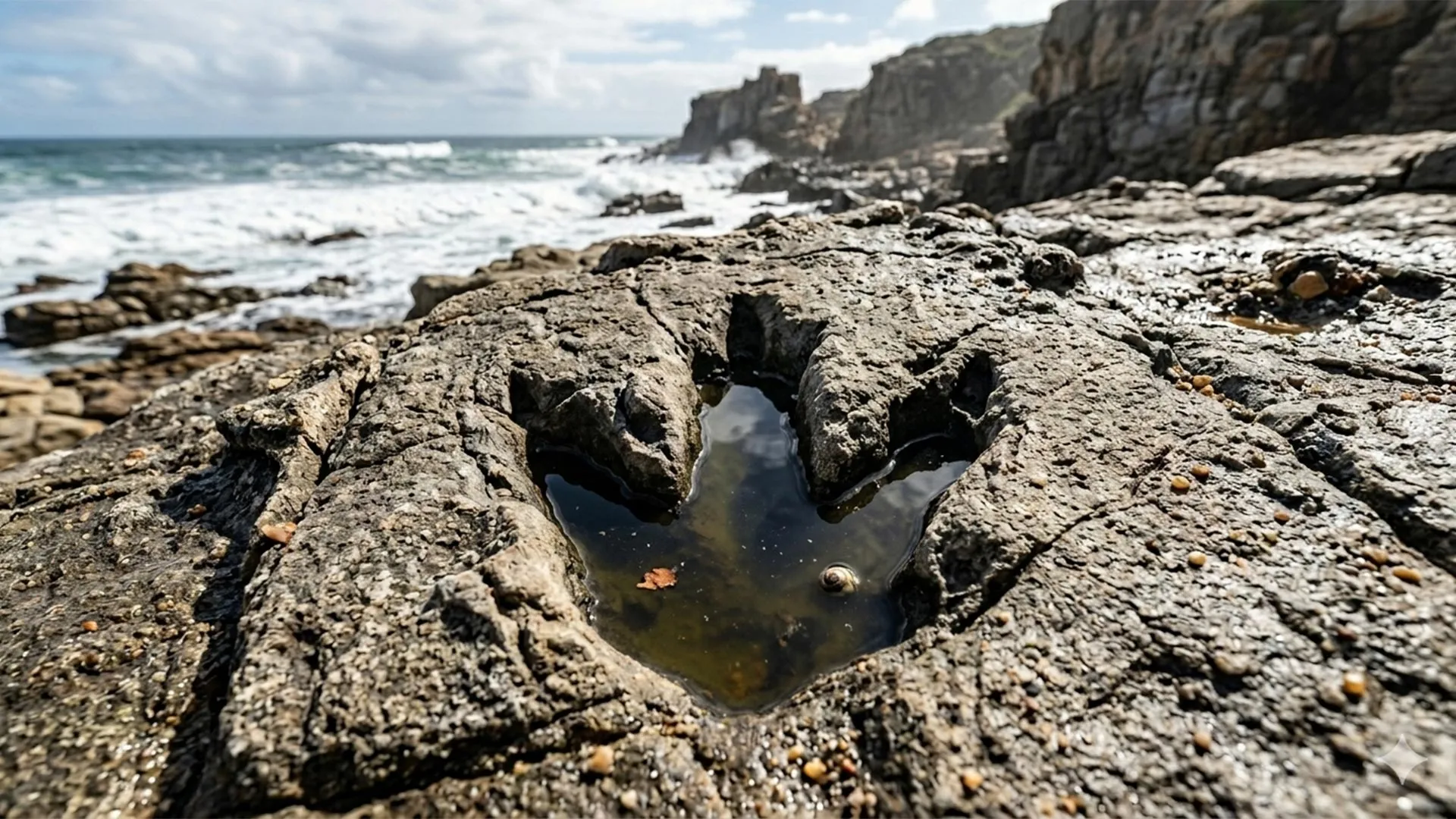
Southern Africa is famous for its rich record of prehistoric life, including dinosaurs. But about 182 million years ago, a massive volcanic eruption spread lava across much of the inland Karoo Basin, once home to many dinosaurs. After this event, the region’s fossil record becomes surprisingly quiet during the Jurassic period (which lasted from 201 million years ago to 145 million years ago).
Recent discoveries are starting to change that. These studies show that dinosaurs continued to live in southern Africa even after the dramatic lava flows.
New dinosaur footprints on South African coast
In 2025, scientists reported dinosaur footprints from around 140 million years ago on a remote coastline in South Africa’s Western Cape. These were the first footprints of that era (Cretaceous period, 145 million to 66 million years ago) in this region.
Now, researchers have found even more evidence.
As ichthyologists (studying fossil footprints and tracks), the team regularly works along the Western Cape coast near Knysna. Most of their research focuses on footprints preserved in coastal aeolianites (cement dunes) that are between 50,000 and 400,000 years old.
During a visit in early 2025, they explored a small rock outcrop that was formed during the early Cretaceous period. It is the only place where the original rock is exposed nearby, and most of it is submerged under water at high tide. The researchers hoped they might find theropod (dinosaur) teeth like the one found there by a 13-year-old boy in 2017.
Instead, they found something more exciting. Linda Helm, a member of the group, discovered dinosaur footprints. Upon closer inspection, it was discovered that there were more than 20 possible footprints.
A small site with a big meaning
The Brenton Formation has a very small outcrop, less than 40 meters long and 5 meters wide, with cliffs rising up to 5 meters above the shore. The discovery of dozens of footprints in such a limited area suggests that dinosaurs were fairly common in the area during the Cretaceous period.
Researchers estimate that the traces are approximately 132 million years old. As such, these are the youngest dinosaur footprints known from southern Africa (50 million years younger than the youngest footprints reported in the Karoo Basin). These are also the second known Cretaceous dinosaur footprints in South Africa and the second in the Western Cape. Some footprints are left on flat rock surfaces, while others appear as cross-sections in cliffs.
Dinosaur fossil record in southern Africa
Southern Africa has an extensive record of vertebrate footprints and traces from the Mesozoic era (the “age of dinosaurs” from 252 million years ago to 66 million years ago, including the Jurassic period), particularly in the Karoo Basin, which is filled with thick layers of sedimentary rock.
Triassic and Jurassic footprints are common in Lesotho and neighboring areas of South Africa, including the Free State and Eastern Cape provinces.
However, subsequent volcanic activity led to the formation of the Drakensberg Group, which covered many of these fossil-bearing layers with lava. Although some dinosaurs may have survived the initial eruption for a short time, they may have been among the last animals living in the Karoo Basin at the time.
When the supercontinent Gondwana began to break up near the end of the Jurassic and early Cretaceous periods, small basins formed in what are now the Western and Eastern Capes. These areas contain limited sediments from the Cretaceous period.
Body fossils from these deposits, mainly in the Eastern Cape, include a variety of dinosaurs. These include sauropods, coelurosaurids, and young iguanodonts, as well as the first known dinosaur in the southern hemisphere (now known to be a stegosaur).
In contrast, fossil remains from the Western Cape are rare. They include several isolated sauropod teeth, scattered bones possibly belonging to sauropods, and two finds near Knysna – a previously discovered theropod tooth and part of a tibia.
Now the focus has shifted from the bones to the footprints.
dinosaurs of knysna
The newly discovered footprints are located in the modern intertidal zone, which is covered by seawater during two high tides a day.
The environment 132 million years ago would have been very different from today’s coastlines, estuaries, and developed landscapes. At that time, dinosaurs likely migrated along currents and point bars, surrounded by plants that are not found in the area today.
The footprints appear to have been made by a mixture of dinosaurs. These include theropods and possibly ornithopods (both of these types of dinosaurs were bipedal and bipedal), as well as the possibility of sauropods (giant quadrupedal dinosaurs with very long necks and very long tails). Theropods were carnivorous, while ornithopods and sauropods ate plants.
It can be difficult to determine the exact type of dinosaur from footprints alone. Theropod and ornithopod tracks can be similar, and although sauropod tracks are larger, they do not always show distinct footprints.
Because of these challenges, researchers decided not to “overinterpret” trackmakers. Their research focuses on documenting the presence and abundance of dinosaur footprints from this era in the Brenton Formation.
More discoveries may occur in the future
The presence of Early Cretaceous dinosaur footprints in both the Robberg and Brenton formations suggests that many more remains may still be waiting to be discovered. Other non-marine Cretaceous rock exposures exist in the Western Cape and Eastern Cape.
Future systematic exploration of these areas may reveal additional dinosaur bones, more footprints, and perhaps traces of other ancient animals.
Mark G. Dixon and Fred Van Berkel of Nelson Mandela University’s Center for African Coastal Paleosciences contributed to the study.
