


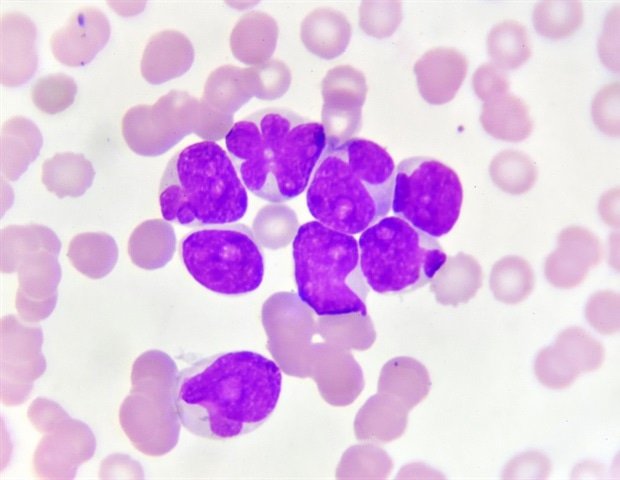
Macrophages, much like Alice in “Alice in Wonderland,” recognize and consume tumor cells that display surface markers that say “eat me.” However, if tumor cells can successfully emit a “don’t eat me” signal, they can evade detection by macrophages. To combat this, researchers have developed drugs aimed at turning off these “don’t eat me” signals. However, these treatments are not as effective as hoped for patients with acute myeloid leukemia (AML) and other blood cancers. To better understand why, a team of researchers from Massachusetts General Brigham, Dana-Farber Cancer Institute, the Massachusetts Institute of Technology and Harvard University’s Broad Institute examined samples taken from patients treated for AML at Massachusetts General Brigham. The team was led by Jooho Chung, MD, PhD, Mounica Vallurupalli, MD, Todd Golub, MD, and Robert Manguso, MD.
The research team conducted a genome-wide loss-of-function screen of AML cell lines, systematically turning off individual genes and cataloging genes that influence detection by macrophages. Surprisingly, the classical CD47 “don’t eat me” signal was only weakly effective. Instead, the researchers found that another signal, CD43, had a much stronger effect on macrophage detection. Their findings suggest that CD43-targeted therapies may hold promise for treating AML patients and potentially a wider range of cancers.
sauce:
Reference magazines:
Chung, J. Others. (2026). Sialylated CD43 forms a glycoimmune barrier that suppresses anti-leukemic immunity. Science. DOI: 10.1126/science.ady5196. https://www.science.org/doi/10.1126/science.ady5196
