


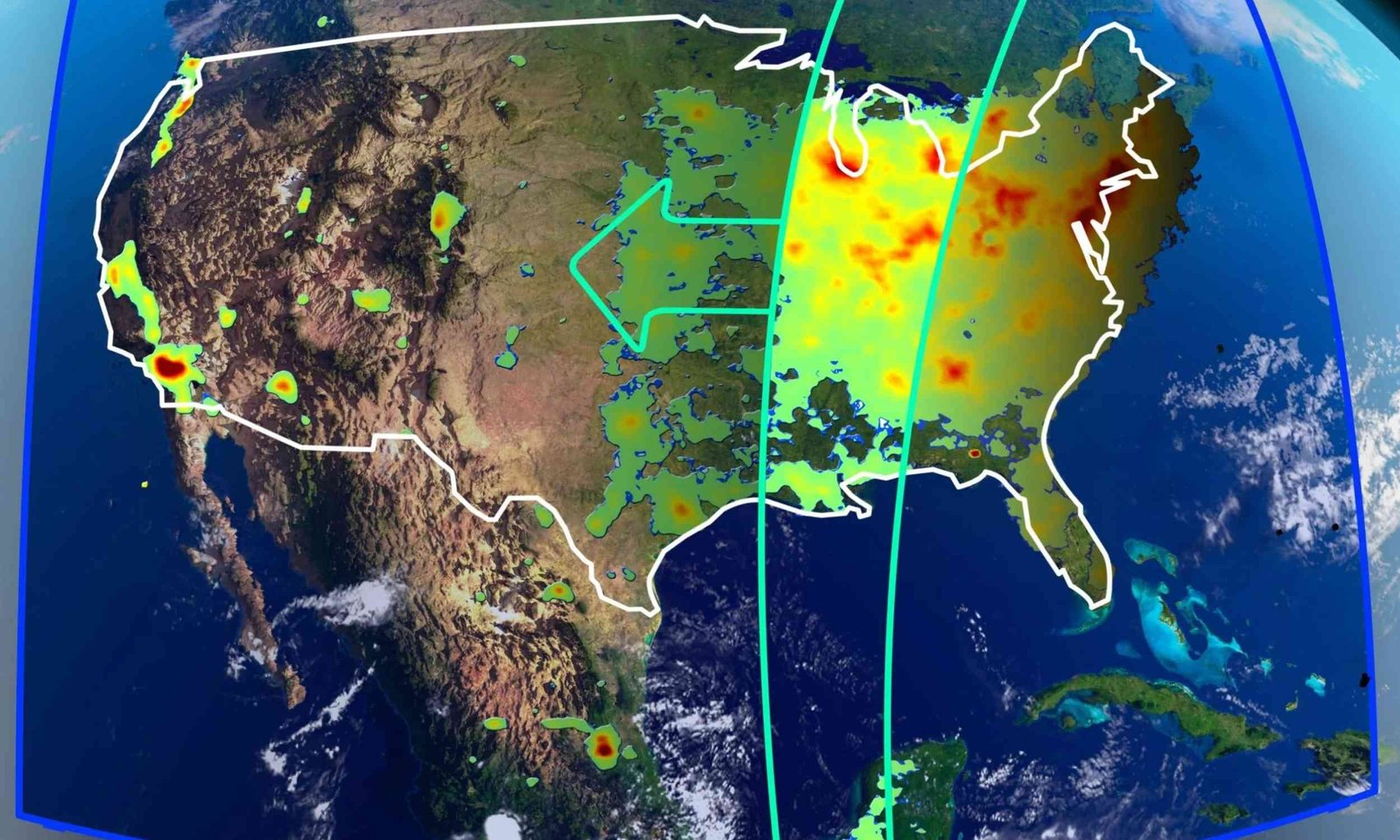
Researchers have found that NASA’s PACE satellite can detect nitrogen dioxide pollution with enough precision to isolate emissions from individual factories and highway corridors.
This new level of detail turns widespread atmospheric haze into a traceable source and reshapes the way pollution is identified, managed, and reduced.
What the map shows

Across Los Angeles and other monitored areas, the satellite’s new map separates nitrogen dioxide into separate plumes that were previously mixed.
Based on these observations, Zachary Fasnacht of NASA’s Goddard Space Flight Center demonstrated that PACE can distinguish nearby emission sources rather than merging them into a single signal.
In these same scenes, each measurement pixel captures a much smaller area, allowing individual pollution streams to be more clearly distinguished.
Even with that precision, the system still relies on favorable viewing conditions, placing clear limits on when and where the sharpest details can be achieved.
How PACE learned
PACE’s Ocean Color Instrument (OCI) was built to monitor oceans, clouds, and aerosols, not track roadside emissions.
One pre-launch study showed that OCI retained enough light pattern detail for software to capture nitrogen dioxide.
To turn that potential into a product, the researchers used machine learning (software that learns patterns from examples) trained on TROPOMI, a European satellite instrument that measures air pollutants from space.
Because TROPOMI already provides well-tested measurements of nitrogen dioxide over a large area, it provided a baseline from which PACE could learn about the gas on a more granular scale.
Why pixels become sharper
As the map becomes clearer, city blocks no longer look like entire cities, and one plant no longer hides another.
Gas signatures are associated with smaller areas, allowing authorities to track highway corridors, ports and industrial sites more directly.
This improves health studies because people breathe air near specific roads and smokestacks, rather than the average across the county.
“These data may enable emissions estimates with reduced uncertainty and higher spatial resolution,” Fasnacht wrote.
How gas works
Burning fuel or wood releases nitrogen dioxide, a reactive gas produced during combustion, which leaves the same footprint in tailpipes, power plants, and fires.
Sunlight creates ozone on the ground, creating near-surface smog that irritates the lungs and stresses crops.
This chemical reaction plays out downwind, so seeing where the nitrogen dioxide starts gives forecasters strong clues about where ozone is likely to rise.
The new product does not replace ground monitors, but adds a wider field of view that street stations cannot provide.
Test satellite accuracy
To confirm the map, the team compared satellite measurements with a ground-based network that measures nitrogen dioxide directly from sunlight.
These tests showed that PACE and TROPOMI performed similarly, with both tending to produce approximately 10% to 20% lower measurements.
At about a mile in diameter, PACE can be checked against local conditions more accurately than the broader TROPOMI footprint.
Verification is still ongoing, so the strongest claims today concern clear skies and strong signal locations.
Data now available
NASA has already posted a new trace gas dataset on Earthdata, with coverage starting March 5, 2024.
In addition to nitrogen dioxide, this release includes an ozone column and quality flags to mark clouds, weak geometry, and insufficient radiation data.
These warnings are important because poor viewing angles or lingering clouds can make the map look sharp and misleading.
Ease of public access means cities, medical researchers, and aviation organizations can quickly test use without having to wait years.
Limits on the water
Water remains harder than land because changes in surface reflection can mimic or mask gas signals in the light.
In an official document, researchers warn that ocean scenes work best when the nitrogen dioxide signal is strong.
Near the equator, changes in instrument tilt can produce strange terrain, and errors are even greater for highly tilted views above the water.
These warnings don’t erase progress, but they pinpoint where improvements need to be made in the next software release.
Adjust your pace to match the tempo
PACE doesn’t work alone, as NASA’s TEMPO mission monitors North America throughout the day.
While PACE sharpens the image once a day, TEMPO tracks how the plume moves, spreads, and changes direction over time.
When used together, agencies can see both source patterns and hourly drifts that bring contamination into neighborhoods.
This combination could make satellite atmospheric data even more useful for same-day decision-making during rush hours and industrial pollution events.
Second reward
The contamination products could also be useful for the rest of PACE’s science, even though the mission was not built for this mission.
Nitrogen dioxide and ozone both absorb light, so measuring them directly can improve the cleanup applied before ocean color analysis.
This is important because near coasts and cities, polluted air can distort how satellites interpret surface reflections.
Thus, the mission launched for plankton and aerosols has acquired a second life as an air quality tool.
What happens next after PACE?
PACE has transformed from an ocean and aerosol mission to a much clearer pollution mapper that shows where dirty air starts and moves.
As validation expands and water algorithms improve, satellites may become even more useful in everyday health management, planning, and emissions tasks.
This research NASA earth data.
—–
Like what you read? Subscribe to our newsletter for fascinating articles, exclusive content and the latest updates.
Check us out on EarthSnap, the free app from Eric Ralls and Earth.com.
—–
