


A major new research effort is set to shed light on a remarkable Roman-era discovery in Frankfurt, Germany. The German Research Foundation (DFG) and the Swiss National Science Foundation (SNF) have jointly awarded a grant of over 1 million euros to support research into the great Roman sanctuary in the ancient city of Nida (Frankfurt-Hedernheim). Over the next three years, researchers will carry out a detailed investigation of what is believed to be one of the most important recent discoveries in Roman Germania.
The project, entitled “Exploring the dynamics of Roman sanctuaries — an interdisciplinary study of the spatial organization and deposits of the central sanctuary of Nida Hedernheim,” brings together experts from multiple institutions. Participants include the Frankfurt Archaeological Museum (Dr. Carsten Wenzel); Goethe University Frankfurt Archaeological Institute (Professor Anja Klöckner, Classical Archaeology; Professor Markus Scholz, Archeology and History of the Roman Province; Professor Astrid Stobbe, Botanical Archeology). and the Institute for Integrated Prehistoric Sciences and Archeology (IPNA) at the University of Basel (Prof. Sabine Deschler-Erb (ⴕ), Dr. Barbara Stop). Additional partners include the Frankfurt City Monument Office (Denkumaramt) and the Romano-Germanic Commission (RGK) of the German Archaeological Institute.
The initiative was formally introduced at a press conference at the Frankfurt Archeology Museum.
Underscoring the importance of this discovery, Dr. Ina Hartwig, Frankfurt’s Culture and Science Commissioner, said: “The central cult quarter of Nida represents an archaeological discovery of almost unparalleled importance in Europe. Furth will be further established as an international center for cutting-edge research. This project is proof of the strength of our research environment when museums, universities, non-university research institutions and heritage conservation work together to make research visible in the city.”
Roman cult complex discovered during school construction
The sanctuary was uncovered during excavations carried out by the Monuments Authority between 2016 and 2018, and again in 2022 in Frankfurt’s Nordweststadt district. The work was carried out during the construction of the new Römerstadtschule, where archaeologists excavated more than 4,500 square meters in the heart of the ancient Roman city.
Excavations have revealed walled ruins that have remained largely untouched since Roman times. The site has been almost completely excavated and carefully recorded using modern archaeological techniques to preserve a clear picture of its original layout.
Frankfurt City Council Member for Planning and Housing Markus Guwechenberger emphasized the importance of this discovery, saying, “The newly discovered cult quarter of the Roman city of Nida is one of the most important archaeological discoveries in Frankfurt in recent years. The funding has made it possible to carry out a detailed scientific analysis of this exceptional discovery. At the same time, it recognizes the continued and highly professional work of the City Heritage Department. This project also shows how urban development and research work together.” Frankfurt, discovered during the construction of the new Römerstadtschule, vividly illustrates how past and future intersect in our city. ”
Evidence of ritual activity and offerings
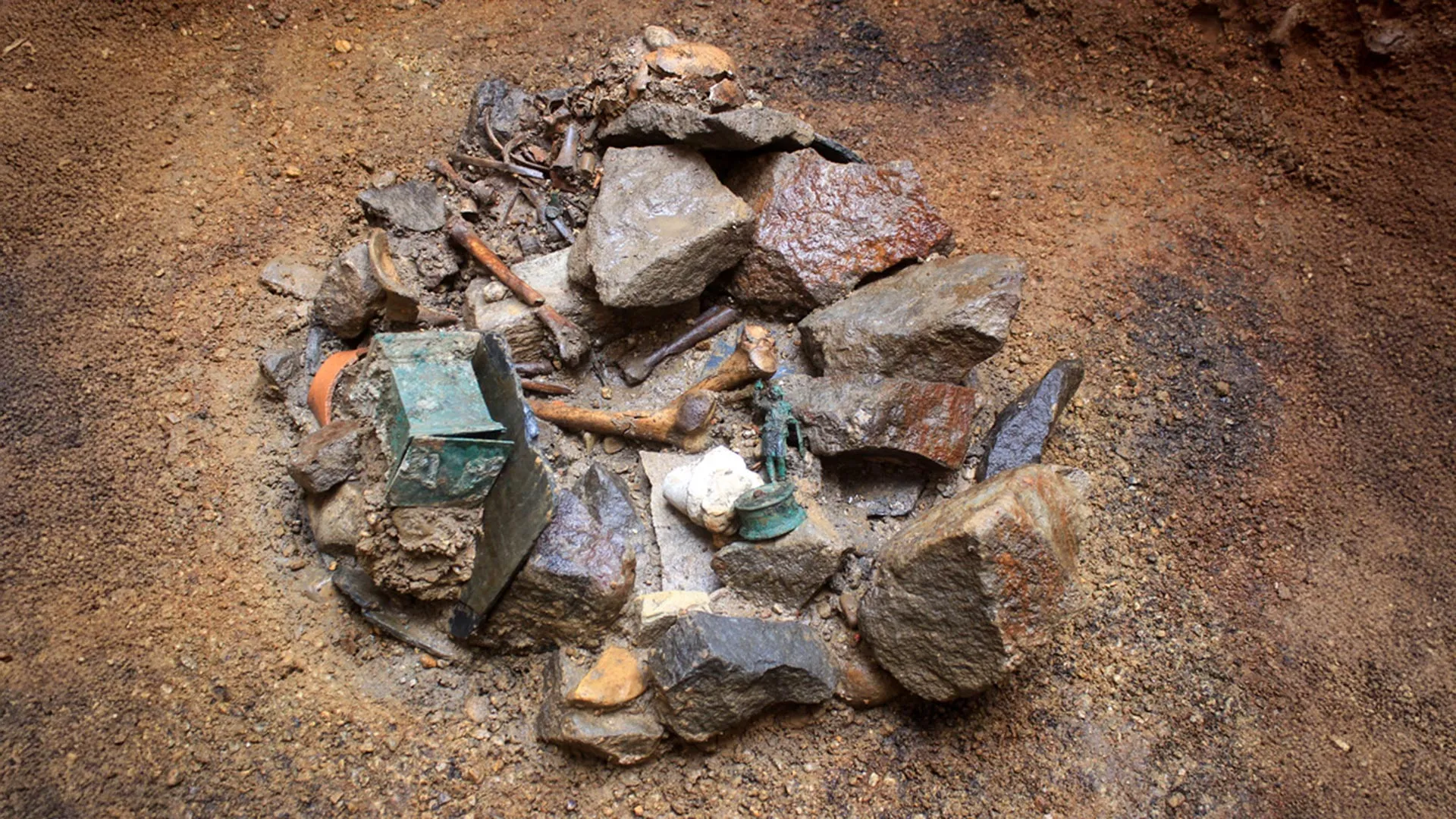
The sanctuary includes 11 stone buildings built in several stages, as well as around 70 shafts and 10 pits used for (ceremonial) deposition. The layout of the buildings is very unusual, with no known similarities in the Roman provinces of Germania or Gaul.
Archaeologists found more than 5,000 pieces of painted wall plaster, along with bronze fittings from doors and windows, indicating a richly decorated structure. The shafts and pits contained ceramic vessels and large quantities of dead plants and animals, including fish and birds. These materials are believed to be the remains of ritual meals and offerings to the gods. Researchers collected 150 samples for detailed archaeozoological and archaeobotanical analyses.
Further insight comes from 254 Roman coins and more than 70 silver and bronze garment clasps (fibulae), some of which are still intact. These items are usually associated with offerings at Roman religious sites. However, researchers have also identified possible evidence of human sacrifice, which would be an extremely rare find in this region.
Despite the wealth of documentation, it remains difficult to determine exactly which deity was worshiped. Inscriptions and images suggest the existence of several gods, including Jupiter, Jupiter Dolichenus, Mercurius Arateus, Diana, Apollo, and Epona. This combination indicates that the sanctuary may have served as an important regional center dedicated to multiple gods.
Current evidence suggests that the site was founded in the early 2nd century AD. A dedication by a soldier to Mercurius Arateus, dated September 9, 246 AD, indicates that the sanctuary remained active until at least the mid-third century AD.
New research aims to reconstruct Roman ritual life
The newly approved funding highlights the growing importance of archaeological research in the Frankfurt region and reflects the strong cooperation between institutions in the Rhine-Main region and beyond.
By combining multiple scientific approaches, the research team aims to better understand how the sanctuary was used. The focus is on analyzing the layout of the building and the patterns of the materials deposited to reconstruct the rituals that once took place there. The project will also place the Sanctuary of Nida within the broader context of the religious landscape spanning the northwest Roman provinces. Five young researchers will participate in the project as part of their doctoral and postdoctoral programs.
The broader significance of Nida in Roman history
The new study builds on decades of past excavations at Nida, which have already revealed important details about the city’s development and layout. Just over a year after the publication of the Silver Inscription of Frankfurt, the oldest known Christian testimony north of the Alps, the ancient site is once again in the spotlight.
Researchers now have a unique opportunity to examine Roman religious practices in detail, including temples, offerings, and ritual practices. The exceptional state of preservation of this site highlights the importance of Nida as an important center of Roman Germania.
Founded as a military base in the 70s of the 1st century AD, Nida grew into a major economic and cultural center by the early 2nd century AD. Known for its cultural diversity, the city remained one of the most important urban centers in the region until it was abandoned around 275-280 AD.
