


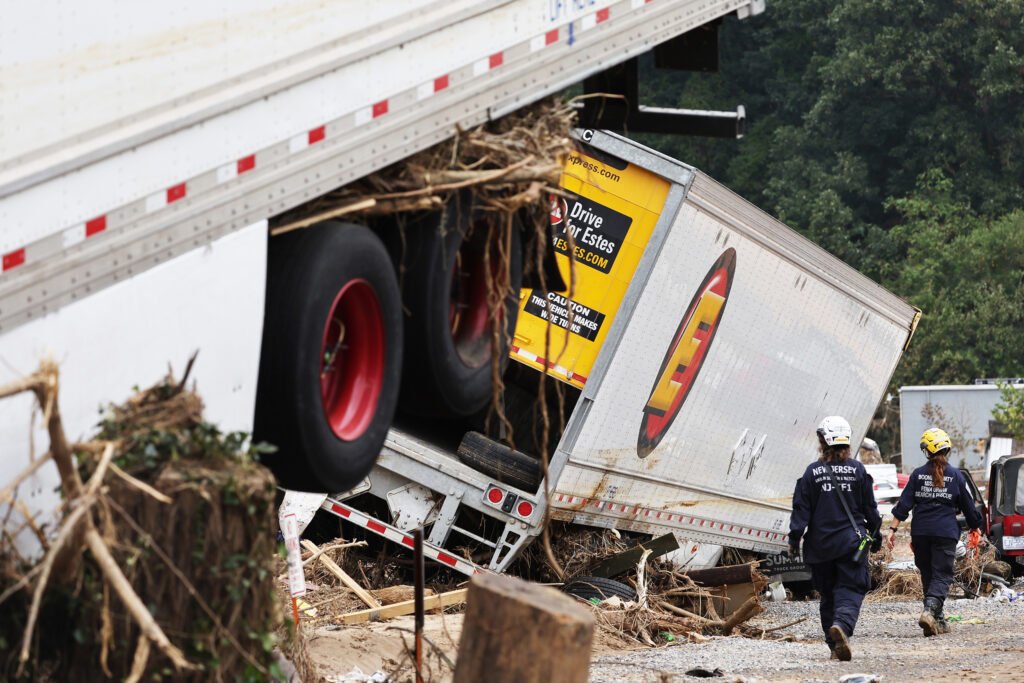
ORLANDO, Fla.—A massive conference to help local residents prepare for hurricane season opened Monday without an agency coordinating the federal disaster response.
Representatives from the Federal Emergency Management Agency blamed the absence from the National Hurricane Conference on the partial government shutdown.
The conference is one of the largest aimed at helping communities prepare for the Atlantic hurricane season, which begins June 1st. More than 1,800 local and state emergency managers signed up to participate, as did representatives from other federal agencies, nonprofits such as the Salvation Army, and businesses such as Publix and Home Depot. The meeting ends on Thursday.
“Due to continued funding shortfalls, FEMA is unable to participate in National Hurricane Conference training,” a statement provided to Inside Climate News said. “These trainings and collaborations are essential to preparedness, and FEMA regrets that we cannot operate as usual. This closure directly impacts our ability to support our communities when it matters most.”
FEMA, an agency of the Department of Homeland Security, has been closed for more than a month as lawmakers battle over spending deals and the Trump administration’s immigration crackdown.
FEMA itself has been in turmoil since President Donald Trump called for fundamental changes at the agency early in his second term, saying states should be more involved in disaster response.
The administration ousted FEMA last May after he told Congress that FEMA should not be abolished. Hamilton’s successor, David Richardson, resigned several months later, citing the ineffectiveness of Republicans and Democrats in responding to deadly July 4 flooding in the Texas Hill Country. Karen Evans, a political appointee specializing in cybersecurity and national security, was sworn in as acting administrator on December 1.
A report from the FEMA Review Board, which was appointed to consider ways to reform FEMA, is still overdue. Kevin Guthrie, director of the Florida Department of Emergency Management and a member of the council, told reporters at a meeting briefing that the report is on hold due to the partial shutdown.
“At the end of the day, we are in a natural evolutionary position for the next evolution of emergency management,” he said. “Even though we are broken, we are still the best emergency management program in the world.”
Guthrie said FEMA’s absence has given state and local governments an opportunity to step up.
“Just because they’re not here doesn’t mean the meeting is suspended,” he said. “The president certainly called on states and local governments to do more.”
At the conference, attendees heard from Michael Brennan, director of the National Hurricane Center in Miami, about new ways to communicate forecasts to improve storm response. Presentations were made about Puerto Rico’s nine-year recovery from Hurricane Maria and Jamaica’s recovery from Hurricane Melissa, which hit the island last year. Another session focused on how changes in federal policy may impact other agencies involved in disaster response.
Brennan expressed concern that some Americans will be slower to prepare this year after the U.S. finished last season relatively unscathed. This is the first time in 10 years that no hurricane has made landfall. The only named storm that threatened land was Chantal, which made landfall as a tropical storm near Litchfield Beach, South Carolina, on July 6, causing less than $500 million in damage.
“It doesn’t really matter what the seasonal forecast says,” he told reporters at a briefing. “That risk exists and we have to be prepared to be affected every year.”
Jeremy Knighton, assistant fire chief for the Asheville, North Carolina, Division of Emergency Management, told Inside Climate News that FEMA’s absence from the meeting was a loss.
“There’s always going to be some level of uncertainty,” he says. “But the uncertainty surrounding FEMA only complicates an already complex event.”
About this story
As you may have noticed, this article, like all news we publish, is free to read. That’s because Inside Climate News is a 501c3 nonprofit organization. We don’t charge subscription fees, keep our news behind paywalls, or fill our website with ads. We provide climate and environmental news free to you and anyone who wants it.
That’s not all. We also share our news for free with dozens of other news organizations across the country. Many of them cannot afford to do their own environmental journalism. We’ve established bureaus across the country to report on local news, partner with local newsrooms and co-publish stories to ensure this important work is shared as widely as possible.
The two of us started ICN in 2007. Six years later, we won the Pulitzer Prize for national reporting and now run the nation’s oldest and largest dedicated climate newsroom. We tell the story in its entirety. We hold polluters accountable. We expose environmental injustice. We debunk misinformation. We explore solutions and inspire action.
Donations from readers like you fund all aspects of our work. If you haven’t already, will you support our ongoing work, our coverage of the biggest crises facing our planet, and help us reach more readers in more places?
Please make a tax-deductible donation. Any of those things make a difference.
thank you,

amy green
florida reporter
Amy Green covers the environment and climate change from Orlando, Florida. She is a mid-career journalist and author whose extensive reporting on the Everglades is featured in the book MOVING WATER, published by Johns Hopkins University Press, and on the podcast DRAINED, available wherever you get your podcasts. Amy’s work has been recognized with numerous awards, including the prestigious Edward R. Murrow Award and the Society of Public Media Journalists Award.
