


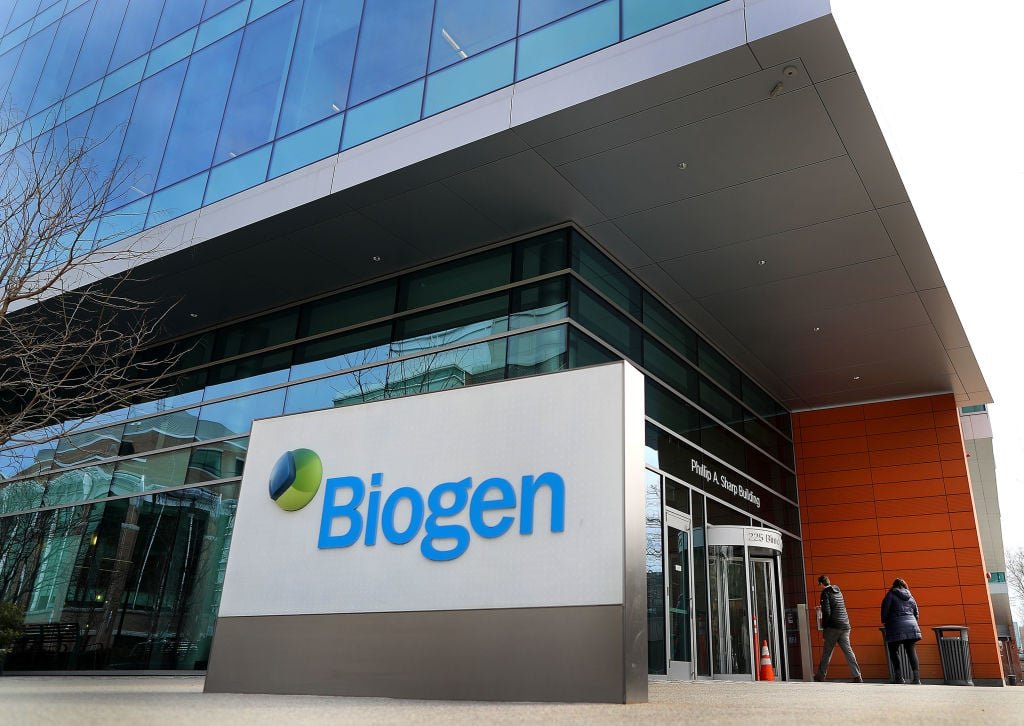
Despite a healthy roster of late-stage assets and a revenue recovery in 2025, it’s no secret that Biogen is looking for near-term revenue drivers ahead of a planned product rollout in the second half of the decade.
Currently, the company is responding by strengthening its immunology field and paving the way for future ambitions in nephrology, adding two new medicines to its active drug portfolio through M&A.
Biogen on Tuesday announced an agreement to acquire Apellis Pharmaceuticals for $41 per share in cash, for a total transaction value of approximately $5.6 billion. For Biogen, the deal provides access to Apellis’ drug Cifobre, approved for the eye disease geographic atrophy (GA), and Empaveli, approved by the FDA last year for the rare kidney diseases complement 3 glomerulopathy (C3G) and primary immune complex membranoproliferative glomerulonephritis (IC-MPGN).
Prior to that nod, Empaveli won the first U.S. approval for the treatment of paroxysmal nocturnal hemoglobinuria (PNH) in 2021.
Combined, Apellis’ two commercially available products had sales of $689 million last year, according to a March 31 press release from Biogen.
Under the agreement, which is expected to close in the second quarter, Apellis investors will also receive contingent value rights (CVR) for each Apellis share they own. Biogen said CVR could be worth up to $4 per share, depending on whether certain sales criteria for Apellis products are met.
Currently, Apellis, headquartered in Waltham, Massachusetts, has about 740 employees, and Biogen said Tuesday that it expects a “substantial portion” of Apellis’ employees to join Biogen after the acquisition. Additionally, Biogen said it will continue to work with Apellis partner Sobi on the commercialization of Empaveli outside the United States.
Biogen CEO Chris Fiebacher explained the rationale for the deal to analysts on Tuesday, saying he feels “fantastic” about the company’s late-stage pipeline, which includes Phase 3 assets such as neurology and immunology, while acknowledging that future drug launches are unlikely to start moving towards growth until around 2028.
Assessing near-term opportunities, Fiebacher said the company “doesn’t want to take on a lot of Phase 3 risk,” and is instead looking for companies with products in the early stages of product launch or just before market debut.
The CEO said Biogen also did not want to “stretch its balance sheet” through a deal and wanted to find a target to acquire at a favorable price.
“This is very much an immunology play,” Wiebacher explained, adding that with the planned acquisition of Apellis, Biogen is likely to end a major M&A move at this point.
Biogen Chief Financial Officer Robin Cramer said on a conference call with analysts on Tuesday that combined near-term sales for Chifobre and Empaveli are expected to grow in the mid-to-high teens annually “for at least the next two years,” adding that the company will adjust its 2026 outlook when it releases its first-quarter results later this year.
In particular, Syfovre, which generated $587 million in GA sales in 2025, has a large market for the drug, with approximately 1.5 million patients in the U.S., but it remains under-penetrated, Dr. Adam Keeney, Biogen’s head of corporate development, said on a conference call.
“While we know the market is competitive, we are optimistic that combining the best-in-class Syfovre with Biogen’s proven U.S. capabilities and Apellis’ sales and marketing team will help us realize the full potential of our product,” he said.
Syfovre’s complement inhibitor’s main rival in the GA space is Astellas Pharma’s Izervay, which decided to expand its label last year after first receiving FDA clearance in 2023.
Regarding Empaveli, the drug’s launch in two new renal indications is still in its early stages, and Biogen believes it can leverage its commercial strength here as well. Empaveli also provides a potential commercial “anchor” to Biogen’s broader nephrology program, Keeney said.
CEO Wiebacher echoed enthusiasm for Empaveli to serve as a broad kidney catalyst for Biogen, noting that the drug could help lay the groundwork for a potential launch of Biogen’s late-stage felzaltamab and give Biogen a “running start” to reach peak sales sooner than starting from scratch commercially.
Ferzaltanab is currently in late-stage trials for three kidney disease indications: antibody-mediated rejection, immunoglobulin A nephropathy, and primary membranous nephropathy, and Biogen expects to announce initial Phase 3 study results in the first half of 2027.
Biogen signs the deal shortly after reporting a 2% increase in sales to $9.9 billion in 2025, marking the first time since 2019 that the company has reported annual sales growth.
At the time, Biogen said it did not expect growth to continue into 2026 and expected a mid-single-digit decline for this year overall, in the range of $9.3 billion to $9.5 billion.
Apellis’ stock more than doubled following the announcement, while Biogen’s stock was down 4% by mid-morning Tuesday.
