


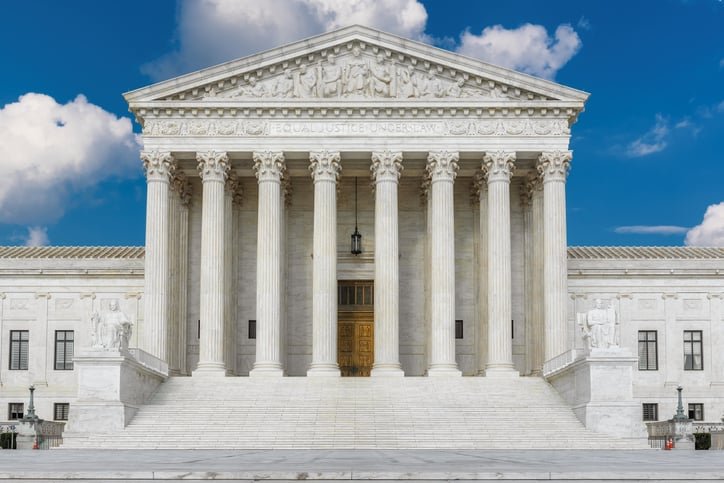
The U.S. Supreme Court has issued an emergency order temporarily blocking a Louisiana federal appeals court ruling banning the abortion drug mifepristone from being prescribed over the phone or by mail in the United States (PDF).
The new ruling allows telemedicine access to mifepristone to remain in place while the case progresses in lower courts, and the case could eventually return to the Supreme Court.
This is the second time this month that the Supreme Court has ruled against Louisiana. On May 4, three days after a lower court ruling immediately halted access to mifepristone, the Supreme Court issued an order granting an “administrative stay,” allowing time to review emergency requests by mifepristone manufacturers Danko Laboratories and GenBioPro to restore telemedicine access to the pill.
Conservative Justices Samuel Alito and Clarence Thomas dissented from the Supreme Court’s ruling Thursday, with Alito calling the latest order “remarkable” as it “undermines” the court’s 2022 decision to restore states’ right to “regulate abortion within their borders.”
Abortion supporters, meanwhile, welcomed the decision but warned that much remains to be determined.
“The telemedicine ban on mifepristone was never about safety. It was about controlling people’s bodies and lives,” Angel Foster, co-founder of the Massachusetts Abortion Access Project, said in a statement. “We know, however, that this reprieve is only temporary, as lawmakers have made clear they will use any means necessary to block access to medical abortion.”
Louisiana Attorney General Liz Murrill, who has been leading the fight against telemedicine access to the pill, said about 1,000 illegal abortions occur in the state each month (PDF).
“It is shocking that the Supreme Court would block a common-sense return to the practice and oversight of medical ethics,” Murrill said in a statement. “The Department of Justice failed to defend big pharmaceutical companies that profit from distributing illegal and unethical abortion pills. We will continue to fight.”
In 2021, the FDA lifted the requirement for in-person delivery of mifepristone, despite claims from anti-abortion activists that taking it at home was dangerous during the coronavirus pandemic.
In April 2023, the Louisiana Fifth Circuit Court of Appeals moved to ban the mailing of pills and limit mifepristone use during pregnancy from 10 weeks to 7 weeks. The ruling matched the Supreme Court’s 2022 decision overturning the landmark Roe v. Wade case.
On May 1, the New Orleans-based Fifth Circuit issued an order blocking online distribution of mifepristone in the United States in response to a lawsuit filed by the state of Louisiana. The order was a temporary measure to restrict access to mifepristone until the case is resolved. The lawsuit sought to reinstate the FDA’s previous requirement that mifepristone be prescribed only through an in-person consultation.
After the Supreme Court granted the injunction early last week, lawmakers, industry leaders and former regulators weighed in to defend mifepristone’s availability.
Nine former FDA commissioners warned in a court brief that the appellate court’s approach “undermines FDA’s gold standard science-based drug approval system” and that the decision “creates a roadmap for attacks on science-based drug regulatory decisions.”
Mifepristone was first approved in 2000 and works by blocking the hormone progesterone, which is necessary for a pregnancy to continue. This drug is often used in conjunction with another product called misoprostol, which helps induce contractions.
By 2023, the pill will account for 63% of abortions in the U.S., up from 53% in 2020. Approximately one-quarter of abortions in the United States in 2024 will be performed via telemedicine.
