


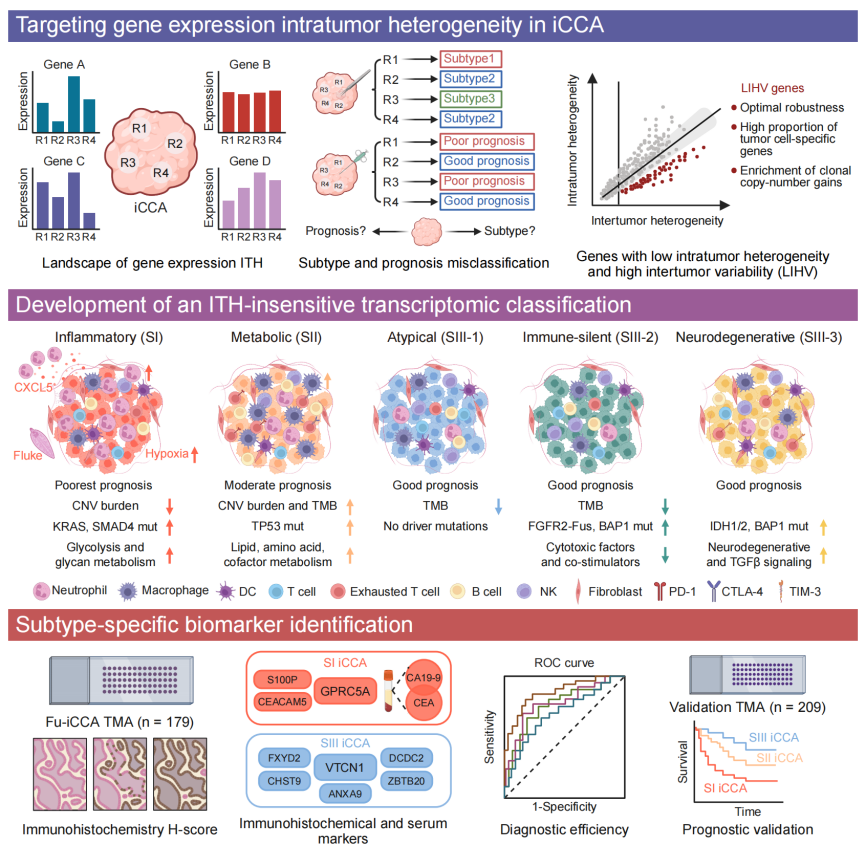
Intrahepatic cholangiocarcinoma (iCCA) is the second most common primary liver cancer after hepatocellular carcinoma, but it remains one of the most difficult malignancies to treat due to its highly occult nature and heterogeneous nature. A joint team from BGI Genomics and Fudan University Zhongshan Hospital has charted the molecular “chaos” of iCCA and provided a navigation framework for more accurate diagnosis and treatment. The study is published in Cell Reports Medicine.
1,341 gene signature to cut sampling bias
A major barrier in iCCA treatment is the significant intratumoral heterogeneity. Cancer cells derived from different regions of the same tumor can exhibit markedly different molecular properties. This means that a single biopsy often does not capture the complete biological picture. The researchers found that current classification approaches misclassify more than a quarter of tumors and up to two-thirds of immune profiles depending on biopsy location.
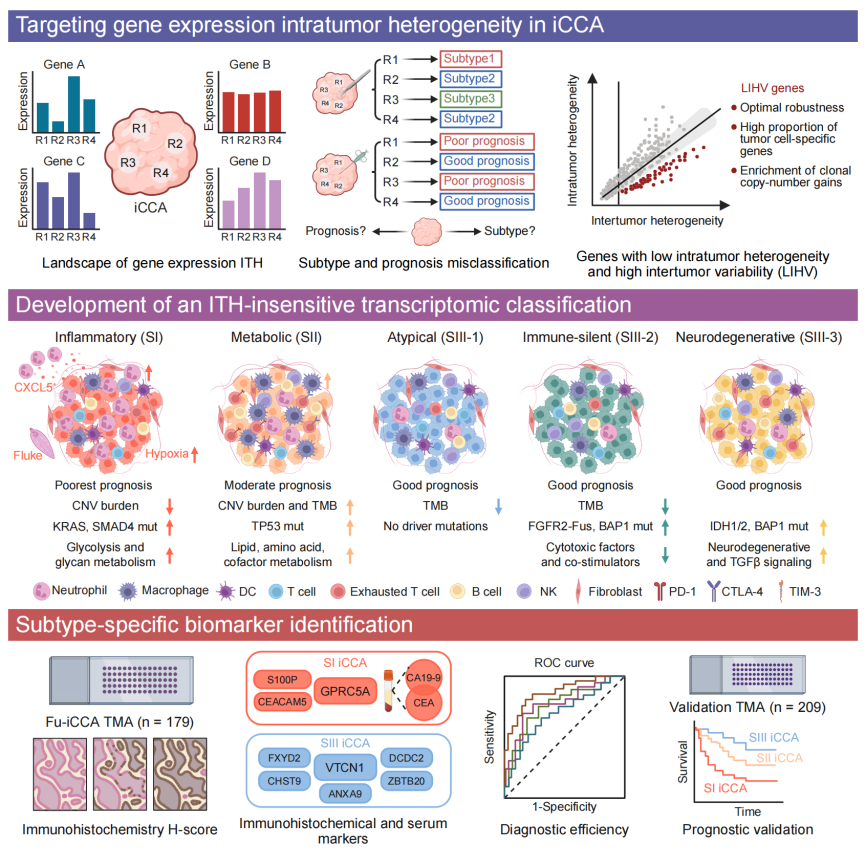
Figure 1. Molecular classification system for intrahepatic cholangiocarcinoma (iCCA). Image credit: BGI Genomics
To address this challenge, the research team identified a gene set with low intra-tumor heterogeneity and high inter-tumor variability (LIHV). This 1,341-gene signature focuses on markers that are stable within an individual’s tumor but vary widely between patients. By filtering out inconsistent “noise,” the LIHV framework allows for a more robust and reproducible classification of iCCA into five molecular subtypes, each associated with different therapeutic vulnerabilities.
Inflammatory subtype (SI): associated with the poorest prognosis and enriched in large bile duct type iCCA. These tumors frequently harbor KRAS and SMAD4 mutations and exhibit elevated serum CA19-9 and CEA levels. Their microenvironment is characterized by a strong neutrophil infiltration in which the chemokine CXCL5 plays a central role.
Metabolic subtype (SII): Shows the highest tumor mutational burden and elevated expression of multiple immune checkpoint molecules. Despite the immunosuppressive phenotype, this profile suggests potential susceptibility to immune checkpoint inhibitors and combination immunotherapy.
SIII group (SIII-1, SIII-2, SIII-3): Consisting of atypical, immunosilent, and neurodegenerative subtypes, respectively, this group is mainly associated with small bile duct type iCCA and generally shows good clinical outcomes. Distinct mutational patterns are observed, including enrichment of BAP1 mutations in SIII-2 and IDH1/2 mutations in SIII-3.
While previous studies have classified iCCA based on genetic alterations and tumor microenvironment features, this framework uniquely emphasizes genes that remain stable within the tumor, minimizing sampling bias and increasing confidence in classification.
Translating subtypes into treatment strategies
Beyond classification, the real clinical value of this framework lies in its ability to guide treatment decisions. This study demonstrated for the first time that HSP90 inhibitors can suppress tumor growth, as the inflammatory (SI) subtype is highly aggressive and often resistant to PD-1 blockade. Importantly, these agents appear to sensitize tumors to PD-1 therapy, suggesting a promising combination strategy for high-risk patients. In the neurodegenerative (SIII-3) subtype, tumors show increased expression of the immune checkpoint TIM-3. Experimental evidence indicates that dual blockade of PD-1 and TIM-3 is significantly more effective in controlling tumor progression than either treatment alone. Metabolic (SII) subtypes are contradictory. Despite their immunosuppressive phenotype, they express high levels of multiple checkpoint molecules. This suggests that combination therapy targeting CTLA-4 and LAG3 may provide a viable strategy to overcome immune resistance. Although these findings are currently in the preclinical stage, they establish a structured foundation for future clinical trials tailored to subtype-specific molecular profiles.
Practical biomarkers for clinical applications
To facilitate clinical translation, researchers have identified accessible biomarkers that serve as surrogate indicators for each subtype.
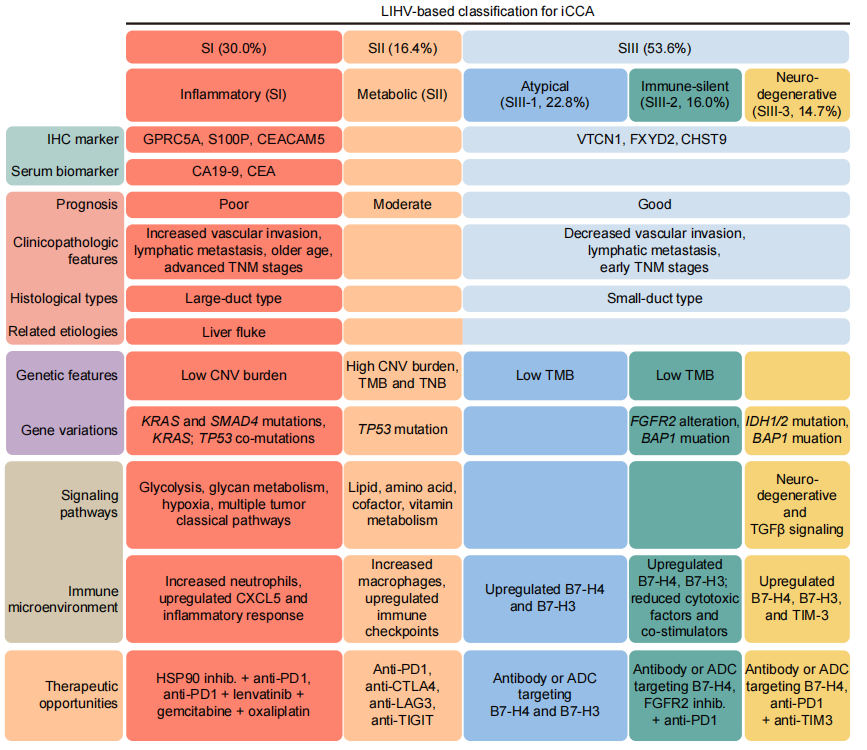
Figure 2. Overview of iCCA molecular subtype characteristics and biomarkers. Image credit: BGI Genomics
GPRC5A was identified as a specific marker for the inflammatory (SI) subtype, demonstrating a sensitivity of 71.4% and specificity of 88.9%. This marker may help pathologists identify this aggressive subtype during routine histopathological evaluation.
VTCN1 (also known as B7-H4) was identified as a marker for the SIII group with a sensitivity of 68.7% and a specificity of 80.6%. Furthermore, serum levels of CEA and CA19-9 may serve as non-invasive indicators of inflammatory subtypes, supporting the integration of molecular classification into routine clinical workflows.
Towards precision oncology in iCCA
This study provides a comprehensive “roadmap” to navigate the biological complexity of iCCA by directly linking molecular subtypes to prognosis and targeted treatment strategies. The LIHV gene signature effectively overcomes the limitations imposed by tumor heterogeneity and enables a more accurate representation of the entire tumor with a small biopsy sample. Future research will focus on validating this framework across diverse patient populations and advancing subtype-specific treatments into clinical trials. This roadmap is expected to significantly improve survival outcomes and quality of life for iCCA patients by moving beyond a one-size-fits-all approach to data-driven precision oncology.
About BGI Genomics
Headquartered in Shenzhen, China, BGI Genomics is the world’s leading integrated solutions provider for precision medicine. Our services cover more than 100 countries and territories and involve more than 2,300 healthcare institutions. In July 2017, as a subsidiary of BGI Group, BGI Genomics (300676.SZ) was officially listed on the Shenzhen Stock Exchange.
