


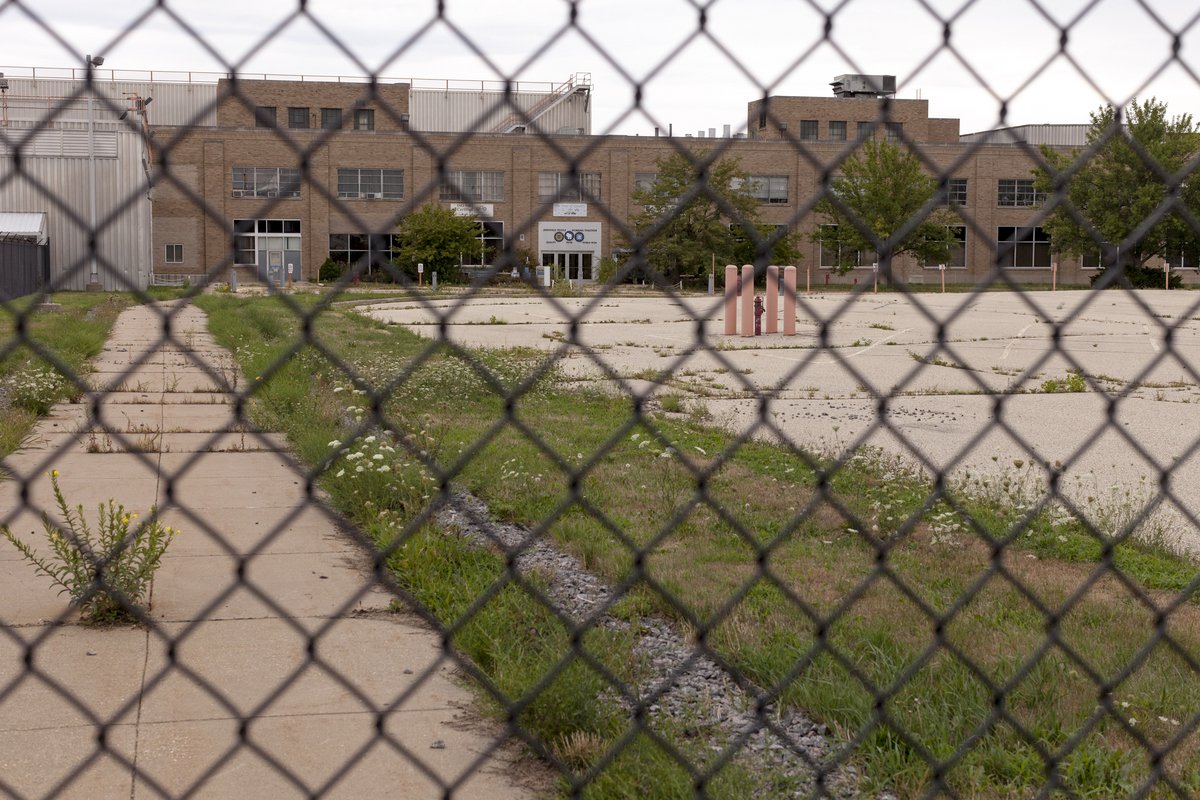
JANESVILLE, Wis. — On a polluted and abandoned parcel of land in this southern Wisconsin city, all that remains is a General Motors factory that was a proud symbol of American auto manufacturing half a century ago. However, a new industry, artificial intelligence, may soon be born there.
A Colorado-based real estate and investment firm has proposed buying the 250-acre site, cleaning it up and building a massive $8 billion data center campus.
This is a test case for the Trump administration’s plan to force this generation of industrial giants to pay for the mistakes of the previous generation.
The administration is touting the idea of redeveloping dilapidated manufacturing sites as a win-win for hollowed-out cities that need jobs and the AI industry it wants to promote. But it remains to be seen whether it can generate enough goodwill to overcome the wave of local opposition that has thwarted data center plans from Ohio to Virginia to Arizona and is swamping Democratic candidates in the midterm elections.
As data center developers scramble to find affordable land with access to water and power infrastructure, former industrial sites, broadly classified as brownfields, and even heavily contaminated Superfund sites with such facilities, are looking increasingly attractive.
When developers are pouring billions of dollars into mega-projects, the hope is that even expensive cleanups will be worth it. EPA is committed to expediting environmental reviews and providing guidance on the remediation and redevelopment process for those willing to take the risk.
“There’s no bigger need for industrial real estate right now than data centers,” said Bruce Lasher, who works on cleaning up and redeveloping auto manufacturing sites at Racer Trust, which oversees other old GM properties. “The larger the data center, the smaller and more feasible the cleanup will be as a percentage of the total cost.”
Janesville city officials say the data center could be a once-in-a-generation opportunity for the city, which is 120 miles from Milwaukee.
The hometown of former Republican House Speaker Paul Ryan, Janesville’s economy was once defined by General Motors factories. At its peak in the 1970s, it employed 7,000 people, but the factory closed during the Great Recession.
Today, the city owns the site and its decaying buildings, fences, and old railroad tracks. The area, located near homes in the residential and working-class Fourth Ward, is layered with concrete to lock in soil contaminated with pollutants from nearly a century of auto manufacturing. City officials want to make use of the land, but it cannot be redeveloped without extensive cleanup.
Now, Colorado-based Viridian Partners is offering to buy the parcel and remediate the soil, which has been contaminated with hydrocarbons, heavy metals, “forever chemicals” and other contaminants. Cleanup is estimated to cost $30 million. The site will then be converted into an 800-megawatt data center campus consisting of 11 buildings.
Supporters argue the project is the most viable option for the blighted site and Janesville’s 66,000 residents.
“There are 200 interested parties in the redevelopment and it’s not moving forward because of the contamination,” Claire Gray, director of policy and strategic initiatives for the business group Forward Janesville, said at an event hosted this month by the Journalism and Natural Resources Institute. “No other chance has ever worked.” “No other chance has ever worked.”
The project won the support of the local chapter of the International Brotherhood of Electrical Workers, thanks to Viridian’s estimates that about 600 permanent jobs and 13,000 jobs will be created during construction.
But other stores in Janesville aren’t selling.
 Old railroad tracks run through a former automobile manufacturing plant in Janesville. The photo was taken on a snowy day in March. |Miranda Wilson/POLITICO E&E News
Kathy Erdman, a firefighter who has lived in the city since 2008, said she is not convinced the project will solve the area’s pressing problems, such as the lack of housing and grocery stores.
Erdmann, whose home is just a half-mile away, said just because the land was once an industrial site doesn’t mean it’s the best location for a data center. She also worries that the city will become financially dependent on the developing AI industry, just as the city once depended on GM for jobs and tax revenue.
“I don’t think all brownfields are created equal,” Erdman said. “This particular brownfield is surrounded by literally thousands of people, and their property values are very likely to be affected not only by the years-long construction process, but also by how it is used after construction and what it ultimately becomes.”
Energy and health concerns
A data center requires about the same amount of electricity as every home in the Milwaukee metropolitan area. Viridian and its development partner, Virginia-based Ableby Strategy Group, will work with Alliant Energy and American Transmission Company to develop a new substation for grid interconnection and “modest” water and wastewater upgrades, the company said.
Critics have raised concerns about how this project and others in Wisconsin, including the massive $15 billion Stargate data center backed by OpenAI and Oracle, could impact electricity prices and increase emissions. Utility company We Energies has proposed two new natural gas peaking plants elsewhere in Wisconsin to meet demand from data centers.
Even city officials who are generally enthusiastic about the project say consumers need binding protections to avoid price gouging.
“One of the most obvious needs that remains unmet is a statewide law that makes it clear that data centers are responsible for 100% of their costs,” said Janesville City Manager Kevin Lerner.
Mr. Viridian declined to answer questions, and Mr. Ableby did not respond to inquiries. However, other similarly sized data centers rely on diesel generators for backup power, which can emit harmful air pollutants like nitrogen oxides.
Voters in this historically Democratic city in Wisconsin’s Republican-leaning 1st District will face a ballot initiative by local residents in November seeking to halt the project, but at least two City Council candidates are running on an anti-data center platform.
Ray Jewell, a pastor whose father worked at the GM plant and now lives a few blocks away, worries about how the project will affect his health and property values. Like other skeptics, he feels the proposal was rushed without enough input from community members who would be most affected.
“My main interest in the beginning was the environment, and it’s still the environment and health,” Jewell said. “I know data centers make a lot of noise, but it’s 24/7. I have Parkinson’s disease, and one of the symptoms is tinnitus, which means it’s constantly ringing in my ears.”
 Wisconsin Democratic gubernatorial candidate and Madison state representative Francesca Hong called for a temporary shutdown of the data center. |Scott Bauer/Associated Press
Jewell, a longtime Republican, said the prospect of a data center being built next door and concerns about AI led him to look “elsewhere” politically. He said Wisconsin state Rep. Francesca Hong (D), a Democratic socialist and gubernatorial candidate who is pushing for a moratorium on data centers, is gaining attention as a Democratic Socialist candidate.
An “ideal opportunity” for brownfields?
It’s unclear how much brownfield land beyond Janesville could be converted into data centers, but the Trump administration is working to sell the idea.
Following direction from the White House, the EPA released guidance in January regarding the potential reuse of brownfield and Superfund lands. The agency has identified 335 blighted brownfield sites that could be candidates for sprawling data center campuses because of their size and access to infrastructure.
Many of these locations are also located in the Midwest, which some experts see as the next widespread epicenter for hyperscale projects. That’s because Virginia lacks access to the electric grid and the Midwest’s warm climate can lower power costs for facilities that need to keep computer servers cool. Wisconsin’s data center tax break is also attractive.
“Hyperscalers are targeting the Midwest, especially Wisconsin, in part because cooler weather reduces cooling costs and directly increases profit margins,” said Julia Town, an AI researcher at the Nature Conservancy who previously worked at Microsoft and Google.
Partly due to a desire to develop AI and other high-tech industries, some lawmakers are seeking to expand the EPA’s modest brownfields grant program that supports redevelopment. House Republicans have introduced a bill that would make corporate developers eligible for federal brownfield loans and grants and exempt them from review under the National Environmental Policy Act.
A key selling point is the promise of bringing new jobs to areas experiencing economic and environmental hardship.
“While we are obviously biased, we strongly believe that data centers provide an ideal opportunity to leverage and repurpose brownfield sites to expand investment, jobs, tax revenue and supply chain ecosystems,” David Robinson, general counsel for Texas-based Aligned Data Centers, said during a House hearing this month.
“We consider this a responsibility.”
Originally, the Janesville property should have been liquidated for GM’s dime after the company declared bankruptcy during the recession. It was for purely technical reasons that the site was excluded from the $773 million environmental trust set up to restore the original plant and return it to productive use.
 This photo taken on August 12, 2012 shows a closed General Motors plant in Janesville, Wisconsin. |Andy Mannis/Associated Press
But while the reasons for the contamination are unique, the property’s cleanup challenges are typical of those faced by data center developers at brownfield sites.
This shipment is contaminated with polycyclic aromatic hydrocarbons (PAHs). PAHs are a class of chemicals found in gasoline, some of which are carcinogenic. Lead, arsenic, volatile organic compounds, and small amounts of “permanent chemicals” are also present.
If the data center and other projects move forward, the Wisconsin Department of Natural Resources would be required to sign off on a cleanup plan to ensure proper management and disposal of contaminated soil. This is typical of brownfields, whose cleanup is controlled by state and tribal regulators rather than the EPA.
Isaac Ross, remediation and redevelopment manager for the Wisconsin Department of Natural Resources, said disturbing the concrete cap could expose site workers to contaminants. He said regulators needed to ensure proper management of groundwater as the land adjoins the Rock River.
“We have certainly had success in redeveloping ‘dirty’ sites,” he says. “It’s more about the size of the footprint involved.”
Initially, Janesville considered other uses for the site. In late 2024, the city applied for a $20 million community transformation grant from the EPA to foster sustainable redevelopment of the area. But the program, funded by the Inflation Control Act, was discontinued under the Trump administration.
So last year, the city began searching for candidates to develop a data center at the site.
“We see this as a responsibility to review the opportunities and consider the risks, and that’s what we’re trying to do,” Lerner said.
Contact Miranda Wilson on the encrypted messaging app Signal (mirandawillson.99).
