

Close Menu

    Subscribe to Updates

    Get the latest creative news from FooBar about art, design and business.

    What's Hot

    Scientists say the evidence is clear: e-cigarettes are better than patches and gum at helping smokers quit smoking

    March 29, 2026

    What teenagers eat may have more of an impact on their mental health than we realize

    March 29, 2026

    Scientists have discovered a way to use light to store large amounts of data in three dimensions.

    March 29, 2026
    Facebook X (Twitter) Instagram
    Facebook X (Twitter) Instagram
    Health Magazine
    • Home
    • Environmental Health
    • Health Technology
    • Medical Research
    • Mental Health
    • Nutrition Science
    • Pharma
    • Public Health
    • Discover
      • Daily Health Tips
      • Financial Health & Stability
      • Holistic Health & Wellness
      • Mental Health
      • Nutrition & Dietary Trends
      • Professional & Personal Growth
    • Our Mission
    Health Magazine
    Home » News » Scientists have discovered a way to use light to store large amounts of data in three dimensions.
    Nutrition Science

    Scientists have discovered a way to use light to store large amounts of data in three dimensions.

    healthadminBy healthadminMarch 29, 2026No Comments4 Mins Read
    Scientists have discovered a way to use light to store large amounts of data in three dimensions.
    Share
    Facebook Twitter Reddit Telegram Pinterest Email


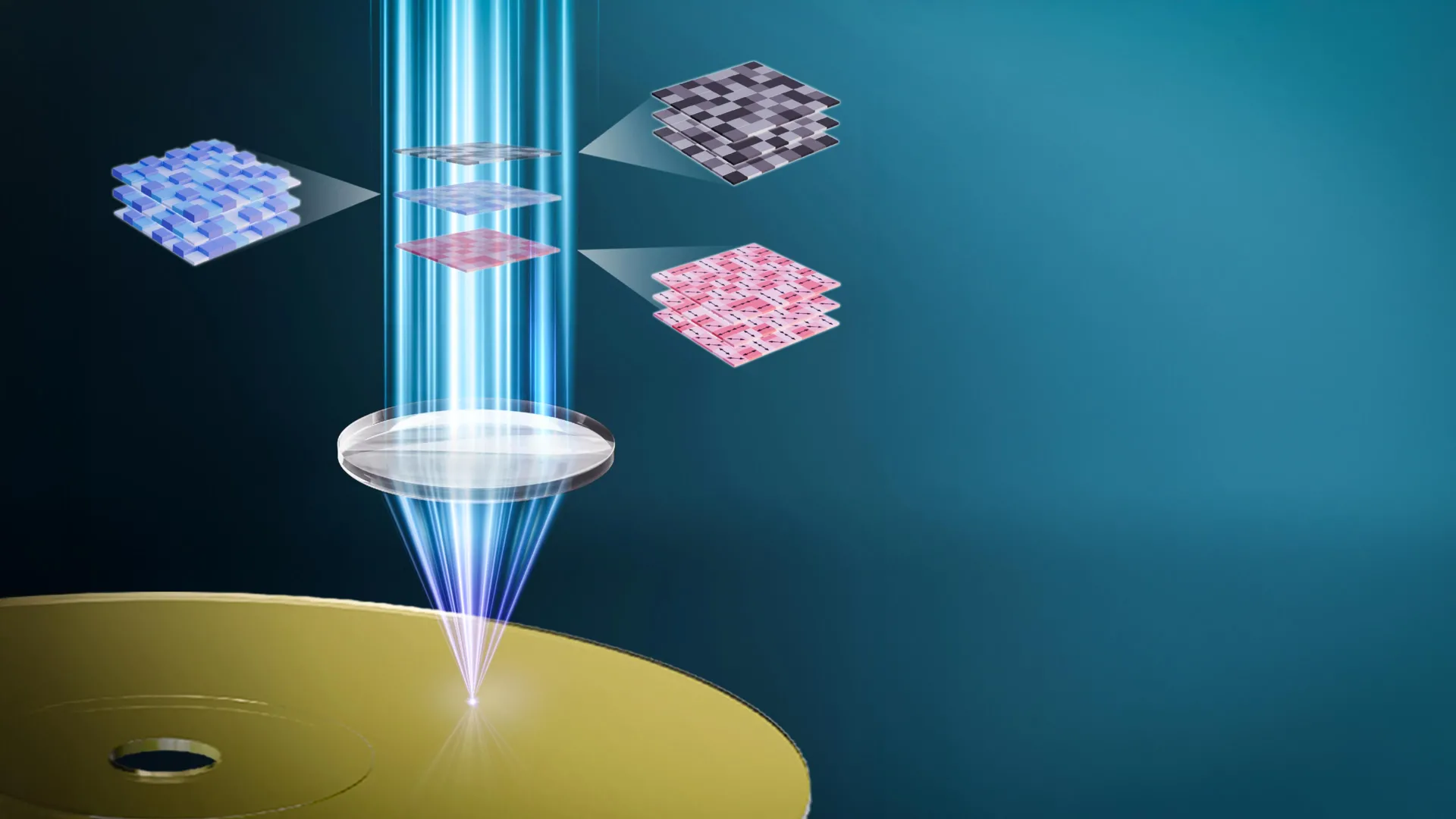
    Researchers have developed a new holographic data storage method that records and retrieves information in three dimensions by combining three important properties of light: amplitude, phase, and polarization. Using all three in combination, this approach allows us to store more data within the same space, providing a potential solution to the growing global demand for data storage.

    Traditional storage systems write data to flat surfaces such as hard drives or optical disks. In contrast, holographic data storage uses laser light to embed information throughout a volume of material. This creates multiple overlapping light patterns within the same space, significantly increasing storage capacity and enabling faster data transfer.

    “In traditional holographic data storage, data encoding typically uses one optical dimension, such as amplitude or phase, alone, or at most two of these dimensions in combination,” said Xiaodi Tang, research team leader at Fujian Normal University in China. “Based on the principles of polarization holography, we used a deep learning architecture known as a convolutional neural network model to enable the use of polarization as an independent information dimension.”

    This study opticala high-impact research journal from Optica Publishing Group, shows that this new technology increases the amount of information stored while making it easier to search.

    “With further development and commercialization, this type of multidimensional holographic data storage has the potential to enable smaller data centers and more efficient large-scale archive storage, while also improving data processing and transmission efficiency,” Tan said. “It also has the potential to contribute to more secure data transmission, optical encryption, and advanced image processing.”

    Extend data encoding using polarization

    In holographic storage, information is stored as image-like pages of data created by patterns of laser light. Encoding transforms digital data into these pages, and decoding transforms them into usable information.

    Light has multiple properties that can be used to carry more data, but combining them effectively has been difficult in practice. To overcome this, the researchers improved a method called tensor-based polarization holography, which preserves the polarization state of light during reconstruction. This makes polarization a reliable channel for storing additional information.

    Based on this research, the team created a 3D modulation encoding strategy. By adjusting the intensity and phase of two orthogonal polarization states and applying a two-phase hologram technique, single-phase-only spatial light modulators are now able to jointly encode amplitude, phase, and polarization in the optical field.

    AI decoding of multidimensional optical data

    This combined information is difficult to decipher because standard sensors only measure the intensity (amplitude) of the light and cannot directly detect the phase or polarization. To address this, the researchers used tensor polarization holography theory and convolutional neural networks to recover all three types of data from the diffraction intensity images.

    The neural network is trained using two complementary diffraction images: one acquired with a vertical polarizer and one without a vertical polarizer. By analyzing these images, the model learns to identify patterns related to amplitude, phase, and polarization. This allows all three to be rebuilt simultaneously, increasing storage density and increasing data transfer speeds.

    Aiming for faster data storage and larger capacity

    After confirming this concept, the researchers built a compact system that can record and reconstruct light fields encoded within polarization-sensitive materials. During testing, intensity images were analyzed to detect signatures related to amplitude, phase, and polarization. These were used as input to a neural network, allowing full 3D reconstruction using only intensity-based measurements.

    “Overall, our results showed that multidimensional joint encoding significantly increases the information carried by a single holographic data page, thereby improving storage capacity,” Tan said. “Furthermore, synchronous decoding of neural networks reduces the need for complex measurements and stepwise reconstruction, supporting more efficient readout and decoding. This could potentially provide a practical route to high-capacity, high-throughput holographic data storage.”

    Next steps for real-world applications

    The researchers stress that the system is still in the research phase and requires further development before it can be used commercially. Future work will focus on increasing the gray levels used for encoding to further expand the capacity, as well as improving the long-term stability, uniformity, and reproducibility of the recording material.

    They also plan to integrate this method with volumetric holographic multiplexing technology, which could potentially store multiple pages and channels of data at once. Increasing the integration of optical hardware and decoding algorithms is essential to achieve faster and more reliable data acquisition under real-world conditions.


    Source link

    Visited 1 times, 1 visit(s) today
    Share. Facebook Twitter Pinterest LinkedIn Telegram Reddit Email
    Previous ArticleWorld’s smallest QR code, smaller than a bacterium, can store data for centuries
    Next Article What teenagers eat may have more of an impact on their mental health than we realize
    healthadmin

    Related Posts

    Scientists say the evidence is clear: e-cigarettes are better than patches and gum at helping smokers quit smoking

    March 29, 2026

    What teenagers eat may have more of an impact on their mental health than we realize

    March 29, 2026

    World’s smallest QR code, smaller than a bacterium, can store data for centuries

    March 29, 2026

    This new treatment reduces pain without opioids or addiction

    March 29, 2026

    This new carbon material could make carbon capture much more affordable

    March 28, 2026

    After 20 years, scientists finally explain club pulsars’ strange ‘zebra stripes’

    March 28, 2026
    Add A Comment
    Leave A Reply Cancel Reply

    Categories

    • Daily Health Tips
    • Discover
    • Environmental Health
    • Exercise & Fitness
    • Featured
    • Featured Videos
    • Financial Health & Stability
    • Fitness
    • Fitness Updates
    • Health
    • Health Technology
    • Healthy Aging
    • Healthy Living
    • Holistic Healing
    • Holistic Health & Wellness
    • Medical Research
    • Medical Research & Insights
    • Mental Health
    • Mental Wellness
    • Natural Remedies
    • New Workouts
    • Nutrition
    • Nutrition & Dietary Trends
    • Nutrition & Superfoods
    • Nutrition Science
    • Pharma
    • Preventive Healthcare
    • Professional & Personal Growth
    • Public Health
    • Public Health & Awareness
    • Selected
    • Sleep & Recovery
    • Top Programs
    • Weight Management
    • Workouts
    Popular Posts
    • the-pros-and-cons-of-paleo-dietsThe Pros and Cons of Paleo Diets: What Science Really Says April 16, 2025
    • Improve Mental Health10 Science-Backed Practices to Improve Mental Health… March 11, 2025
    • How Healthy Living Is Transforming Modern Wellness TrendsHow Healthy Living Is Transforming Modern Wellness… December 3, 2025
    • "The Best Daily Health Apps to Track Your Wellness Goals"The Best Daily Health Apps to Track Your Wellness… August 15, 2025
    • Healthy Living: Expert Tips to Improve Your Health in 2026Healthy Living: Expert Tips to Improve Your Health in 2026 November 16, 2025
    • daily vitamin D needsWhy Sunlight Is Crucial for Your Daily Vitamin D Needs June 12, 2025

    Demo
    Stay In Touch
    • Facebook
    • Twitter
    • Pinterest
    • Instagram
    • YouTube
    • Vimeo
    Don't Miss

    Scientists say the evidence is clear: e-cigarettes are better than patches and gum at helping smokers quit smoking

    By healthadminMarch 29, 2026

    A comprehensive review of global research on smoking cessation suggests that nicotine-containing e-cigarettes may help…

    What teenagers eat may have more of an impact on their mental health than we realize

    March 29, 2026

    Scientists have discovered a way to use light to store large amounts of data in three dimensions.

    March 29, 2026

    World’s smallest QR code, smaller than a bacterium, can store data for centuries

    March 29, 2026

    Subscribe to Updates

    Get the latest creative news from SmartMag about art & design.

    HealthxMagazine
    HealthxMagazine

    At HealthX Magazine, we are dedicated to empowering entrepreneurs, doctors, chiropractors, healthcare professionals, personal trainers, executives, thought leaders, and anyone striving for optimal health.

    Our Picks

    World’s smallest QR code, smaller than a bacterium, can store data for centuries

    March 29, 2026

    This new treatment reduces pain without opioids or addiction

    March 29, 2026

    Research reveals countries with strong beliefs about masculinity tend to be less happy

    March 28, 2026
    New Comments
      Facebook X (Twitter) Instagram Pinterest
      • Home
      • Privacy Policy
      • Our Mission
      © 2026 ThemeSphere. Designed by ThemeSphere.

      Type above and press Enter to search. Press Esc to cancel.