


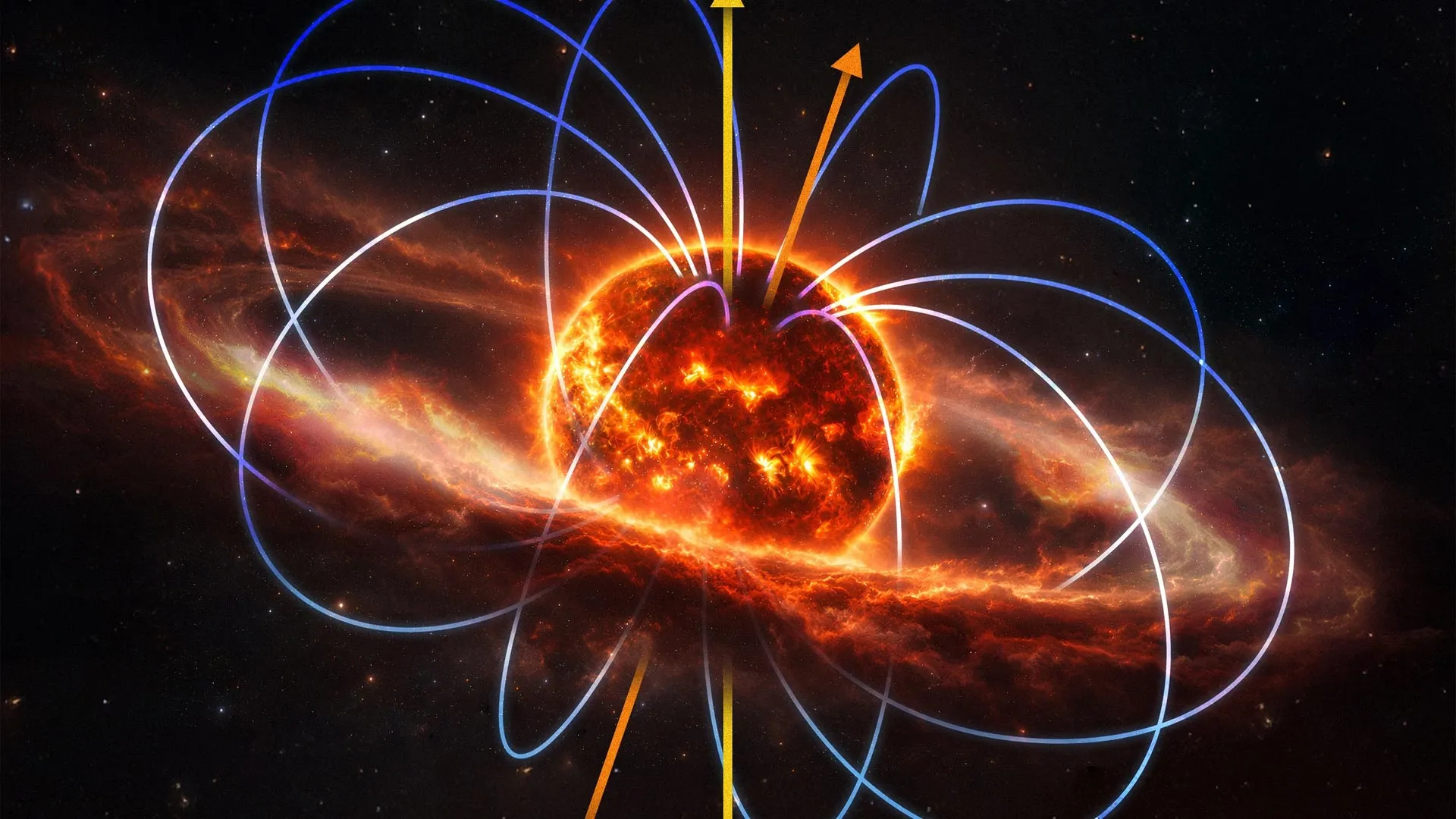
To what extent do stars determine the appearance of their planets, and could that affect whether those worlds can support life? Carnegie University’s Luke Buuma is researching a new way to tackle this question by using naturally occurring “space weather observatories” that appear around some young stars. His findings will be presented this week at a meeting of the American Astronomical Society.
M dwarfs are smaller, cooler, and dimmer than the Sun, but most host at least one rocky planet about the size of Earth. Many of these worlds are not considered friendly to life. It can be too hot, lack a stable atmosphere, and be exposed to frequent flares and strong radiation. Still, it provides a rare opportunity to study how stars affect the environment around planets.
“Stars influence planets, that’s obvious. They influence them through light, which we’re good at observing, and through particles like the solar wind and magnetic storms, or space weather, which are more difficult to study at great distances,” Bouma explained. “And that’s very frustrating, because we know that in our solar system, particles can sometimes be more important to what happens to the planets.”
A new way to study stellar space weather
It is impossible to place instruments directly around distant stars to measure space weather.
Or is it?
Bouma, in collaboration with Moira Jardine of the University of St. Andrews, focused on an unusual class of M dwarfs known as complex periodic variables. These young stars rotate rapidly and undergo repeated declines in brightness. Scientists weren’t sure whether these dips were caused by dark spots on the star or by nearby orbiting matter.
“For a long time, no one knew what to make of this strange little gloom,” Bouma said. “But we were able to demonstrate that they can tell us something about the environment just above the star’s surface.”
Plasma rings act like natural space weather observatories
To investigate further, the research team created a “spectroscopic movie” of one of these stars. Their analysis revealed that this dimming was caused by a large cloud of relatively cool plasma trapped within the star’s magnetosphere. These clumps of plasma are carried by the star’s magnetic field and form a donut-shaped structure called a torus.
“Once you understand this, the darkening blip ceases to be a strange little mystery and becomes a space weather observatory,” Bouma exclaimed. “The plasma torus gives us a way to learn what’s happening to matter near these stars, including where it’s concentrated, how it’s moving, and how strongly it’s influenced by the star’s magnetic field.”
Bouma and Jardine estimate that at least 10 percent of M dwarfs may have these plasma structures early on. That means astronomers could use them to better understand how star particles affect planetary environments.
What this means for the alien world
Buma’s next goal is to determine where the material in the torus came from, whether it came from the star itself or from an external source.
“This is a great example of a serendipitous discovery, something we never expected to find, but one that gives us a new window into understanding the relationships between planets and stars,” Buma concluded. “We don’t yet know whether planets orbiting M dwarfs are suitable for life, but I believe space weather will be an important part of answering that question.”
