


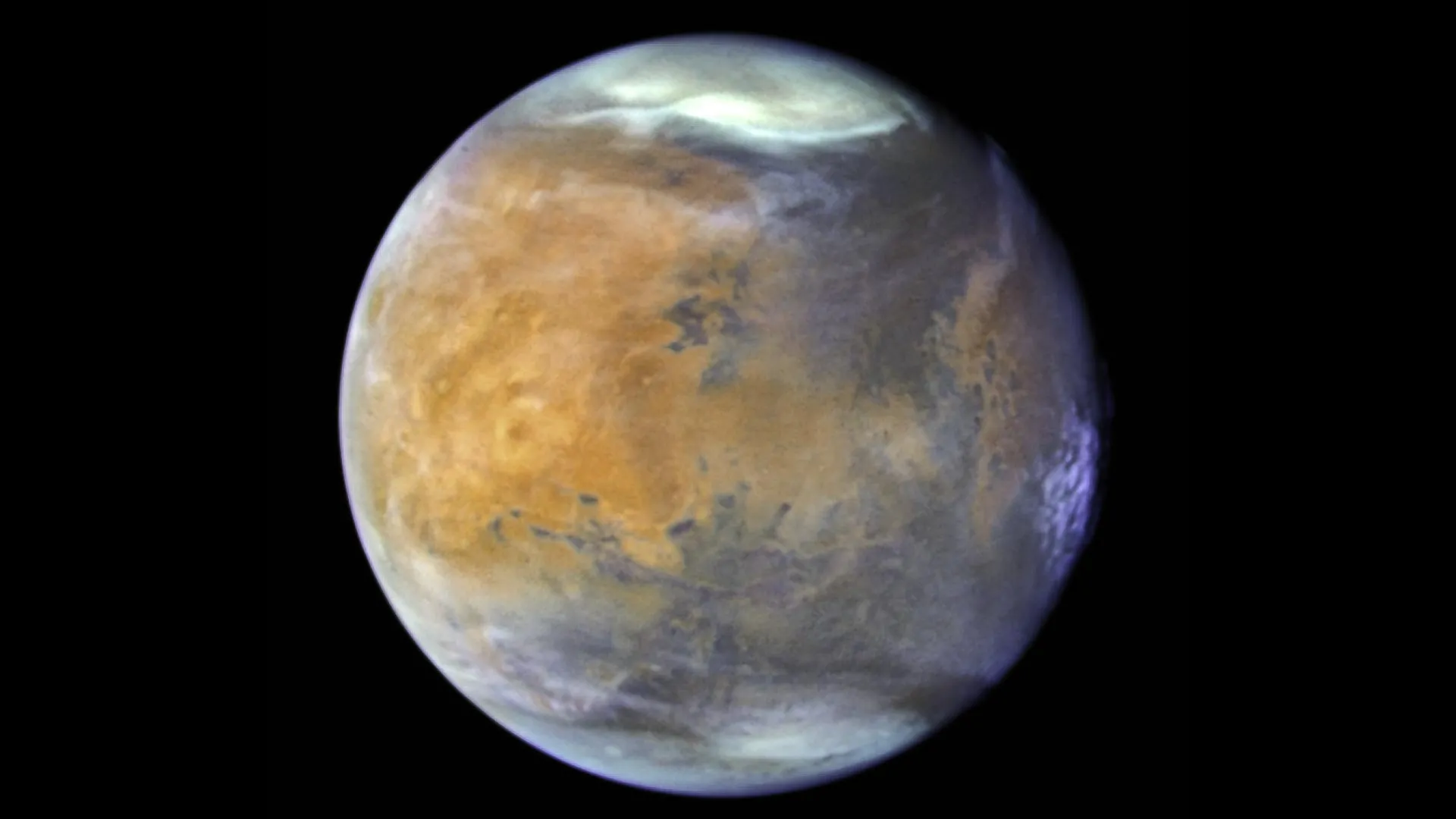
Today, Mars is known as a cold, dry desert, but its surface tells a completely different story. Ancient water channels, water-altered minerals, and other geological features indicate that the planet once had an abundance of water and a much more dynamic environment. Understanding how this wet world transformed into the barren landscape we see today remains a big question in planetary science. Scientists have identified several processes that contribute to water loss, but much of Mars’ lost water remains unknown.
New international research published in Communication: Earth and Environment Scientists are getting closer to solving this mystery. Researchers found that unusually intense but localized dust storms were able to push water vapor into the Martian atmosphere during the Northern Hemisphere summer, when it was previously thought to play little role in this process.
“This discovery sheds light on the impact of this type of storm on the evolution of Earth’s climate and opens new avenues for understanding how Mars lost so much water over time,” said Adrian Brines, a researcher at the Andalusian Institute for Astronomy (IAA-CSIC) and co-first author of the study, along with researcher Shohei Aoki from the University of Tokyo Graduate School of Frontier Sciences and Tohoku University Graduate School of Science.
small storms have big impacts
Although dust storms have long been associated with water loss from Mars, most research has focused on large-scale global phenomena. This new study shows that smaller, localized storms can also play a powerful role in lifting water to higher altitudes, where it can more easily escape into space. Previous research has also highlighted that summer is the main period of water loss in the Southern Hemisphere, making this Northern Hemisphere finding particularly surprising.
During Martian Year 37 (2022-2023 on Earth), scientists observed a sudden increase in water vapor in the middle atmosphere associated with this unusual storm. At that height, the water level reached up to 10 times its normal level. This dramatic increase has not been seen in previous years and was not predicted by existing climate models.
Hydrogen leakage reveals water loss
Shortly after, researchers detected a significant increase in hydrogen in the outer base, the boundary where Mars’ atmosphere transitions into space. Hydrogen levels rose 2.5 times what was recorded in previous years during the same season. Tracking escaping hydrogen is very important. That’s because hydrogen is formed when water molecules break down, and provides a direct clue to how much water Mars is losing.
“These results add an important new piece to the incomplete puzzle of how Mars has been losing water over billions of years, and show that short but intense episodes can play a relevant role in Mars’ climate evolution,” concluded Aoki (University of Tokyo and Tohoku University).
Data from multiple Mars missions
The study is based on data collected through an international collaboration involving several Mars missions. These include observations from ESA’s ExoMars mission (2016)’s Trace Gas Orbiter (TGO) and its NOMAD instrument, as well as NASA’s Mars Reconnaissance Orbiter (MRO) and Emirates Mars Mission (EMM), all currently operating in orbit around Mars.
