


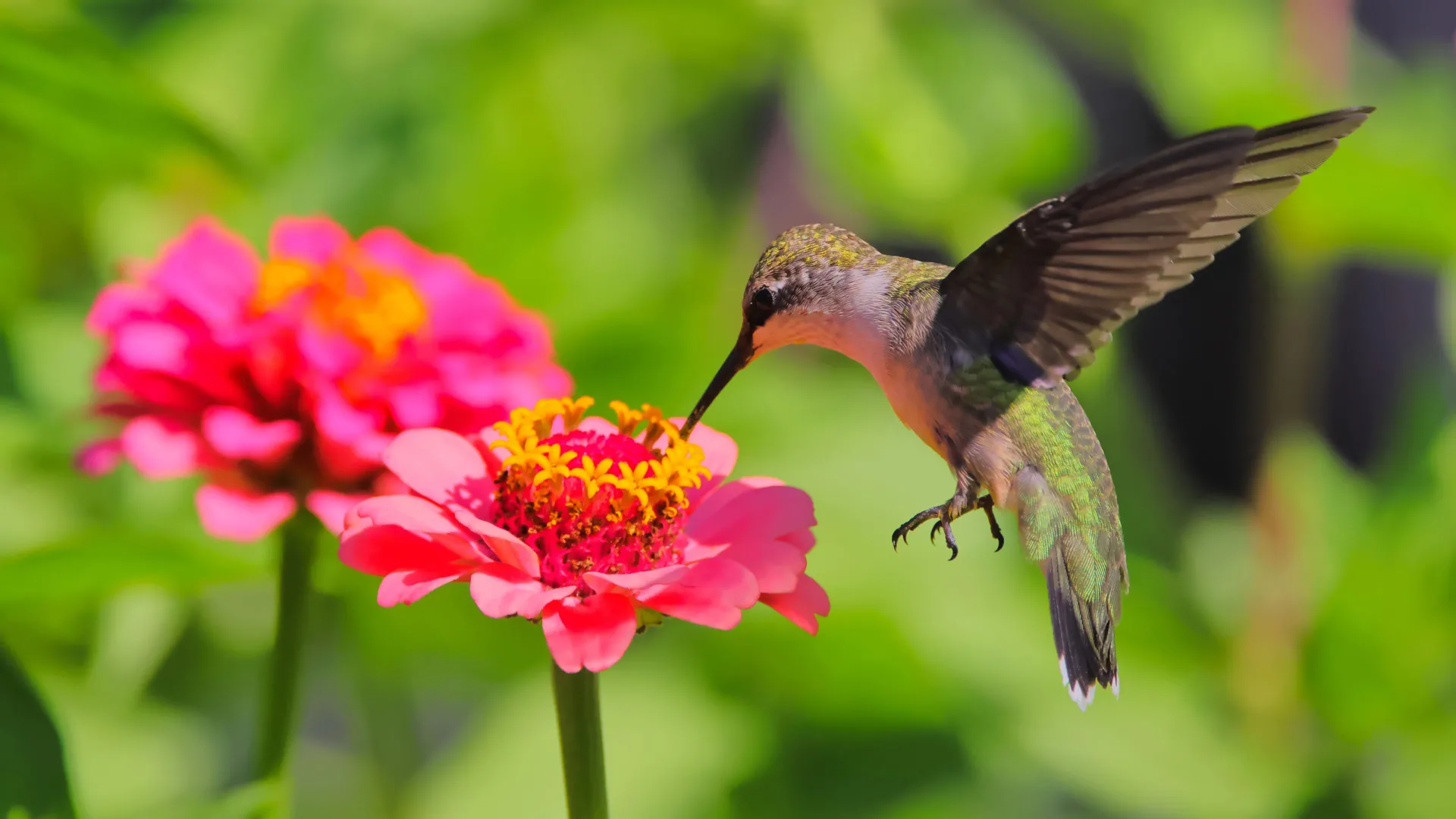
Bees and hummingbirds move from flower to flower, helping plants reproduce and sucking nectar, while also consuming something unexpected: small amounts of alcohol.
In the first large-scale study of alcohol in flower nectar, biologists at the University of California, Berkeley detected ethanol in at least one sample of 26 of the 29 plant species they studied. Most nectar samples contain only trace amounts, probably produced by fermentation of sugars by yeast. However, one sample reached an ethanol weight ratio of 0.056%. This is about 1/10 proof.
How much alcohol do pollinators consume?
Although these levels may seem small, nectar is a major energy source for many species. Hummingbirds, for example, drink 50% to 150% of their body weight in nectar each day. Based on these dietary habits, researchers estimate that the Anna hummingbird (Calypte anna), commonly found along the Pacific coast, consumes approximately 0.2 grams of ethanol per kilogram of body weight each day. This is equivalent to drinking about one alcoholic beverage for a human.
Despite this regular consumption, bees and birds consume alcohol gradually throughout the day and show no obvious signs of intoxication. A previous study by the same research team found that hummingbirds drink sugar water containing up to 1% alcohol, but that they begin to avoid sugar water when the concentration exceeds that level.
Possible effects other than drunkenness
Still, nectar contains other compounds known to affect animal behavior, such as nicotine and caffeine. Ethanol may have similar subtle effects.
“Hummingbirds are like little furnaces. They burn everything up so quickly that you can’t expect anything to accumulate in their bloodstream,” said Alexi Malo, a doctoral student who worked on the nectar analysis with postdoctoral fellow Ammon Cole. “But we don’t know what signaling or appetitive properties alcohol has. As with humans, there are other things ethanol can do besides generate buzz.”
Robert Dudley, a professor of integrative biology at the University of California, Berkeley, added, “Other types of effects specific to the foraging biology of the species in question may be beneficial.” “They’re burning so quickly that I think they’re probably not affected by intoxication. But it could also be that there’s another influence on their behavior.”
Maro, Cole and Dudley reported their findings on March 25th. Royal Society Open ScienceBerkeley colleagues Lauri Bowie and Jimmy McGuire are professors of integrative biology and curators of the campus’ Museum of Vertebrate Zoology.
Experiment reveals alcohol tolerance
Previous experiments conducted at a feeder outside Dudley’s office showed that Anna’s hummingbirds were largely indifferent to low alcohol concentrations (less than 1% by volume) in sugar water. However, when the concentration reaches 2%, the frequency of visits to feeders is approximately halved.
“Somehow they’re measuring intake, so the concentrations they’re likely to find in the wild may be higher than that,” he says.
Another study led by former graduate student Cynthia Wang Claypool found that feathers, including those of the Anna’s hummingbird, contain ethyl glucuronide, a byproduct of ethanol metabolism. This shows that these birds not only consume alcohol, but also process it in a similar way to mammals. Taken together, these findings suggest that other animals, including birds and human ancestors, may have evolved a tolerance to, and in some cases a preference for, alcohol.
“Laboratory experiments have shown that they do mix ethanol with nectar and drink it, but they develop an aversion to it when the concentration of ethanol gets too high,” Coll said. “Feathers say they do metabolize it, and this study shows that ethanol is actually quite widespread in the nectar they consume.”
Comparison of alcohol intake between species
After measuring ethanol levels using an enzymatic assay, the researchers estimated daily alcohol intake based on the caloric needs of several nectar-sucking species. Detailed feeding data are limited, so the researchers focused on two species of hummingbirds, including the Anna’s hummingbird, and three species of sunbirds that feed on plants, including honey bees (Melianthus major) in South Africa. Sunbirds play a similar ecological role in Africa as hummingbirds in the Americas.
The researchers also compared these values to other animals such as European honey bees, pen-tailed shrews, fruit-eating chimpanzees, and humans who consume one standard drink per day (0.14 grams/kg/day). Shrews had the highest intake at 1.4 g/kg/day, and honeybees had the lowest intake at 0.05 g/kg/day. Nectar-feeding birds are in a similar range, consuming about 0.19-0.27 g/kg/day when eating native flowers.
Interestingly, feeder experiments suggest that Anna’s hummingbirds may ingest even more alcohol from the fermented sugar water in the feeder than from natural nectar (0.30 g/kg/day).
Evolutionary adaptation to food alcohol
The study is part of a broader five-year National Science Foundation project to collect genetic data from hummingbirds and sunbirds to understand how they adapt to different environments and food sources, including high altitudes, sugar-rich diets, and frequently fermented nectar.
“These studies suggest that there may be widespread physiological adaptations across the animal kingdom to the ubiquity of dietary ethanol, and that the responses seen in humans may not be representative of all primates or all animals in general,” Dudley said. “Maybe there are other physiological detoxification pathways or other types of nutritional effects of ethanol in animals that consume ethanol every day of their lives. That’s what’s interesting. Although this is chronic throughout the day, this is a lifelong exposure after weaning. This means the comparative biology of ethanol intake deserves further study.”
