


As quantum computers become more powerful, many of our current encryption methods may eventually become vulnerable. One promising solution is quantum cryptography. It relies on the laws of physics rather than mathematical complexity to keep your data safe. But for quantum communications to become a reality, we need small, reliable devices that can accurately read the delicate quantum signals carried by light.
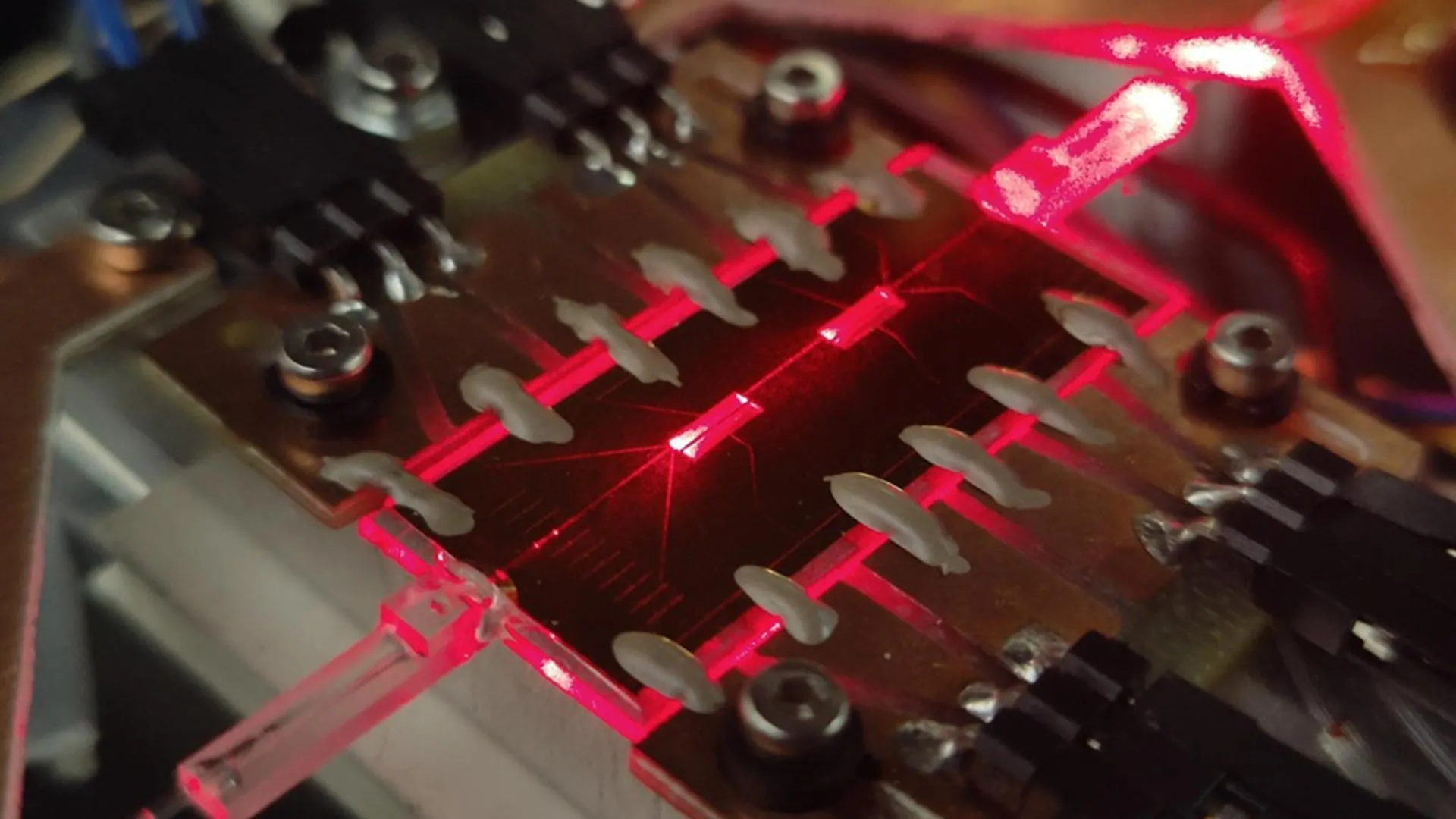
Researchers from the University of Padua, Politecnico di Milano, and CNR Institute of Photonics and Nanotechnology have demonstrated a new approach using an unexpected material: borosilicate glass. reported in advanced photonicstheir work describes a high-performance quantum coherent receiver built directly inside glass using femtosecond laser writing. This method provides low optical loss, stable performance, and compatibility with existing fiber optic systems. All of this is important for pushing quantum technology beyond laboratory experiments.
Why glass is better than silicon in quantum devices
Continuous variable (CV) quantum information processing, used in quantum key distribution (QKD) and quantum random number generation (QRNG), relies on measurements of the amplitude and phase of light waves. To do this, a coherent receiver combines a weak quantum signal with a stronger reference beam and analyzes how they interfere.
Most of today’s integrated receivers are made of silicon. Although silicon is widely used and supports high integration, it is sensitive to polarization and tends to have high optical losses, which can limit the performance and reliability of quantum systems.
Glass has several advantages. It is inherently polarization-insensitive, highly stable, and allows waveguides to be written in three dimensions with minimal signal loss. Using femtosecond laser micromachining, researchers can create light-guiding paths directly inside a material and form compact photonic circuits without the complexities of semiconductor manufacturing.
Inside a laser-written quantum receiver
The research team created a fully tunable heterodyne receiver, a key component of CV-QKD and CV-QRNG, by writing optical circuits directly inside borosilicate glass. Chips include:
- Fixed and adjustable beam splitters
- Thermo-optic phase shifter for precise electrical control
- 3D waveguide crossing
- Directional coupler independent of polarization
These features allow the quantum signal and the reference beam to interact in a controlled manner, allowing simultaneous measurements of two conjugate quadratures. The device also displays:
- Extremely low insertion loss (approximately 1 dB)
- Polarization independent operation
- Common mode rejection ratio greater than 73 dB indicates strong suppression of classical noise
- Stable S/N performance for at least 8 hours
Overall, these results match or exceed the performance of many silicon-based photonic receivers.
One chip, two quantum technologies
The device combines low loss, tunability, and stability, allowing it to handle multiple quantum communication tasks without the need for separate hardware. When used as a heterodyne detector, it enables a QRNG system that is independent of the source device, meaning it remains secure even when the input optical signal is unreliable. The chip achieved a secure random bit generation rate of 42.7 Gbit/s, setting a record for this type of system.
The same chip was also used for the QPSK-based CV-QKD protocol, where information is encoded in a four-point constellation of quantum states. On a simulated 9.3 km fiber link, the system reached a secret key rate of 3.2 Mbit/s. These results demonstrate that glass-based photonic front ends can support advanced CV-QKD without the drawbacks found in silicon platforms.
Glass photonics moves toward real-world use
In addition to their strong performance, this study highlights several practical advantages of using glasses in integrated quantum photonics.
- Environmental stability: Glass is inert and resistant to temperature and mechanical changes.
- Low-loss fiber coupling: The waveguide closely matches the size of standard communications fibers.
- 3D design flexibility: Circuits can include crossovers and complex layouts without adding signal loss.
- Scalability and cost-effectiveness: Femtosecond laser writing enables rapid prototyping without the need for expensive semiconductor manufacturing.
These qualities support long-term reliability and durability. This is important for real-world deployment and even potential use in space-based quantum communication systems. Researchers say glass-based photonics could help bridge the gap between experimental devices and practical quantum networks.
Towards scalable quantum communication networks
By leveraging these advantages, the team demonstrated two major applications on a single chip. One is a source device independent QRNG with the highest secure generation rate on record at 42.7 Gbit/s, and the other is a QPSK-based CV-QKD system that achieves a secure key rate of 3.2 Mbit/s over a simulated 9.3 kilometer fiber link.
Beyond these results, this study shows that glass-based integrated photonics is a durable and versatile platform for future quantum technologies. Glass is stable, cost-effective, and resistant to harsh environments, making it suitable for scalable deployments. This approach will help move quantum communications from controlled laboratory environments to real-world infrastructure and could be an important step toward building global quantum networks.
